

A Senior Economist resignation letter is a formal document. It is written to inform the employer of a decision. The letter signifies a Senior Economist’s intent to leave their job. It’s the official goodbye note.
This article is your guide to crafting the perfect letter. We know leaving a job can be tricky. That’s why we’ve prepared some helpful resources. We’ll share various templates and samples.
These examples will make it easy for you. You can adapt them to your specific situation. Consider it your creative launchpad. Writing a resignation letter just became simpler.
Senior Economist Resignation Letter
Below is a sample of a Senior Economist Resignation Letter:
[Your Name]
[Your Address]
[Your Phone Number]
[Your Email Address]
[Date]
[Recipient Name]
[Recipient Title]
[Company Name]
[Company Address]
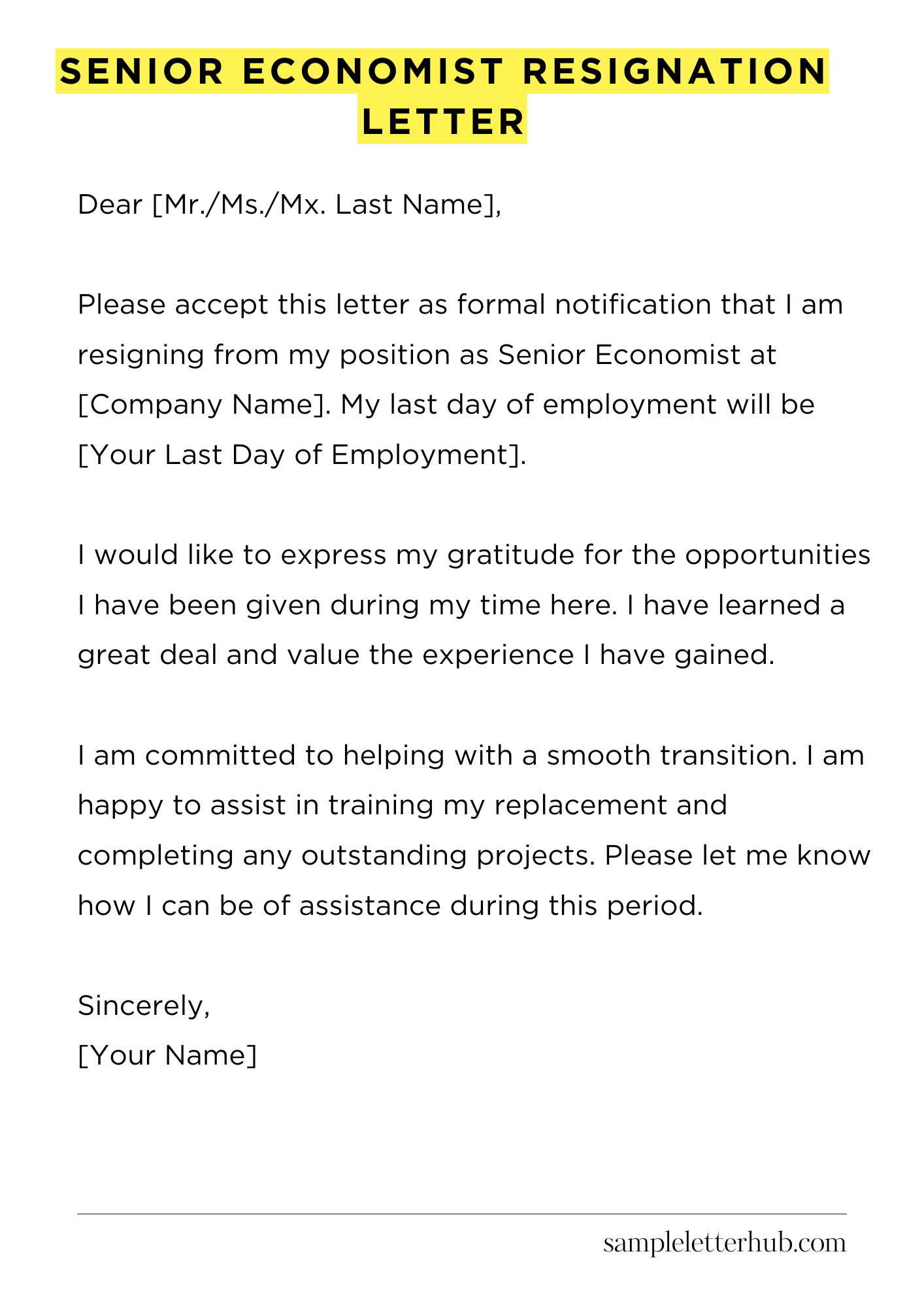
Dear [Mr./Ms./Mx. Last Name],
Please accept this letter as formal notification that I am resigning from my position as Senior Economist at [Company Name]. My last day of employment will be [Your Last Day of Employment].
I would like to express my gratitude for the opportunities I have been given during my time here. I have learned a great deal and value the experience I have gained.
I am committed to helping with a smooth transition. I am happy to assist in training my replacement and completing any outstanding projects. Please let me know how I can be of assistance during this period.
I wish [Company Name] continued success in the future.
Sincerely,
[Your Name]
How to Write a Senior Economist Resignation Letter
So, you’re a Senior Economist, and you’ve made the big decision: it’s time to move on. That’s great! Maybe a new opportunity has come your way. Perhaps you’re pursuing a different career path. Whatever the reason, you’re going to need to write a resignation letter.
This isn’t just a formality; it’s your final professional communication with your current employer and it sets the tone for future interactions. Let’s make sure it’s a good one.
1. Keep it Concise and Clear
First and foremost, your resignation letter should be brief and to the point. Nobody wants to read a novel! Start by clearly stating your intention to resign. This should be in the very first sentence. State your official last day of employment. This is critical. Don’t leave any room for misinterpretation.
Avoid vague language or any unnecessary rambling. Remember to keep it professional. Avoid emotional language, even if you’re not entirely happy. You’re aiming for a clean break.
Here’s a basic example: “Please accept this letter as formal notification that I am resigning from my position as Senior Economist at [Company Name], effective [Date].” Simple, direct, and gets the message across effectively. You can easily adjust the wording to fit your specific needs, but the core message must be crystal clear.
2. Express Gratitude and Positive Reinforcement
Even if your time at the company wasn’t always perfect, it’s essential to express gratitude for the opportunities you’ve been given. Acknowledge the experience you’ve gained and the positive aspects of your employment. This demonstrates professionalism and leaves a good impression.
Mentioning specific colleagues you enjoyed working with or specific projects you found rewarding is a nice touch. For example, “I am grateful for the opportunities I have received during my time at [Company Name], and I particularly valued my work on the [Project Name] project.”
Positive reinforcement is key. Remember you may need a reference in the future.
3. Provide Assistance with Transition
Offer your assistance with the transition process. This shows consideration for your employer and your colleagues. You can offer to help train your replacement, complete any outstanding tasks, or provide documentation of your work. Consider it a sign of professionalism. Be specific in your offer.
For example: “I am happy to assist in the transition process and can be available to train my replacement or answer any questions.” This is a thoughtful step.
Consider the company’s requirements and any ongoing projects.
4. Maintain a Professional Tone
Your tone throughout the letter should be professional and respectful. Avoid any negative comments about your current employer, colleagues, or your reasons for leaving (unless absolutely necessary and even then, tread carefully and diplomatically). Keep the focus on your career aspirations or the new opportunity that awaits you.
Don’t burn bridges. Your departure should be positive and professional. Proofread your letter carefully for any spelling or grammatical errors before you send it.
Remember that this is part of your professional record.
5. Finalize and Follow Up
Before submitting, review your letter carefully. Does it meet all the key requirements? Is it concise, clear, and professional? Is your contact information correct? Once you’re satisfied, submit the letter to your supervisor or HR department, as per company policy. Consider handing it to them in person if possible.
After submitting the letter, be prepared to answer any questions your employer may have and begin the handover process. Follow all company protocols for exiting the organization. After all, you have to work during the notice period.
A well-written resignation letter is a crucial step in maintaining a positive professional reputation. By following these guidelines, you can ensure that your departure is smooth, respectful, and leaves a lasting positive impression.
FAQs about Senior Economist resignation letter
How do I start a Senior Economist resignation letter?
The standard practice is to begin your resignation letter with a formal salutation, such as “Dear [Manager’s Name]”. Immediately follow this with a clear and concise statement of your intention to resign from your position as Senior Economist. State your last day of employment as well. Be direct and avoid unnecessary preamble.
What key information should be included in a Senior Economist resignation letter?
Your letter should clearly state your resignation and the effective date. Briefly mention your role (Senior Economist) and to whom you are reporting. Express gratitude for the opportunities you’ve been given during your time with the company. You may also briefly mention any assistance you can provide during the transition, such as training a replacement or completing ongoing projects.
Is it necessary to provide a reason for resigning in a Senior Economist resignation letter?
While not mandatory, it’s often wise to offer a brief, professional reason for your departure. This can be as simple as “pursuing other opportunities” or “seeking a new challenge.” Avoid negative comments about your current employer or colleagues. If you have a specific reason like accepting a better offer, it’s acceptable to mention this briefly.
What is the appropriate tone for a Senior Economist resignation letter?
Maintain a professional and respectful tone throughout the letter. Express gratitude for the experience and opportunities provided. Be positive and avoid expressing any negativity or complaints. Maintain a tone that leaves a positive lasting impression of your professionalism. Keep it brief and to the point.
Should I offer to help with the transition in my Senior Economist resignation letter?
Offering to assist with the transition is generally recommended. This demonstrates professionalism and a commitment to ensuring a smooth handover. You can offer to help train your replacement, complete ongoing projects, or provide any necessary documentation. Specify any timeframe you can provide the assistance.
Related:
Resignation letter due to rude boss
Resignation letter moving to another state
Resignation letter due to illness of family member
Resignation letter due to study