

You’re ready to move on. A Regulatory Affairs Specialist resignation letter is your formal way of saying goodbye. It officially informs your employer of your departure. This letter follows a specific format. It ensures a smooth transition.
This article can help you. We have prepared several templates. These are tailored for Regulatory Affairs Specialists. They cover various scenarios. Use these samples as your starting point.
Writing a resignation letter is now easy. Browse our examples. Customize them to fit your situation. Craft your perfect farewell with confidence.
Regulatory Affairs Specialist Resignation Letter
Below is a sample of a Regulatory Affairs Specialist Resignation Letter:
[Your Name]
[Your Address]
[Your Phone Number]
[Your Email Address]
[Date]
[Hiring Manager Name] (If known, otherwise use title)
[Hiring Manager Title]
[Company Name]
[Company Address]
Dear [Mr./Ms./Mx. Last Name],
Please accept this letter as formal notification that I am resigning from my position as Regulatory Affairs Specialist at [Company Name], effective [Your Last Day of Employment].
I would like to thank you and the company for the opportunity to work here. I have learned a great deal during my time at [Company Name], and I appreciate the experience I have gained. I have enjoyed my role in [briefly mention key responsibilities or projects].
I am committed to ensuring a smooth transition during my departure. I am happy to assist in training my replacement and completing any outstanding tasks to the best of my ability before my last day. Please let me know how I can be of assistance.
I wish you and [Company Name] all the best in the future.
Sincerely,
[Your Signature]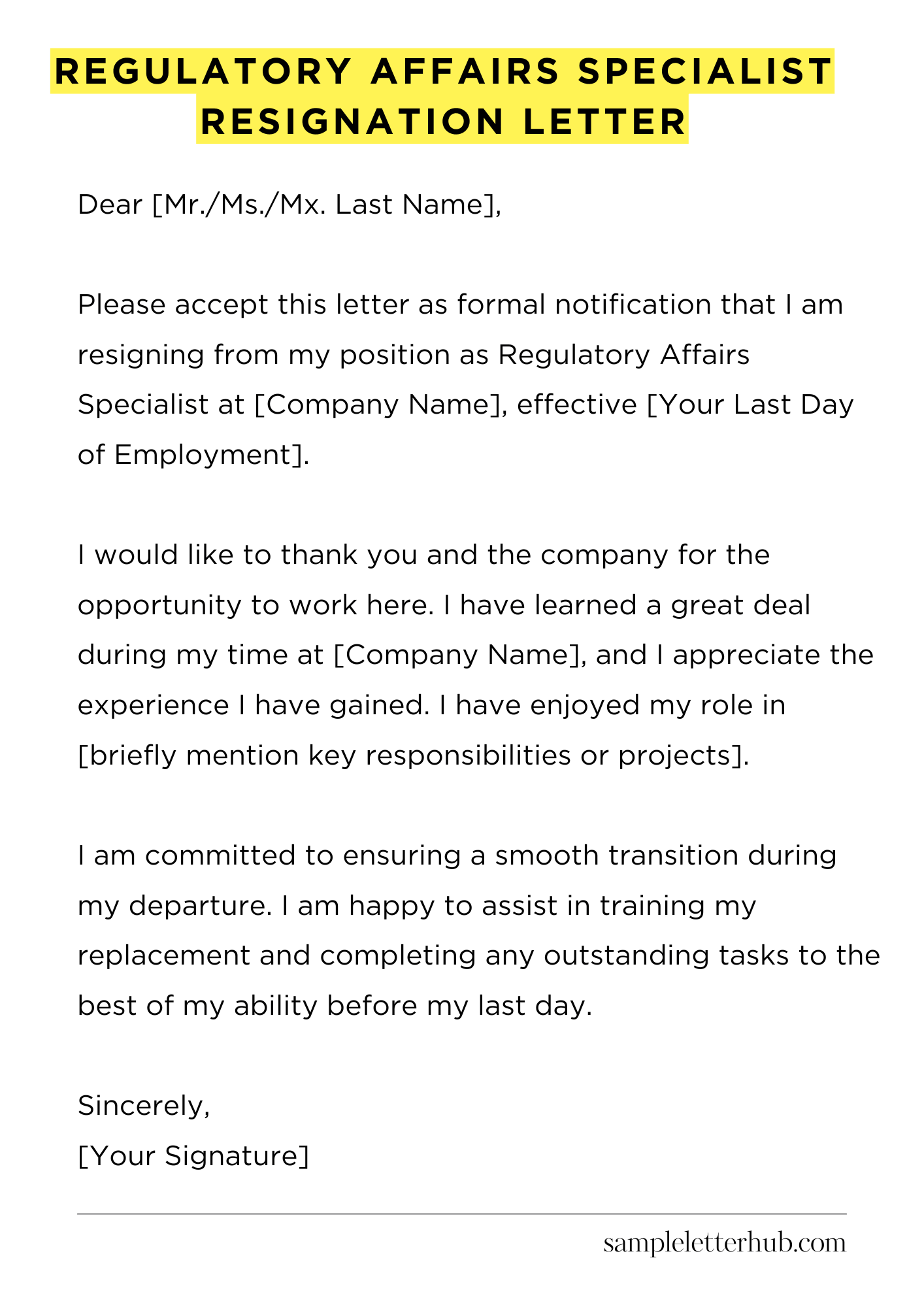
How to Write a Regulatory Affairs Specialist Resignation Letter
So, you’re ready to move on. Maybe a new opportunity has landed in your lap, or perhaps it’s simply time for a change. Whatever the reason, crafting a well-written resignation letter is a crucial step in ensuring a smooth transition and maintaining a positive professional relationship. It’s important to do this right.
1. Keep it Concise and Professional
First and foremost, keep your letter brief. This isn’t the time for a novel. Get straight to the point. State your intention clearly and directly: “Please accept this letter as formal notification that I am resigning from my position as Regulatory Affairs Specialist at [Company Name], effective [Your Last Day of Employment].”
This is the bedrock of your letter, it’s the core. Always use a professional tone; avoid overly emotional language or personal grievances. You want to leave a good impression, even if you’re unhappy with your current role. Remember this is a document that will be on file; keep it simple and straightforward.
2. Express Gratitude (Always)
Even if the job wasn’t a perfect fit, showing gratitude is vital. A simple sentence acknowledging your time with the company can go a long way. Consider something like: “I am grateful for the opportunities I have been given during my time here.” Or maybe: “Thank you for the experience and the support I’ve received while working here.”
This displays maturity and professionalism and helps preserve a positive relationship with your former employer. It’s also good for networking in the future.
3. Provide Details (When Necessary)
While brevity is key, you might need to include a few key details. If you’re willing to assist with the transition, offer your support. For example: “I am happy to assist in the transition of my responsibilities during my remaining two weeks.”
Also, check your employment contract! It outlines any specific requirements, such as the required notice period. Adhering to these terms is vital to prevent any complications.
4. Structure and Formatting Matters
Your resignation letter should follow a standard business letter format. Use a clear, easy-to-read font (like Times New Roman or Arial). Keep it single-spaced, with a space between each paragraph. Include the date, your name and address, the recipient’s name and title, and the company address.
Remember to proofread meticulously! Typos and grammatical errors are unprofessional and can undermine the impact of your letter. It shows you care about the details.
5. Review and Revise (Before Sending)
Before you hit the “send” button or hand in a physical copy, read your letter aloud. Does it sound clear, concise, and professional? Ask a friend or colleague to proofread it for you; a fresh pair of eyes can often catch mistakes you missed. Ensure all contact information is correct.
Make sure you have your final day of work down. Double-check everything. This final step helps prevent any avoidable issues.
FAQs about Regulatory Affairs Specialist resignation letter
How should I structure my Regulatory Affairs Specialist resignation letter?
Your resignation letter should be clear, concise, and professional. Begin with a formal salutation (e.g., “Dear [Manager’s Name]”), followed by a straightforward statement of your resignation and your last day of employment.
Briefly express gratitude for the opportunity. Keep the tone positive, avoid negative comments, and include your contact information for any necessary follow-up. Proofread carefully before sending.
What specific information must be included in the resignation letter?
The most critical elements are the explicit statement of your resignation (e.g., “I am writing to formally resign from my position as Regulatory Affairs Specialist”), your last day of employment, and your signature. It is also beneficial to state your role or title, the department you are leaving and the date.
You may also want to express your gratitude for the opportunity to work there and offer assistance with the transition, if appropriate.
Should I provide a reason for leaving in my resignation letter?
You are not typically required to provide a detailed reason for your departure. A simple statement such as “I am pursuing other opportunities” or “I have accepted a position elsewhere” is usually sufficient. However, if you are comfortable, you can briefly mention a general reason, but avoid any negative comments.
How much notice should I give when resigning as a Regulatory Affairs Specialist?
The standard notice period is typically two weeks. However, review your employment contract or company policies, as a longer notice period may be required. Providing adequate notice is a sign of professionalism and helps ensure a smooth transition for your employer.
Is it necessary to include any references to ongoing projects in my resignation letter?
It is beneficial to briefly mention any ongoing projects you are involved in. Offer assistance in the handover of your responsibilities to ensure a smooth transition. Providing a list of active projects can be helpful.
This demonstrates your commitment to a professional departure and can ease the transition process. However, the level of detail depends on the complexity of the projects and your relationship with the management.
Related:
Resignation letter due to rude boss
Resignation letter moving to another state
Resignation letter due to illness of family member
Resignation letter due to study