


A “Docente resignation letter” is a formal document. It is written by a teacher or educator. The purpose is to officially inform a school or institution of their intention to leave their position. It’s a crucial step in the process of ending employment.
Looking for help to craft your own resignation letter? You’re in the right place. We’ll share several templates and examples. These are designed to guide you. Use them as inspiration or a starting point.
No more staring blankly at a page. We provide samples to make things easy. Adapt them to your specific situation. This article equips you to write a professional and clear resignation letter.
Docente Resignation Letter
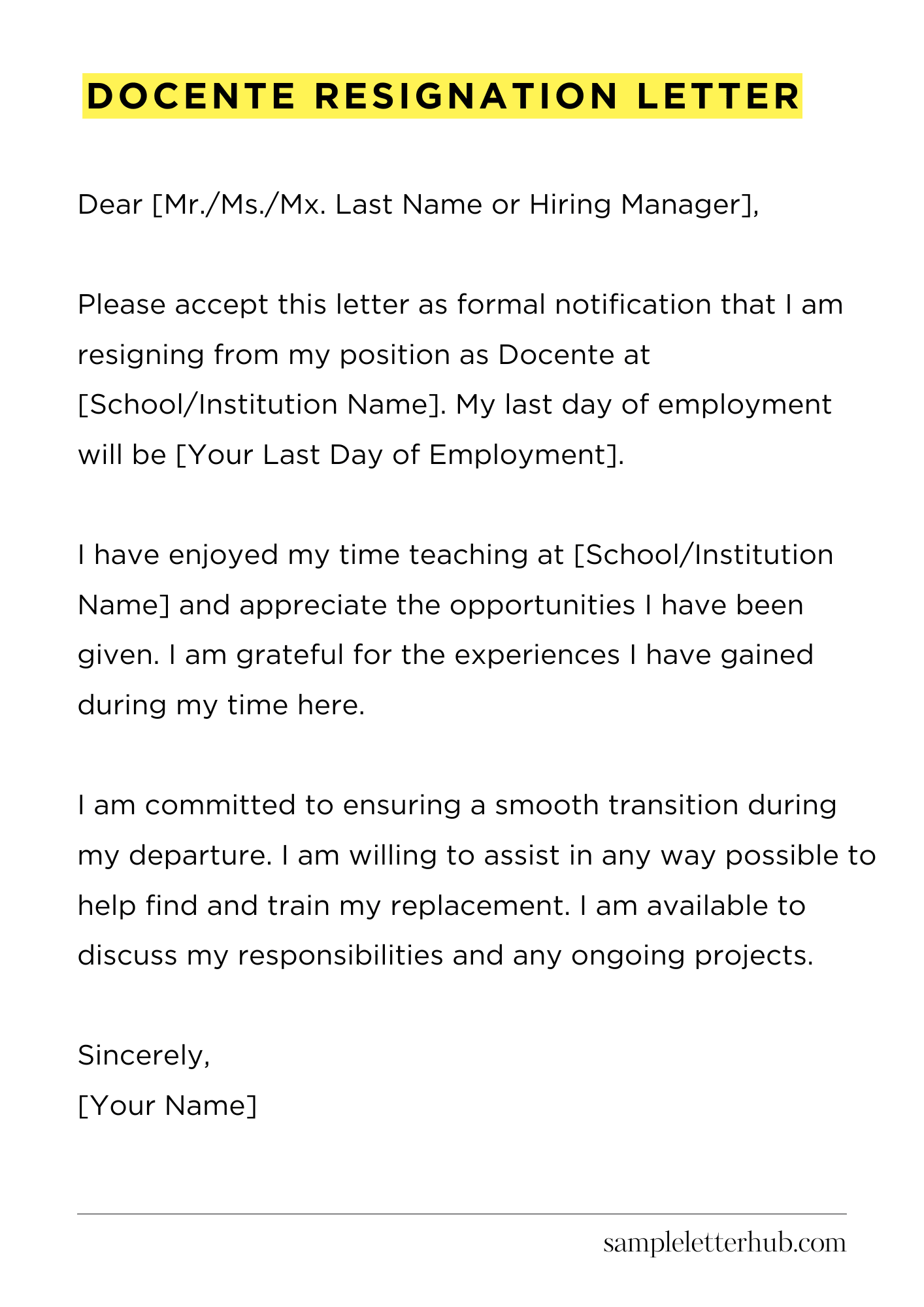
Below is a sample of a Docente Resignation Letter:
[Your Name]
[Your Address]
[Your Phone Number]
[Your Email Address]
[Date]
[Hiring Manager Name] (If known, otherwise use title)
[Hiring Manager Title]
[School/Institution Name]
[School/Institution Address]
Dear [Mr./Ms./Mx. Last Name or Hiring Manager],
Please accept this letter as formal notification that I am resigning from my position as Docente at [School/Institution Name]. My last day of employment will be [Your Last Day of Employment].
I have enjoyed my time teaching at [School/Institution Name] and appreciate the opportunities I have been given. I am grateful for the experiences I have gained during my time here.
I am committed to ensuring a smooth transition during my departure. I am willing to assist in any way possible to help find and train my replacement. I am available to discuss my responsibilities and any ongoing projects.
I wish [School/Institution Name] continued success in the future.
Sincerely,
[Your Name]
How to Write a Docent Resignation Letter
Resigning from a docent position? It’s a common part of career transitions. This letter serves as a formal declaration, making your departure official. It is a necessary step, providing important information to your employer. Think of it as a bridge, ensuring a smooth transition. Writing a good resignation letter can set a positive tone for your future.
1. Keep It Concise and Clear
Avoid unnecessary fluff! Get straight to the point. Start by clearly stating your intention to resign. Specify your role as a docent, and mention the date your resignation takes effect. A simple sentence often does the trick. You don’t need a novel. Remember, brevity is your friend here. Focus on the essential details; the rest can come later.
For example: “Please accept this letter as formal notification that I am resigning from my position as Docent, effective [Date].”
2. Express Gratitude (A Touch of Class!)
Even if you’re leaving, taking a moment to acknowledge your experience is important. Thank your supervisor or the institution for the opportunity. Mention any specific experiences you appreciated, like interesting projects or supportive colleagues.
A few kind words can leave a lasting, positive impression. It demonstrates professionalism and respect. This gesture also leaves the door open for future opportunities.
For example: “I am grateful for the opportunity to have served as a docent at [Institution Name] for the past [Number] years. I especially enjoyed [Specific Example].”
3. Provide a Reason (If You Choose To)
While not mandatory, you may choose to briefly explain your reason for leaving. This is often done to help maintain a positive relationship. Be brief and keep it neutral. Avoid negativity or overly detailed explanations.
You can simply state that you are pursuing another opportunity. Or, you can mention your need to relocate. Keep it brief. There is no need for a lengthy justification.
Examples: “I am pursuing another opportunity that aligns with my career goals.” or “I am relocating and will no longer be able to fulfill my duties.”
4. Offer Assistance with Transition
This shows your commitment to a smooth handover. Offer to assist with the transition process. This might involve training your replacement, completing outstanding tasks, or providing documentation.
Offering help is a great way to maintain a positive relationship and leave a good impression. Consider it a courteous gesture. This is a crucial element, showing respect and responsibility.
For example: “I am happy to assist in training my replacement and completing any pending projects before my departure.”
5. Finalize with a Professional Closing and Contact Information
End the letter with a polite closing, such as “Sincerely” or “Best regards.” Include your full name, your title, and your contact information.
This makes it easy for your supervisor to reach you if needed. Double-check everything for accuracy, including the spelling of names and dates. Make sure it’s perfect before sending. It is important to maintain professionalism. Proofread and then proofread again.
Example:
Sincerely,
[Your Full Name]
[Your Title]
[Your Phone Number]
[Your Email Address]
FAQs about Docente resignation letter
Resigning from a teaching position requires careful consideration and a well-crafted letter. Here are some of the most frequently asked questions about docente resignation letters.
What essential information should a docente resignation letter include?
A docente resignation letter should include your formal announcement of resignation, the effective date of your last day of employment, a clear statement of your reason for leaving (optional but often included for context), an expression of gratitude for the opportunity, and your contact information. If appropriate, you may also offer to assist with the transition.
What is the appropriate format for a docente resignation letter?
The standard format includes a formal business letter style. Begin with your name, address, and contact information, followed by the date. Then, address the letter to the appropriate administrator (e.g., Head of Department, Principal). Use a professional tone throughout. Keep the letter concise and to the point. Consider using a template as a guide.
How much notice should a docente give when resigning?
The required notice period typically depends on your employment contract or institutional policy. It is crucial to review your contract or consult with Human Resources to determine the correct notice period. Common notice periods range from two weeks to one or two months. Adhering to the required notice period is crucial to maintaining a professional standing.
Should I provide a reason for my resignation in the letter?
Providing a reason is often optional but can be beneficial. It helps provide context and can facilitate a smoother transition. If you choose to include a reason, keep it brief and professional. Avoid negativity or personal grievances. Focus on the positive aspects of your new opportunity or personal circumstances.
How should I handle the delivery of the docente resignation letter?
Deliver your resignation letter to the appropriate person or department head, depending on your institution’s procedures. It is recommended to hand-deliver the letter in person when possible, accompanied by a brief discussion. Otherwise, send the letter via certified mail or email to maintain a record of receipt. Always retain a copy for your records.
Related:
Resignation letter due to rude boss
Resignation letter moving to another state
Resignation letter due to illness of family member
Resignation letter due to study