

A crew resignation letter is a formal document. It notifies an employer about an employee’s decision to leave. The purpose is to officially communicate the departure. It also states the last day of employment.
Are you a crew member planning to resign? Don’t stress about writing the perfect letter. We’ve got you covered. We’ll share several templates. These templates will help you craft a professional resignation letter. It is easier than you think.
Our examples are easy to adapt. You can customize them. Make them fit your specific situation. Whether you’re moving on or pursuing new opportunities, you will find a sample that suits your need. Get ready to bid farewell gracefully!
Crew Resignation Letter
Below is a sample of a Crew Resignation Letter:
[Your Name]
[Your Address]
[Your Phone Number]
[Your Email Address]
[Date]
[Recipient Name] (e.g., Captain [Last Name])
[Recipient Title]
[Company Name]
[Company Address]
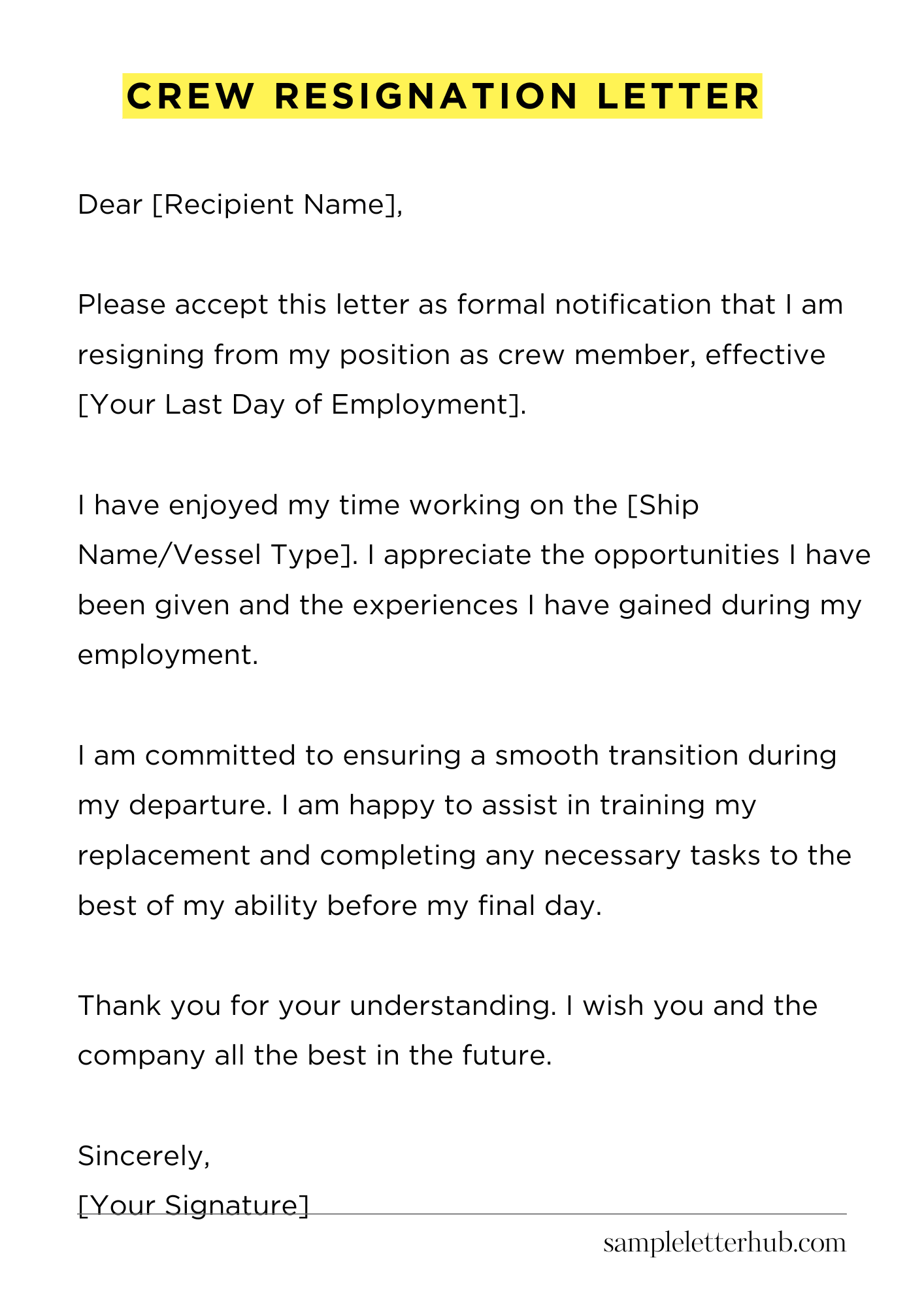
Dear [Recipient Name],
Please accept this letter as formal notification that I am resigning from my position as crew member, effective [Your Last Day of Employment].
I have enjoyed my time working on the [Ship Name/Vessel Type]. I appreciate the opportunities I have been given and the experiences I have gained during my employment.
I am committed to ensuring a smooth transition during my departure. I am happy to assist in training my replacement and completing any necessary tasks to the best of my ability before my final day.
Thank you for your understanding. I wish you and the company all the best in the future.
Sincerely,
[Your Signature]
How to Write a Crew Resignation Letter
Know When to Jump Ship
So, you’re ready to move on. That’s a big decision, and it’s important to make sure it’s the right one. Before you even *think* about writing that letter, ask yourself: Am I actually ready to leave?
Consider if the problems you are facing are resolvable. Do you see a future for yourself at this workplace? If you’ve exhausted all options, and you’re still sure it’s time to move on, then it’s time to start preparing your resignation. Take a deep breath. You’ve got this!
Setting the Stage: Your Letter’s Purpose
The goal is simple: to formally notify your employer of your departure. Your letter should be a clear, concise, and professional document. Don’t let emotions take over.
Focus on the facts. It’s not the place for venting or lengthy explanations of your grievances, even if you have them. This letter serves as your official notice. Keep it short and to the point. It is a business letter after all.
Crafting the Letter: The Key Components
Let’s get down to the nitty-gritty. Your letter needs a few essential elements. First, include your name, job title, and the date. Next, state your intention to resign. Specify your last day of employment. This is crucial for a smooth transition. Keep it professional. A brief statement of gratitude for the opportunity is always a good idea.
Offer your assistance during the transition period, if you feel comfortable doing so. Keep it respectful. This will help maintain a positive relationship.
Formatting for Success: Making it Look Good
Presentation matters! Use a standard business letter format. Include your contact information. Address it to your direct supervisor or the appropriate HR representative. Use a clear and easy-to-read font, such as Times New Roman or Arial, with a standard font size (10-12 points). Keep the letter concise; aim for one page, if possible. Proofread, proofread, and proofread!
Check for grammar and spelling errors. Errors undermine your professionalism.
Beyond the Letter: After You Submit
Once you’ve submitted your letter, what next? Be prepared to discuss your resignation with your supervisor. Be polite, and professional. You might be asked questions about your reasons for leaving or how you can assist with the transition. Stick to the points you raised in your letter. Remember, you’re leaving on good terms.
Remain professional until your last day. This is a very important part of the process. Maintain your integrity. Finally, remember to collect any final paperwork and ensure you receive your final paycheck. Good luck with your future endeavors!
FAQs about Crew resignation letter
What is the purpose of a crew resignation letter?
The primary purpose of a crew resignation letter is to formally notify an employer of an employee’s intent to leave their position. It serves as a written record of the resignation, the employee’s last day of employment, and provides an opportunity for the employee to express gratitude or provide any necessary information, such as forwarding address or contact details for future communication.
What key information should be included in a crew resignation letter?
A well-crafted resignation letter should include: a clear statement of resignation, the effective date of the resignation (last day of employment), the employee’s name and job title, and the recipient’s name and title.
It may also include a brief expression of gratitude to the employer, a mention of any outstanding tasks or projects, and contact information for future correspondence. Avoid negativity and focus on professionalism.
How much notice should I give when submitting a crew resignation letter?
The amount of notice required varies based on the company’s policies, employment contracts, and local laws. However, a standard practice is to give at least two weeks’ notice, which allows sufficient time for the employer to find a replacement and manage the transition. Review your employment contract or company handbook to understand the specific notice period requirements.
Should I provide a reason for resigning in my crew resignation letter?
While not mandatory, it is often considered a professional courtesy to briefly state the reason for your resignation. You can keep it concise and positive, such as “to pursue another opportunity” or “to focus on personal commitments.” Avoid going into excessive detail or expressing negative opinions about the company or colleagues.
What is the proper format for a crew resignation letter?
The format of a resignation letter is generally straightforward. Use a standard business letter format, including your contact information, the date, the employer’s contact information, a formal salutation (e.g., “Dear [Manager’s Name]”), the body of the letter, a closing (e.g., “Sincerely,”), and your typed name. Keep the tone professional, concise, and polite.
Related:
Resignation letter due to rude boss
Resignation letter moving to another state
Resignation letter due to illness of family member
Resignation letter due to study