

A UX Designer resignation letter is a formal document. It announces your departure from a company. Its main purpose is to officially notify your employer. This signals the end of your employment.
So, you’re moving on from your UX role? Congratulations! We understand writing a resignation letter can be tricky. Don’t worry, we’ve got you covered.
Here, we provide various templates. These templates offer different approaches. Find the best fit for your situation. Use them as a starting point. Make your letter clear, concise, and professional.
Ux Designer Resignation Letter
Below is a sample of a Ux Designer Resignation Letter:
[Your Name]
[Your Address]
[Your Phone Number]
[Your Email Address]
[Date]
[Hiring Manager Name (if known), or “Hiring Manager”]
[Company Name]
[Company Address]
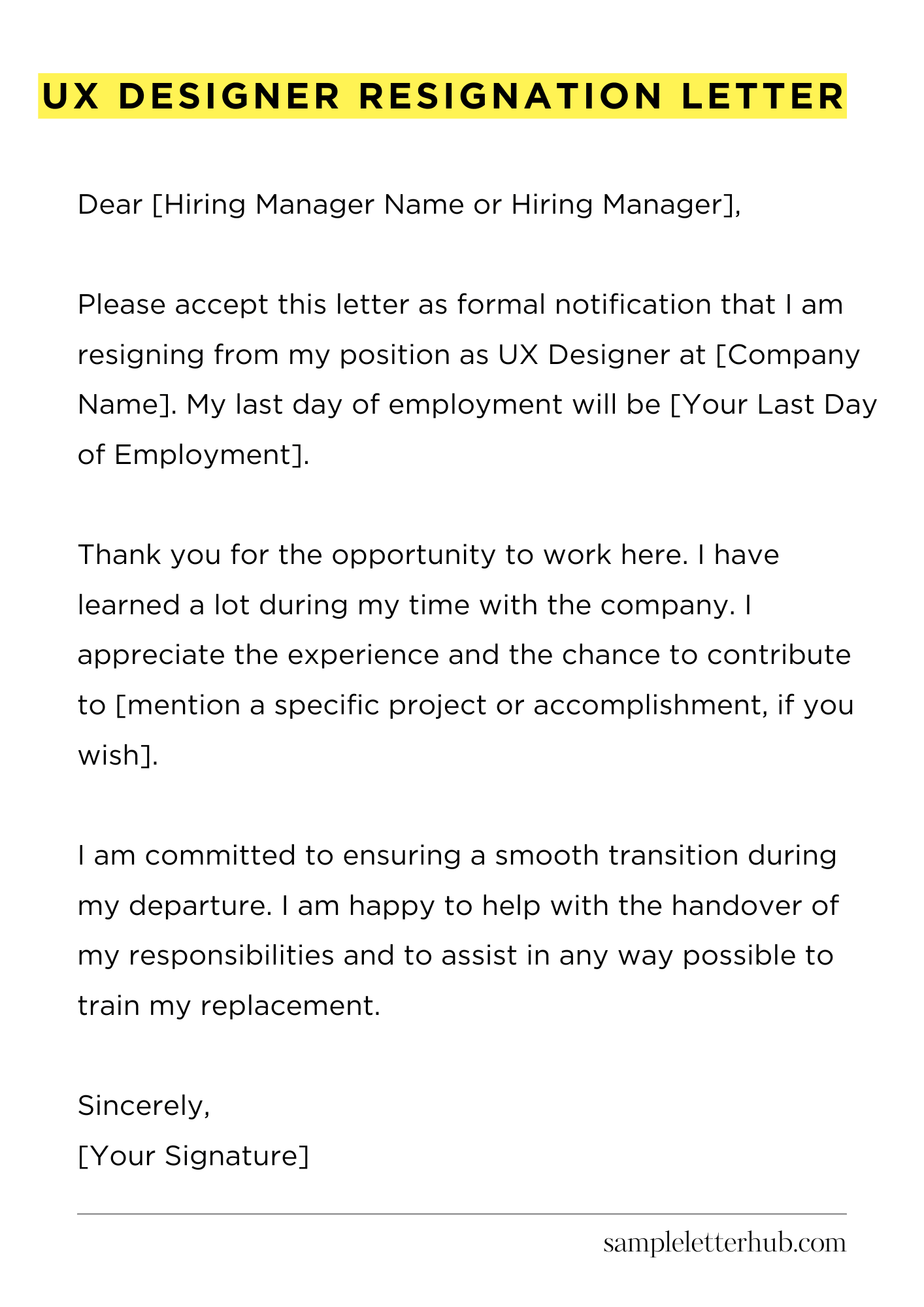
Dear [Hiring Manager Name or Hiring Manager],
Please accept this letter as formal notification that I am resigning from my position as UX Designer at [Company Name]. My last day of employment will be [Your Last Day of Employment].
Thank you for the opportunity to work here. I have learned a lot during my time with the company. I appreciate the experience and the chance to contribute to [mention a specific project or accomplishment, if you wish].
I am committed to ensuring a smooth transition during my departure. I am happy to help with the handover of my responsibilities and to assist in any way possible to train my replacement.
I wish you and the company all the best in the future.
Sincerely,
[Your Signature]
How to Write a UX Designer Resignation Letter
Getting Started: The Basics You Need to Know
Resigning from your UX design role? That’s a big decision! You’ll need to formally inform your employer, and the best way to do this is with a well-crafted resignation letter. This isn’t just about saying “I quit.” It’s a professional courtesy and it’s also important for your career. It can help you leave on good terms. You should always aim to make a positive impression.
Think of it as a final piece of user experience design – for your employer. The user (your boss) needs to understand your decision easily. Keep it clear, concise, and respectful. Before you start writing, make sure you know your company’s policy regarding resignation. Most companies need at least two weeks’ notice, but some might require more.
Crafting the Perfect Letter: What to Include
So, what should you actually write? Start with a simple, direct statement of your intent to resign. State your name, your position (UX Designer, of course!), and the effective date of your resignation.
That’s the day you’ll officially leave. Avoid beating around the bush; be clear from the get-go. Then, express your gratitude. Acknowledge the opportunities you’ve had during your time at the company. Even if you’re not thrilled about leaving, a little appreciation goes a long way.
Next, it’s wise to offer assistance with the transition. Offer to help train your replacement, complete any outstanding tasks, or document your processes. This shows you’re a team player and care about leaving things in good shape. Finally, end on a positive note. Thank your employer again, and perhaps express your best wishes for the company’s future. Keep it brief; no need for a novel.
Formatting is Key: Keeping it Professional
Formatting matters. Always use a professional business letter format. Your letter should be single-spaced, using a standard font like Arial or Times New Roman. Start with your name, address, and contact information. Then, add the date, and your manager’s name and address. Following this standard format presents a professional image.
Use clear paragraphs. Break up your text for readability. Keep it concise. Get straight to the point. Proofread carefully. Check for any grammatical errors or typos before sending. A well-formatted letter shows you care about your professional image.
Avoiding Common Mistakes: What to Leave Out
There are definitely things you should *not* include. Avoid negativity, even if your experience hasn’t been ideal. Don’t complain about your colleagues or the company. This isn’t the place for grievances. Steer clear of lengthy explanations for your departure. Keep the reason concise (e.g., “I have accepted a position elsewhere”).
Do not burn bridges. Do not include details about your new job, salary, or company. The letter’s purpose is to resign, not to brag. And never, ever make threats. Keep it classy.
Finalizing and Delivering Your Letter: The Last Step
Before you send your letter, reread it carefully. Ask a friend or colleague to review it for any errors. After you’ve checked everything, make a copy for your records. Consider who you will give it to. Normally, you will hand it to your immediate supervisor, but check your company policy. Once you’re sure it’s perfect, deliver the letter in person. If that’s not possible, send it via email.
FAQs about UX Designer Resignation Letter
What is the most important information to include in a UX Designer resignation letter?
The most crucial elements of a UX Designer resignation letter are: a clear and concise statement of your intent to resign, the effective date of your resignation, and a professional expression of gratitude for the opportunity. It’s also helpful to briefly mention your reason for leaving, if you choose to do so. Finally, always include your contact information for any follow-up.
Should a UX Designer explain the reasons for leaving in their resignation letter?
While not mandatory, briefly mentioning your reason for leaving can be beneficial. It helps provide context and can leave a positive impression. You can choose to keep it general, like “pursuing other opportunities,” or be more specific if you’re comfortable. However, avoid negativity or complaints. Keep the tone professional.
How much notice should a UX Designer give when resigning?
The standard notice period for a UX Designer, like most professional roles, is typically two weeks. However, this can vary based on your employment contract or company policy. Always refer to your contract or employee handbook to determine the required notice period to ensure you meet your contractual obligations.
What should be the tone of a UX Designer’s resignation letter?
The tone of the resignation letter should be professional, respectful, and positive. Express your gratitude for the experience, the opportunities you’ve been given, and the relationships you’ve built. Avoid any negativity, complaints, or criticisms of the company or your colleagues.
Is it necessary to offer assistance with the transition in a UX Designer’s resignation letter?
Offering assistance with the transition is a thoughtful and professional gesture. Briefly state your willingness to help train your replacement or assist with the handover of ongoing projects. This demonstrates your commitment to a smooth transition and leaves a positive final impression. However, it’s also important to be realistic about your availability during your remaining time.
Related:
Resignation letter due to rude boss
Resignation letter moving to another state
Resignation letter due to illness of family member
Resignation letter due to study