

A Policy Advisor resignation letter is a formal document. It announces your departure from your role. Its primary purpose is to inform your employer. It also communicates your resignation’s effective date.
Writing this letter can seem daunting. Don’t worry, we’re here to help. We’ve gathered helpful templates for you. You’ll find different examples. These will guide you through the process.
Our goal is to make it easy. We provide a range of samples. You can adapt them to fit your needs. Crafting a professional resignation letter is now simple.
Policy Advisor Resignation Letter
Below is a sample of a Policy Advisor Resignation Letter:
[Your Name]
[Your Address]
[Your Phone Number]
[Your Email Address]
[Date]
[Recipient’s Name]
[Recipient’s Title]
[Company Name]
[Company Address]
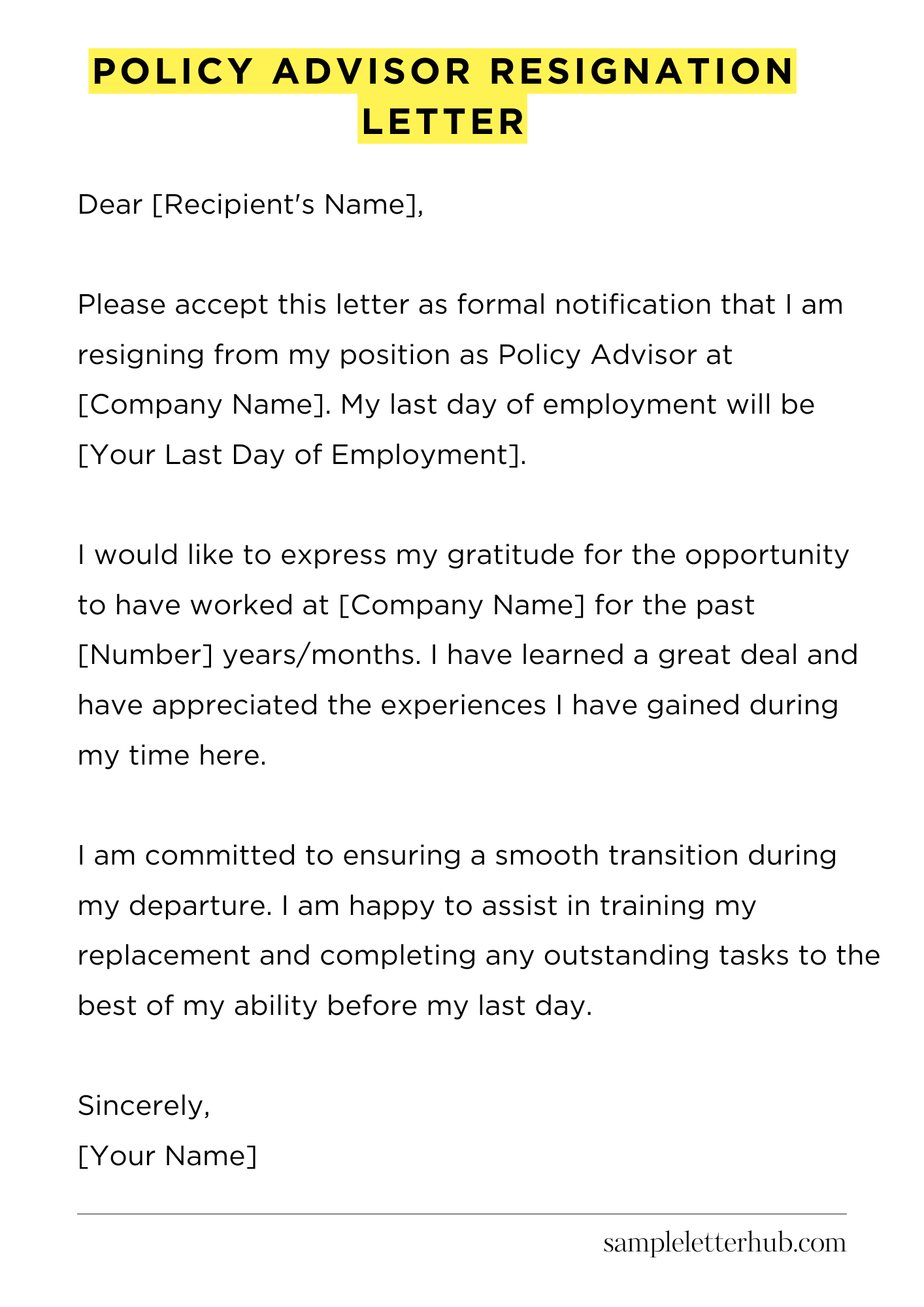
Dear [Recipient’s Name],
Please accept this letter as formal notification that I am resigning from my position as Policy Advisor at [Company Name]. My last day of employment will be [Your Last Day of Employment].
I would like to express my gratitude for the opportunity to have worked at [Company Name] for the past [Number] years/months. I have learned a great deal and have appreciated the experiences I have gained during my time here.
I am committed to ensuring a smooth transition during my departure. I am happy to assist in training my replacement and completing any outstanding tasks to the best of my ability before my last day.
I wish [Company Name] continued success in the future.
Sincerely,
[Your Name]
How to Write a Policy Advisor Resignation Letter
1. Getting Started: The Basics of a Resignation
So, you’re moving on from your role as a Policy Advisor. Good for you! Writing a resignation letter is a formal process. It’s important to do it right. This is often the last impression you’ll make on your employer.
A well-written letter is key, even if you’re leaving due to negative circumstances. Begin by understanding the core purpose: to officially announce your departure. Always keep it professional. Simple, yet powerful!
2. Essential Components: What to Include
There are several elements your resignation letter must have. First, you need to clearly state your intention to resign. Specify your job title, too! Next, state your last day of employment. This is crucial for HR purposes and transition planning. Express gratitude for the opportunity. Mentioning the good times you had shows respect and professionalism.
A brief explanation for your departure is optional. Be concise, even if the reasons are complex. You do not have to write a novel. Finally, end with a courteous closing and your signature.
3. Crafting the Content: A Step-by-Step Guide
Let’s break down the writing process. Start with a professional salutation, like “Dear [Manager’s Name]”. Then, in the first paragraph, clearly state your resignation from the position of Policy Advisor.
The next paragraph should specify your last day of employment. This allows the organization time to plan. In the subsequent paragraph, you can express gratitude. Mention specific experiences or opportunities you’ve valued during your tenure. If you are comfortable, briefly explain your reason for leaving.
A simple sentence or two will suffice. Keep the reasons factual. Finally, close with a professional sign-off, such as “Sincerely” or “Regards,” followed by your typed name and your signature. That is all. It is easier than you think!
4. Dos and Don’ts: Avoiding Common Mistakes
Avoid negativity at all costs. Resignation letters should be positive, even if your experience was not. Don’t burn bridges. A small world is a real one. Keep it brief. Long, rambling letters are unnecessary.
Be factual. Do not include personal opinions or grievances. Proofread carefully. Check for any grammar or spelling mistakes. It can reflect poorly on you. Be professional in every single sentence. Focus on your future, not your past.
5. Examples and Templates: Putting it All Together
Here’s a basic template to get you started:
[Your Name]
[Your Address]
[Your Phone Number]
[Your Email Address]
[Date]
[Manager’s Name]
[Manager’s Title]
[Company Name]
[Company Address]
Dear [Manager’s Name],
Please accept this letter as formal notification that I am resigning from my position as Policy Advisor at [Company Name]. My last day of employment will be [Your Last Day].
I am grateful for the opportunities I have been given during my time here. [Optional: Briefly mention a specific experience or skill you learned].
[Optional: You may briefly mention the reason for your departure if you wish].
I wish you and [Company Name] all the best in the future.
Sincerely,
[Your Typed Name]
[Your Signature (if sending a physical copy)]
Adapt this template to fit your specific circumstances. Be flexible. The key is to be clear, concise, and professional.
FAQs about Policy Advisor Resignation Letter
What information should I include in my Policy Advisor resignation letter?
Your resignation letter should clearly state your intention to resign, the effective date of your resignation, and your official title. It’s also customary to express gratitude for the opportunity to work in the role. You might briefly mention reasons for leaving, but this is optional. Include your contact information for any follow-up.
How much notice should I give when resigning as a Policy Advisor?
The standard notice period is typically two weeks. However, this can vary based on your employment contract or organizational policy. Review your contract or consult your HR department to confirm the required notice period. If you are in a senior role, a longer notice period may be expected. Always try to provide as much notice as possible.
Should I provide a reason for resigning in my Policy Advisor resignation letter?
While not mandatory, briefly mentioning your reason for leaving can be helpful. You can simply state that you are pursuing other opportunities or making a career change. Keep your reason professional and positive. Avoid including negative comments about the organization or colleagues.
How should I deliver my Policy Advisor resignation letter?
The most professional method is to submit a formal, written letter to your supervisor or HR department. You may also be expected to discuss this with your superior face to face. It’s generally a good practice to deliver the letter in person if possible and follow up with a brief discussion. Keep a copy for your records.
What should I do after submitting my Policy Advisor resignation letter?
After submitting your letter, cooperate fully with any handover procedures. This may include transferring your responsibilities, training your replacement, and returning company property. Remain professional and positive throughout your remaining time. You should also be available for any exit interviews. Be sure to collect your final paycheck.
Related:
Resignation letter due to rude boss
Resignation letter moving to another state
Resignation letter due to illness of family member
Resignation letter due to study