

So, you’re an Executive Board Member and need to resign? A resignation letter formally announces your departure. It’s a crucial document. It officially informs the board of your decision. It also outlines your final day of service.
Need help crafting the perfect letter? This article is for you. We understand writing these can be tricky. That’s why we’re sharing ready-to-use samples. These templates will help you compose your resignation with ease.
We’ve got various examples. These cover different scenarios. Whether you’re moving on or facing a difficult situation, we have something for you. Just customize them. Make them your own.
Executive Board Member Resignation Letter
Below is a sample of a Executive Board Member Resignation Letter:
[Your Name]
[Your Address]
[Your Phone Number]
[Your Email Address]
[Date]
[Executive Board Member Name]
[Executive Board Title]
[Organization Name]
[Organization Address]
Dear [Executive Board Member Name],
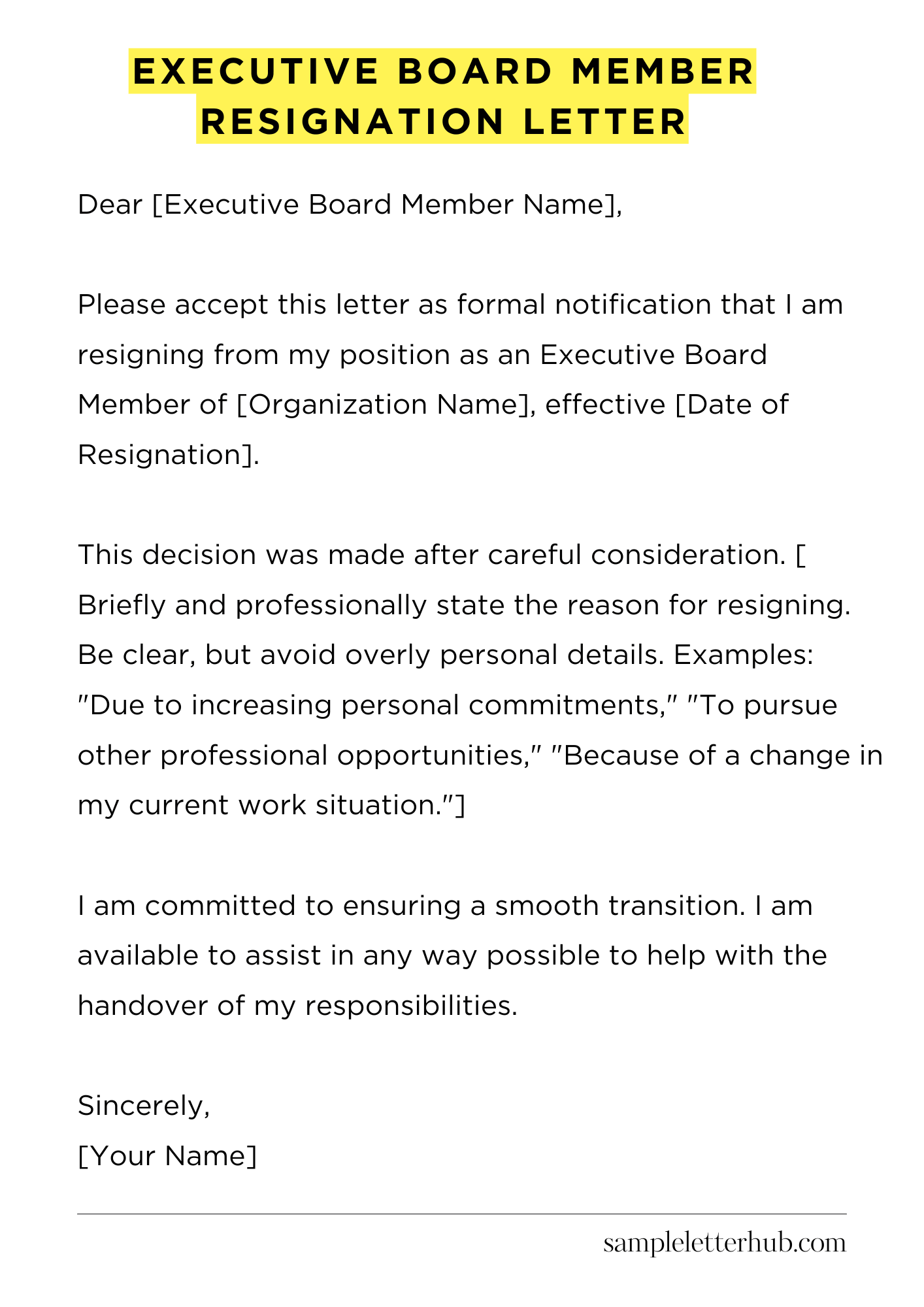
Please accept this letter as formal notification that I am resigning from my position as an Executive Board Member of [Organization Name], effective [Date of Resignation].
This decision was made after careful consideration. [ Briefly and professionally state the reason for resigning. Be clear, but avoid overly personal details. Examples: “Due to increasing personal commitments,” “To pursue other professional opportunities,” “Because of a change in my current work situation.”]
I am committed to ensuring a smooth transition. I am available to assist in any way possible to help with the handover of my responsibilities. I am happy to provide any information or documentation needed.
I have truly valued my time serving on the Executive Board. I am proud of the accomplishments we have achieved during my tenure. I wish the organization continued success in the future.
Sincerely,
[Your Name]
How to Write an Executive Board Member Resignation Letter
Resigning from an executive board position is a significant step. It’s often a necessary one, but it’s important to do it with professionalism and grace. Think of it as a final official act, and the way you handle it can leave a lasting impression. You want to make sure your departure is remembered positively, right? That all begins with a well-crafted resignation letter.
1. Start with a Clear and Concise Statement
The first paragraph is crucial. It sets the tone and purpose of the letter. State clearly and directly that you are resigning from your position. Avoid ambiguity. The reader should understand immediately what you’re communicating. Include the effective date of your resignation. Be specific about when your term will end.
This removes any doubt and prevents confusion. This section shouldn’t take up too much space.
For example: “Please accept this letter as formal notification that I am resigning from my position as [Your Position] on the Board of Directors of [Organization Name], effective [Date].” Keep it simple. Keep it straightforward.
2. Briefly Explain Your Reason (Optional but Recommended)
While not always mandatory, offering a brief explanation for your resignation is often a good idea. This doesn’t mean you need to provide a detailed account of your reasons. You may be comfortable sharing this. Focus on keeping your explanation brief and professional.
Consider it a courtesy to the organization and the other board members. You might be leaving for personal reasons, another opportunity, or due to a change in circumstances. However, avoid negativity or complaints. Choose phrases that convey your reason positively. Nobody wants to read something negative.
Consider these examples: “I am resigning to pursue other professional opportunities.” Or, “Personal circumstances require that I reduce my commitments at this time.” You can also state, “I am no longer in a position to dedicate the necessary time.”
3. Express Gratitude and Positive Sentiment
Now is the time to express your appreciation for the opportunity and your experiences. Acknowledge the organization, the team, and any specific individuals who contributed to your positive experiences.
This shows respect for the organization and builds goodwill. Remember that your relationships will continue after your departure. Mentioning positive aspects of your time will leave a lasting positive impression. Acknowledge what you learned.
Here’s how: “I am grateful for the opportunity to have served on the board and for the support I have received from my colleagues.” Or perhaps, “I have greatly valued my time with [Organization Name] and appreciate the collaborative spirit of the board members.”
4. Offer Assistance with the Transition
Offering your assistance with the transition is a thoughtful gesture. It demonstrates your commitment to the organization’s continued success. Show that you are willing to help your successor or provide any support during the handover period. This includes offering to train the incoming board member.
Consider the specifics of your role and what support you can realistically provide. This also displays professionalism and leaves a lasting positive impact.
You could say: “I am happy to assist in the transition process in any way I can, including the introduction of a new board member.” Alternatively: “I am available to assist in any way to help ensure a smooth transition.”
5. Conclude with a Professional Closing and Contact Information
End your letter with a professional closing. Use a formal and respectful closing. Standard closing phrases are “Sincerely,” “Respectfully,” or “Best regards.” Include your full name, title, and contact information, such as your email address and phone number. This makes it easy for the board to reach you if needed.
Proofread carefully before sending. Make sure that everything is correct. Ensure that the letter is free of grammatical errors and typos. Check that you include all required details.
For example: “Sincerely, [Your Full Name] [Your Title] [Your Contact Information]”
FAQs about Executive Board Member resignation letter
What is the primary purpose of an Executive Board Member resignation letter?
The primary purpose of an Executive Board Member resignation letter is to formally communicate an individual’s decision to leave their position on the board. It serves as an official record of the resignation, providing a clear date of departure and outlining any relevant details pertaining to the transition.
It is a critical document for ensuring a smooth handover of responsibilities and for maintaining proper governance records.
What key information should be included in an Executive Board Member resignation letter?
A comprehensive resignation letter should include: a clear statement of resignation; the effective date of resignation; a brief explanation for the resignation (optional, but often included for context); acknowledgment of the commitment to assist with the transition (if applicable); and expressions of gratitude or well wishes.
Contact information for future correspondence should also be included if the board would like to keep in touch.
Is it necessary to provide a reason for resignation in the letter?
While not always mandatory, including a reason for resignation is often considered a courtesy. Providing a brief explanation, such as pursuing other opportunities, personal reasons, or conflicts of interest, can help the board understand the context of the departure. However, the level of detail is at the discretion of the resigning member. In some situations, no reason is given.
How should an Executive Board Member submit their resignation letter?
The resignation letter should be submitted to the appropriate party, typically the Board Chair, Board Secretary, or a designated representative as outlined in the organization’s bylaws or policies. The letter is commonly delivered in writing, either in hard copy or electronically, in a formal manner. It’s often best to keep a copy of the letter for personal records.
What happens after an Executive Board Member submits their resignation letter?
After the resignation letter is received, the board will typically acknowledge receipt and initiate the transition process. This may involve discussing the resignation at a board meeting, appointing a replacement (if necessary), updating official records, and facilitating the handover of responsibilities.
The board might also send an official acknowledgement back to the resigning board member.
Related:
Resignation letter due to rude boss
Resignation letter moving to another state
Resignation letter due to illness of family member
Resignation letter due to study