

An Executive Administrator resignation letter is a formal document. It announces your departure from your current role. The purpose is to officially inform your employer of your resignation. It also provides key details like your last day.
Crafting this letter can feel daunting. We’re here to help ease the process. We’ve compiled various templates and examples. These samples cover different scenarios.
Use these to create your own letter. Tailor them to fit your specific needs. Say goodbye to guesswork. Say hello to a professionally written resignation.
Executive Administrator Resignation Letter
Below is a sample of a Executive Administrator Resignation Letter:
[Your Name]
[Your Address]
[Your Phone Number]
[Your Email Address]
[Date]
[Recipient Name]
[Recipient Title]
[Company Name]
[Company Address]
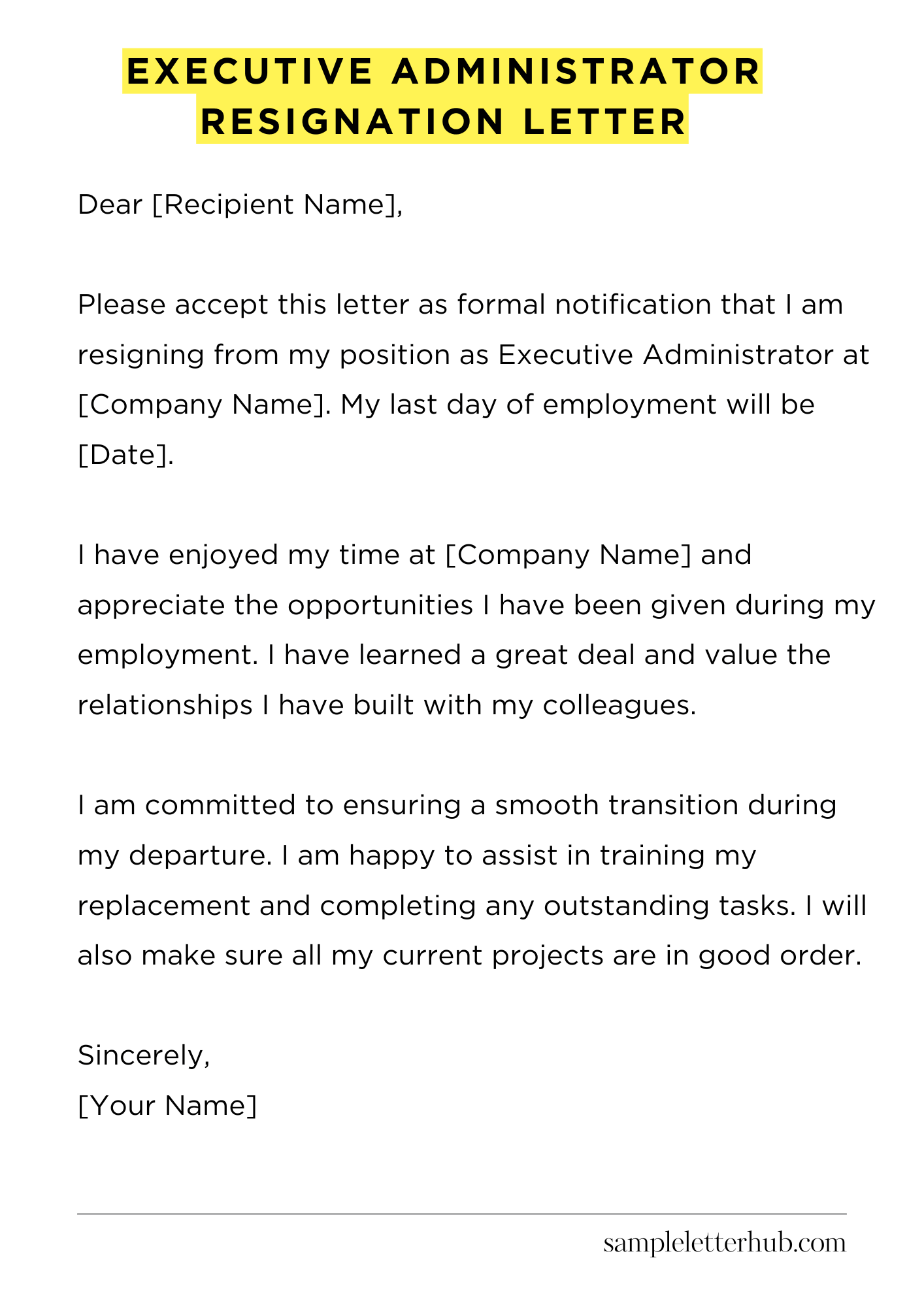
Dear [Recipient Name],
Please accept this letter as formal notification that I am resigning from my position as Executive Administrator at [Company Name]. My last day of employment will be [Date].
I have enjoyed my time at [Company Name] and appreciate the opportunities I have been given during my employment. I have learned a great deal and value the relationships I have built with my colleagues.
I am committed to ensuring a smooth transition during my departure. I am happy to assist in training my replacement and completing any outstanding tasks. I will also make sure all my current projects are in good order.
Thank you again for the experience. I wish you and [Company Name] all the best for the future.
Sincerely,
[Your Name]
How to Write Executive Administrator Resignation Letter
1. Grasping the Core: What Goes In Your Letter?
Resigning from a top-tier administrative position requires a carefully crafted letter. Think of it as your final professional statement. Your executive administrator resignation letter should be clear, concise, and respectful.
It needs to convey your intent to leave, your last day of employment, and ideally, a brief expression of gratitude. It’s not the place to air grievances; it’s a bridge to a graceful exit.
Keep your language formal. Avoid slang or overly casual terms. This letter is a reflection of your professionalism. This is incredibly important.
2. Structure: Laying Out Your Words.
A well-structured letter is easy to understand. Start with a formal salutation, addressing the appropriate person – usually your direct supervisor, or potentially the CEO or Board of Directors. Clearly state your intention to resign. Include the specific date of your last day. This is a must.
Follow this with a brief statement of gratitude for the opportunity to work there. You can mention specific aspects of your role or the company culture you appreciated. Don’t go on and on, though. Keeping it short is best. Finally, offer assistance during the transition. Offer to help train your replacement, if possible. That shows respect.
3. Key Elements: Specifics You Can’t Miss.
Ensure that you include your formal resignation, in the first paragraph. Being direct is essential. State the exact date of your last day. This clarity avoids any confusion or ambiguity. Then include a polite, brief thank you.
Expressing gratitude is good form. If you’re willing to assist with the handover process (e.g., training a replacement, providing documentation), state this clearly.
Always proofread! Typos or grammatical errors can undermine your professionalism. Double-check all names, titles, and dates.
4. Keeping it Professional: Dos and Don’ts
Maintain a professional tone throughout the letter. Do not include negative comments about the company, your colleagues, or your supervisor. Even if you’re leaving due to negative circumstances, keep it positive. Keep personal opinions out of it.
Keep the letter brief and to the point. Long letters can be tedious. If you want to expand, you should wait until your exit interview. Focus on the essentials. Proofread meticulously. A well-written letter reflects positively on you and is a sign of professionalism. Finally, keep a copy for your records.
5. Sample Letter: A Practical Example
Here is a basic template to get you started:
        [Your Name]
        [Your Address]
        [Your Phone Number]
        [Your Email Address]

        [Date]

        [Recipient's Name]
        [Recipient's Title]
        [Company Name]
        [Company Address]

        Dear [Mr./Ms./Mx. Last Name],

        Please accept this letter as formal notification that I am resigning from my position as Executive Administrator at [Company Name], effective [Your Last Day of Employment].

        I am grateful for the opportunities I have been given during my time here.

        I am happy to assist in the transition of my responsibilities, and I am available to help train my replacement.

        I wish you and [Company Name] all the best in the future.

        Sincerely,

        [Your Signature]

        [Your Typed Name]
This is a starting point. Feel free to adjust the wording to suit your specific situation. This example is very easy to follow.
FAQs about Executive Administrator resignation letter
Why is a formal resignation letter necessary for an Executive Administrator?
A formal resignation letter serves several crucial purposes. It provides a documented record of your departure, officially notifying your employer of your intention to leave. This document is essential for HR purposes, employment verification, and to establish the effective date of your resignation.
It also communicates your professionalism and allows you to express your gratitude and maintain a positive relationship with your employer, which is vital for future references and networking opportunities.
What key information should be included in an Executive Administrator’s resignation letter?
An effective resignation letter should include the following: a clear statement of your intent to resign, the effective date of your resignation, a brief and professional expression of gratitude for the opportunity, and any relevant details regarding the handover of your responsibilities. It’s also helpful to include your contact information for any follow-up questions.
How much notice should an Executive Administrator give when resigning?
The standard notice period for an Executive Administrator is typically two weeks, but this can vary depending on your employment contract, company policy, or industry norms. Review your contract and company handbook to determine the appropriate notice period.
If your contract specifies a longer period, you should adhere to that. It’s always best to provide as much notice as possible to ensure a smooth transition and maintain a professional reputation.
What is the appropriate tone for an Executive Administrator resignation letter?
The tone should be professional, courteous, and positive. Express your gratitude for the opportunity you’ve been given, and avoid any negative comments about your current role or employer. Keep the language concise and focused on the facts of your resignation. This approach will help you leave on good terms and maintain a positive professional image.
Should an Executive Administrator explain the reason for leaving in their resignation letter?
While not mandatory, it’s generally not necessary to provide detailed reasons for your departure. A brief and neutral explanation, such as “to pursue other opportunities” or “to focus on personal commitments,” is usually sufficient. Keep the explanation brief and avoid any negative or critical language.
If you have a specific reason you wish to share, consider doing so in a separate conversation with your supervisor or HR department rather than within the formal letter.
Related:
Resignation letter due to rude boss
Resignation letter moving to another state
Resignation letter due to illness of family member
Resignation letter due to study