

A Consulting Manager resignation letter is a formal document. It informs your employer of your intention to leave. This letter initiates the official process of your departure. It’s a crucial step in transitioning out of your role.
Need to resign as a Consulting Manager? This article is for you. We understand the task can be daunting. We have you covered. Find various templates and examples. These samples will ease your letter-writing process.
Ready to craft your resignation letter? We’ve created options for different situations. Use these to customize your own. Make the process as smooth as possible. Say goodbye the right way.
Consulting Manager Resignation Letter
Below is a sample of a Consulting Manager Resignation Letter:
[Your Name]
[Your Address]
[Your Phone Number]
[Your Email Address]
[Date]
[Hiring Manager Name] (If known, otherwise use title)
[Hiring Manager Title]
[Company Name]
[Company Address]
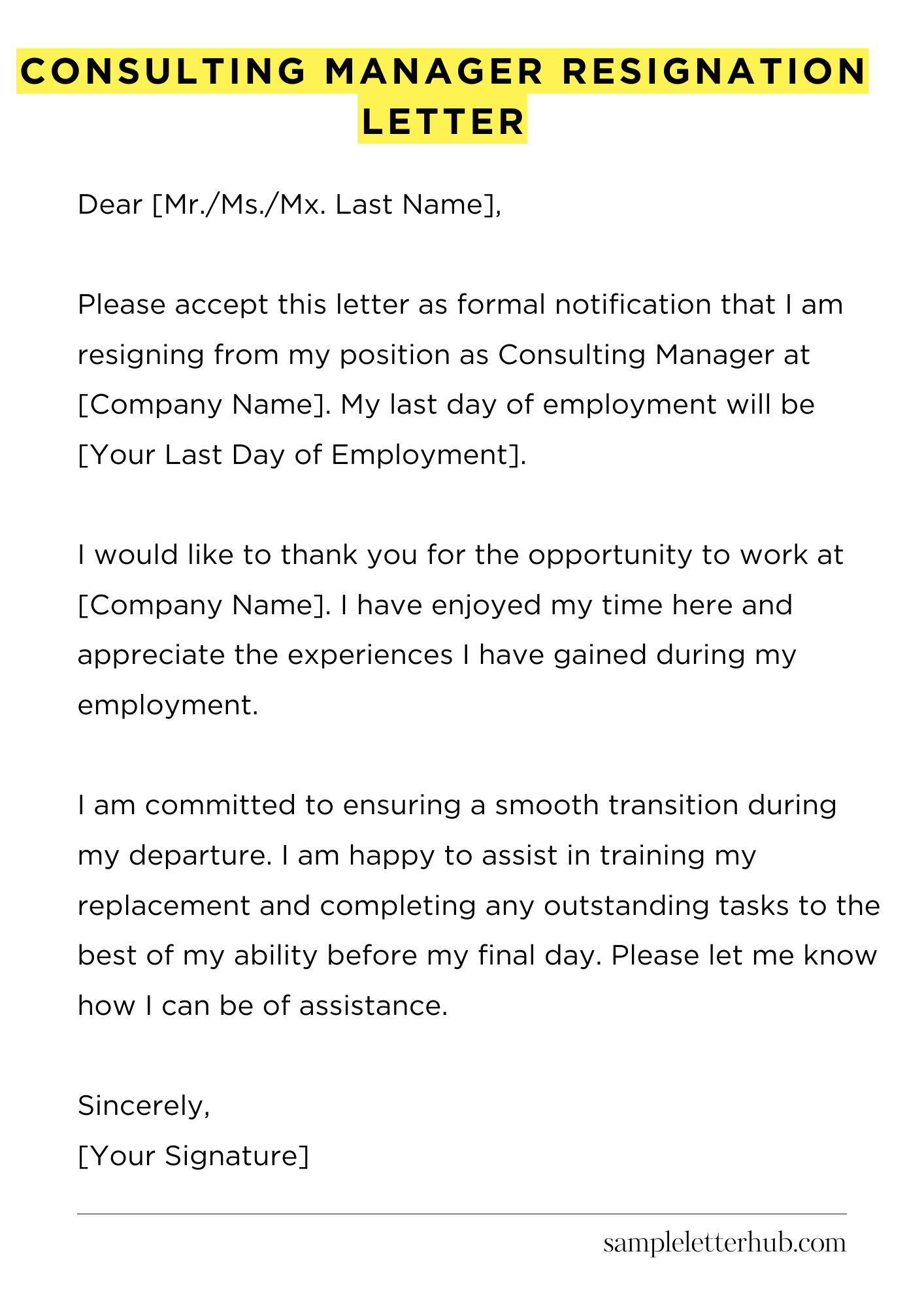
Dear [Mr./Ms./Mx. Last Name],
Please accept this letter as formal notification that I am resigning from my position as Consulting Manager at [Company Name]. My last day of employment will be [Your Last Day of Employment].
I would like to thank you for the opportunity to work at [Company Name]. I have enjoyed my time here and appreciate the experiences I have gained during my employment.
I am committed to ensuring a smooth transition during my departure. I am happy to assist in training my replacement and completing any outstanding tasks to the best of my ability before my final day. Please let me know how I can be of assistance.
I wish you and the company continued success in the future.
Sincerely,
[Your Signature]
How to Write a Consulting Manager Resignation Letter
Leaving a consulting manager position? It’s a big step. Your resignation letter is a crucial document. It professionally communicates your departure to your employer. It also sets the stage for your future endeavors. Writing a solid resignation letter is an art in itself. It’s important to get it right. Let’s delve into crafting a resignation letter that reflects well on you and your career.
1. Start with the Basics: Formatting and Formalities
First impressions matter. Your letter should be well-formatted. Use a standard business letter format. Include your contact information. Also, include the date and the recipient’s information. Address your letter to your direct supervisor or the appropriate HR representative. Keep it concise.
This is not the time for rambling. Stick to the point and be respectful. Maintain a professional tone throughout the letter. It’s a reflection of you. It showcases your professionalism.
2. State Your Intentions Clearly and Directly
The core of your letter should clearly and directly state your intention to resign. Avoid ambiguity. State the effective date of your resignation. This date is critical. Make sure it aligns with your employment contract or company policy.
Be specific. Example: “I am writing to inform you of my resignation from my position as Consulting Manager, effective [Date].” The clearer you are, the better. This eliminates any confusion. This also protects you. This is an important detail for both you and your employer.
3. Express Gratitude and Positive Reflections
A touch of class goes a long way. Express gratitude for the opportunity to work at the firm. Acknowledge your experiences and any professional growth you’ve gained. This is a chance to show appreciation. Briefly mention any positive aspects of your time there. Keep it genuine.
You can say something like, “I am grateful for the opportunities I’ve been given.” or “I have learned a lot during my time here.” This leaves a positive lasting impression.
4. Offer Assistance with the Transition
Being helpful is always a good idea. Offer your assistance during the transition period. This demonstrates your commitment and professionalism. This also shows you are a team player. You could offer to help train your replacement, complete ongoing projects, or provide documentation.
For example, “I am happy to assist in any way possible to ensure a smooth transition.” or “I am available to train my replacement.” However, this is optional. It shows that you care. It leaves a good impression.
5. Conclude with a Professional Closing and Signature
End your letter on a strong note. Use a formal closing, such as “Sincerely,” or “Respectfully,” followed by your typed name. Sign your name above your typed name. If you’re sending a digital copy, you can add a scanned signature. A well-crafted closing reinforces your professionalism.
Make sure you proofread everything before sending. Make sure your signature is clear. This is the last impression you make. Make it count.
FAQs about Consulting Manager resignation letter
A Consulting Manager resignation letter is a formal document that officially communicates an employee’s intent to leave their position. It’s a crucial step in the departure process, requiring careful consideration and attention to detail. Below are some of the most frequently asked questions on this topic.
What is the primary purpose of a Consulting Manager resignation letter?
The primary purpose of a Consulting Manager resignation letter is to formally notify the employer of the employee’s intent to leave their position. It serves as a legal record of the resignation, providing a clear date of departure and initiating the transition process. It also helps to maintain a professional relationship with the employer.
What key elements should be included in a Consulting Manager resignation letter?
Key elements include a clear statement of resignation, the effective date of departure, a brief expression of gratitude for the opportunity (optional but recommended), any relevant handover instructions, and a professional closing. It should also include the consultant’s name, job title, and the company’s address.
It is crucial to adhere to any company policies regarding resignation procedures.
How much notice should a Consulting Manager give when resigning?
The notice period depends on the employment contract or company policy. Typically, a Consulting Manager is expected to provide at least two to four weeks’ notice. Always refer to your employment agreement to clarify the required notice period. Providing adequate notice ensures a smooth transition and demonstrates professionalism.
Should I provide a reason for my resignation in the letter?
While not mandatory, it’s generally acceptable to briefly state the reason for your resignation. Keep the explanation concise and professional. Reasons can include pursuing a new opportunity, personal reasons, or other professional goals.
Avoid negative comments about the company or colleagues. Stating a reason isn’t always necessary, especially if you prefer to keep the matter private.
How should a Consulting Manager handle the handover process outlined in the resignation letter?
The resignation letter should mention willingness to assist with the handover process. This includes cooperating with any training of successors, completing outstanding tasks, and providing relevant documentation.
Being cooperative during the handover is essential. The consultant must also respond to any questions or requests that may arise. Proper handover ensures business continuity and leaves a positive impression on the departing consultant.
Related:
Resignation letter due to rude boss
Resignation letter moving to another state
Resignation letter due to illness of family member
Resignation letter due to study