

A Staff Assistant resignation letter is a formal document. Its purpose is to officially inform an employer about leaving a job. It states the employee’s intent to resign. It also includes the last day of employment.
This article is for you. We understand writing these letters can be tough. We will provide you with examples. You will find different resignation letter templates here. They are easy to use and adaptable.
You will find a range of samples. Use them to tailor your letter. Make it fit your specific situation. Writing your resignation letter just became much easier.
Staff Assistant Resignation Letter
Below is a sample of a Staff Assistant Resignation Letter:
[Your Name]
[Your Address]
[Your Phone Number]
[Your Email Address]
[Date]
[Employer’s Name]
[Company Name]
[Company Address]
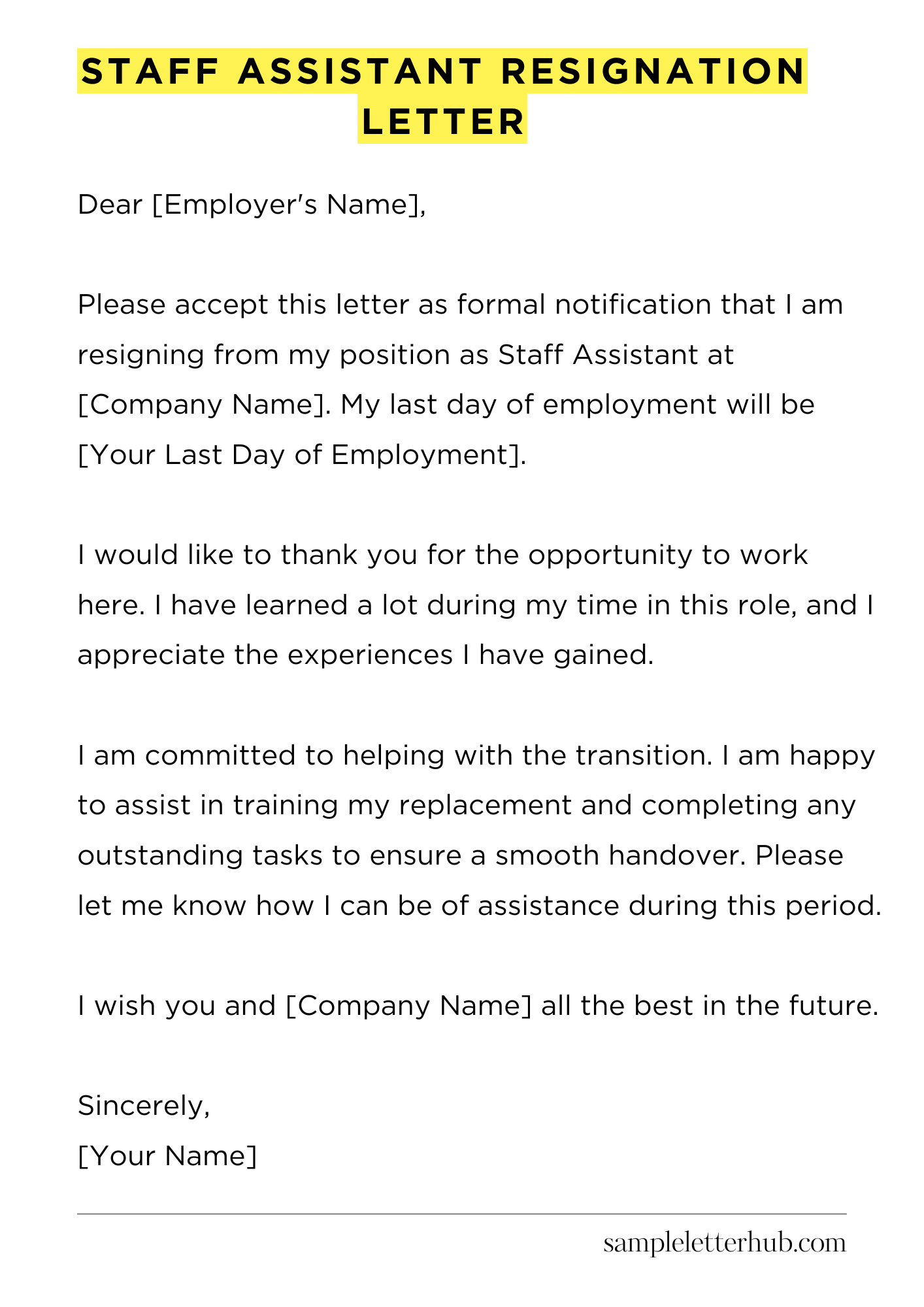
Dear [Employer’s Name],
Please accept this letter as formal notification that I am resigning from my position as Staff Assistant at [Company Name]. My last day of employment will be [Your Last Day of Employment].
I would like to thank you for the opportunity to work here. I have learned a lot during my time in this role, and I appreciate the experiences I have gained.
I am committed to helping with the transition. I am happy to assist in training my replacement and completing any outstanding tasks to ensure a smooth handover. Please let me know how I can be of assistance during this period.
I wish you and [Company Name] all the best in the future.
Sincerely,
[Your Name]
How to Write a Staff Assistant Resignation Letter
Knowing When to Leave
Deciding to leave your current role as a Staff Assistant is a big decision. Consider your situation carefully. Are you facing a better opportunity? Perhaps the current job isn’t fulfilling your needs, or maybe the work environment is no longer a good fit.
Whatever the reason, you’ve decided to move on. Now what? Your resignation letter is your first step toward a graceful exit. It is also a very important formality. It sets the stage for your departure and can impact future opportunities.
Before putting pen to paper (or fingers to keyboard), reflect on your reasons for leaving. This will help you express yourself clearly and professionally.
The Anatomy of a Resignation Letter
A well-crafted resignation letter is concise and professional. It doesn’t need to be overly elaborate. Keeping things simple is often best. The core components are pretty straightforward. It should include the date, your name and contact information, the recipient’s name and title, and then the body of the letter.
Start with a clear statement of your intent to resign. Next, state your last day of employment. Offer a brief expression of gratitude for the opportunity. Finally, keep it positive and focus on the future.
Crafting the Perfect Message
Let’s delve into the actual writing. Begin with a polite and formal greeting, such as “Dear [Manager’s Name].” Then, clearly state your intention: “Please accept this letter as formal notification that I am resigning from my position as Staff Assistant, effective [Your Last Day of Employment].” This needs to be very clear.
Next, express your appreciation for the opportunity. For example, “I would like to thank you for the opportunity to have worked as a Staff Assistant at [Company Name] for the past [Number] years/months.”
Keep it brief, but genuine. Finally, wrap up with a forward-looking closing like, “I wish you and the company all the best in the future” or “I am grateful for the experiences I have gained and wish the company continued success.”
The Importance of Professionalism
Remember that your resignation letter is a professional document. Always maintain a professional tone, even if your experience hasn’t been ideal. Avoid negativity, complaints, or lengthy explanations of your reasons for leaving. It is a good practice to avoid any complaints in this format.
Proofread carefully. Ensure that your letter is free of grammatical errors and typos. Double-check the dates and the recipient’s name and title. Maintain a positive attitude, as this letter is a reflection of you. Your final impression matters.
Finalizing and Sending
Once you’ve drafted your letter and are happy with it, review it one last time. Save a copy for your records. Consider the company’s preferred method for submitting resignations. In many cases, it is sent to your direct supervisor. Some companies might prefer a digital copy via email. Other may want a hard copy.
After you have successfully submitted your resignation, follow up if you have not heard anything within a few days. Be sure to ask about the next steps. This includes things such as the return of any company property and any exit interviews. Leaving on a positive note can often open doors for future opportunities. Good luck!
FAQs about Staff Assistant resignation letter
How do I write a Staff Assistant resignation letter?
A well-written resignation letter should be concise, professional, and clear. Start by stating your intent to resign, followed by your official last day of employment. Briefly express gratitude for the opportunity to work at the company, and, if you wish, briefly explain the reason for leaving (optional).
Proofread for any errors before submitting the letter to your supervisor or HR department.
What should I include in a Staff Assistant resignation letter?
Include the following core elements: your formal intent to resign, the effective date of your resignation, and a brief expression of gratitude. It’s also a good practice to offer assistance with the transition, such as offering to help train your replacement, if appropriate. It is not necessary to provide an explanation for your resignation, although you may choose to do so.
When should I submit my Staff Assistant resignation letter?
Typically, the standard notice period for a Staff Assistant, and most other positions, is two weeks. However, this can vary based on your employment contract or company policy. Review your employment agreement or consult with HR to determine the required notice period. Submit your letter at least the minimum notice period before your planned last day.
Can I include a reason for my resignation in the letter?
Yes, you can include the reason for your resignation, but it is not mandatory. If you choose to, keep the explanation brief and professional. If you are leaving due to a positive opportunity (e.g., a new job), you can state that.
If the reason is more complex, such as issues with management or the work environment, you can simply state that you are seeking a new opportunity. You are not obligated to disclose detailed reasons.
How should I deliver my Staff Assistant resignation letter?
The most common practice is to submit the letter in person to your direct supervisor or to HR. You might also provide a digital copy. Always retain a copy for your own records. After submitting, be prepared to discuss your resignation and the transition process with your manager.
Related:
Resignation letter due to rude boss
Resignation letter moving to another state
Resignation letter due to illness of family member
Resignation letter due to study