

A “School Administrator resignation letter” is a formal document. It is written by a school administrator. The purpose? To officially announce their departure from their position. It’s a crucial step in the resignation process. It informs the school of their decision.
This article has some exciting stuff. We will be sharing various resignation letter templates. Think of them as your secret weapon. These examples cover different scenarios.
They will help you write your own letter. It doesn’t matter your reason for leaving. These samples are designed to make it simple. Consider them your starting point. Write your perfect resignation letter today.
School Administrator Resignation Letter
Below is a sample of a School Administrator Resignation Letter:
[Your Name]
[Your Address]
[Your Phone Number]
[Your Email Address]
[Date]
[School Administrator’s Name]
[School Name]
[School Address]
Dear [School Administrator’s Name],
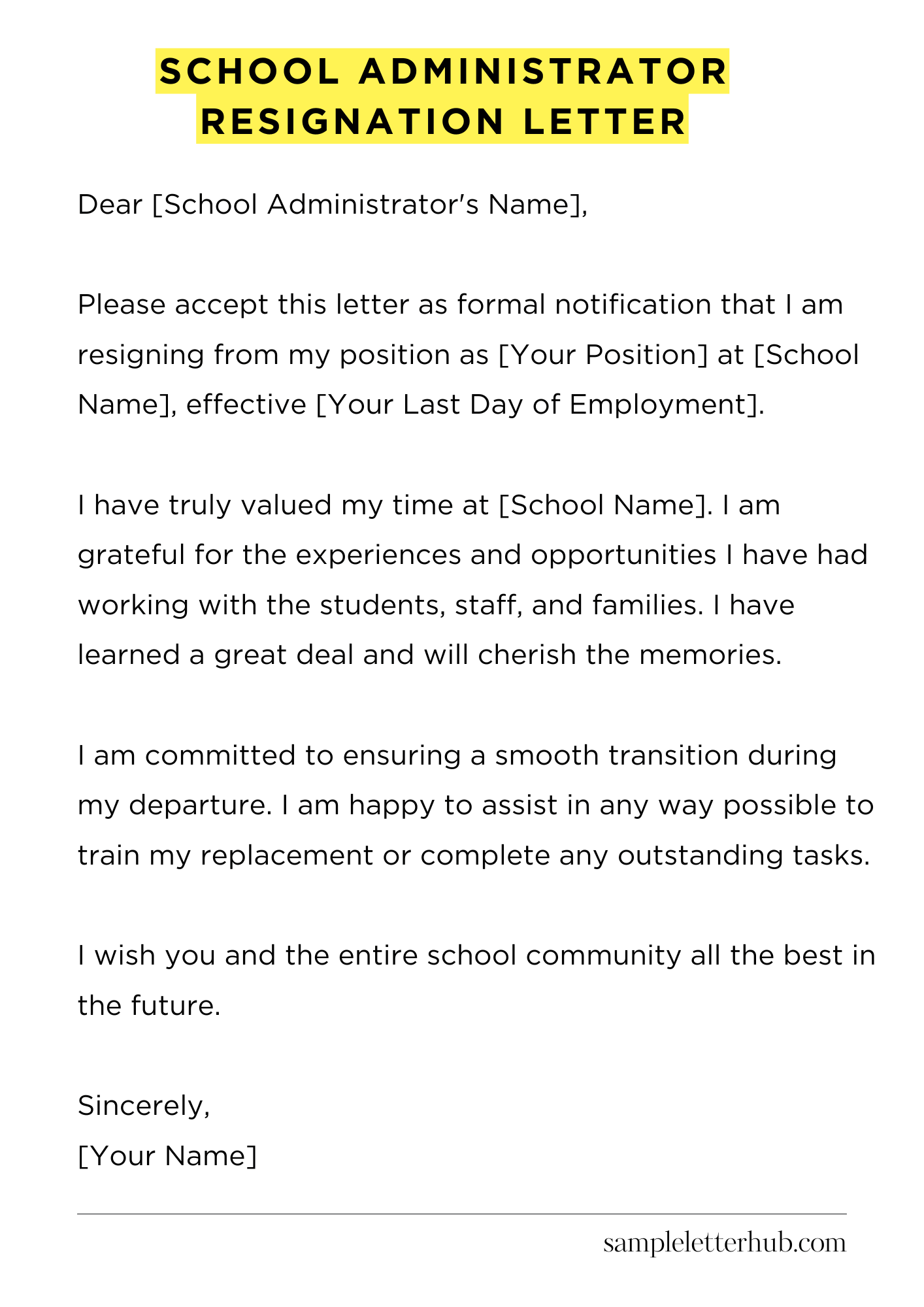
Please accept this letter as formal notification that I am resigning from my position as [Your Position] at [School Name], effective [Your Last Day of Employment].
I have truly valued my time at [School Name]. I am grateful for the experiences and opportunities I have had working with the students, staff, and families. I have learned a great deal and will cherish the memories.
I am committed to ensuring a smooth transition during my departure. I am happy to assist in any way possible to train my replacement or complete any outstanding tasks.
I wish you and the entire school community all the best in the future.
Sincerely,
[Your Name]
How to Write a School Administrator Resignation Letter
Resigning from a school administrator position is a big decision, and it requires careful consideration. You’ve poured your heart and soul into this role, making a real difference in the lives of students, teachers, and the community. But now, it’s time to move on.
Crafting a professional and respectful resignation letter is the first crucial step. This letter serves as your formal notification and sets the tone for your departure. Let’s delve into how you can do it right.
1. Start with the Basics: Formatting and Tone
First things first, your letter needs to look professional. Use a standard business letter format. This means a clear heading with your contact information, the date, and the recipient’s information (the Superintendent or the Board President).
The tone of your letter is absolutely critical. You want to remain professional, even if you’re leaving because of difficult circumstances. Keep it polite, positive, and concise. Avoid negativity or making accusations.
Here’s a quick overview of what to include:
- Your Name
- Your Address
- Your Phone Number
- Your Email
- Date
- Recipient’s Name
- Recipient’s Title
- School District Address
Keep your tone respectful and acknowledge the impact of your decision on the school.
2. The Core: Stating Your Resignation Clearly
The most important part is making your intentions clear. Be direct and state that you are resigning from your position. Include the official title of your position, and the effective date of your resignation.
Ensure that date provides enough notice, as per your contract or the district’s policies. You should review your employment contract to understand the required notice period. This is often 30, 60, or even 90 days. This information is non-negotiable and requires a straightforward approach.
For example, you can begin by writing: “Please accept this letter as formal notification that I am resigning from my position as Principal of [School Name], effective [Date].” It’s that simple.
3. Expressing Gratitude: Show Appreciation
Even if your time hasn’t been perfect, remember to express your gratitude. Acknowledge the opportunities you’ve been given and the experiences you’ve gained.
This is a chance to show appreciation for your time in the school. Highlight specific positive aspects, such as the dedicated staff, supportive parents, or the students you have worked with. A brief, heartfelt sentence or two can make a big difference.
For example: “I am grateful for the opportunity to have served as principal of [School Name] for the past [Number] years. I have truly valued the relationships I’ve built with the staff, students, and families.” This builds good will and leaves a positive impression.
4. Offer of Assistance: Be Helpful
Demonstrate your professionalism by offering assistance during the transition period. This shows that you are committed to a smooth handover.
Offer to help train your replacement, compile relevant information, or complete any outstanding tasks. This can be especially important if you are leaving at a critical time in the school year. However, don’t feel obligated to do more than you are comfortable with.
You might write: “I am happy to assist in the transition process and will do everything I can to ensure a smooth handover. Please let me know how I can be of assistance during my remaining time here.” This goes a long way towards a positive departure.
5. Final Touches: Sign Off and Review
Conclude your letter with a formal closing and your signature. Use a professional closing such as “Sincerely,” or “Respectfully,” followed by your typed name and, ideally, your handwritten signature.
Be sure to proofread carefully for any errors in grammar, spelling, or punctuation. Ask a trusted colleague or friend to review your letter as a second set of eyes can often catch mistakes. Make a copy for your records before submitting the original.
Finally, deliver the letter in the manner specified by your school district’s policies (e.g., in person, by email, or by certified mail).
By following these steps, you can craft a resignation letter that is professional, respectful, and leaves a positive lasting impression. Remember, this letter is your final official communication as a school administrator; make it count.
FAQs about School Administrator resignation letter
How much notice should I give in my school administrator resignation letter?
The standard practice is to provide at least two weeks’ notice. However, the specific requirements may vary based on your employment contract, school district policy, or any applicable state laws.
Always review your contract and the school’s handbook to determine the required notice period. Providing more notice, such as a month or longer, is often appreciated, especially for leadership positions, as it allows for a smoother transition.
What information should be included in a school administrator resignation letter?
A well-crafted resignation letter should include: your formal resignation statement; the date of your last day of employment; a brief, professional statement of gratitude for the opportunity; and any relevant information the school may require, such as contact details for forwarding mail and a willingness to assist with the transition.
It should be concise, professional, and positive. Avoid lengthy explanations of your reasons for leaving.
Should I provide a reason for my resignation in the letter?
While not mandatory, it’s generally acceptable to briefly state your reason for leaving, if you choose. The reason should be concise and professional. You can simply state that you are pursuing other opportunities or personal reasons. Avoid including negative comments about the school, colleagues, or situations, as this could burn bridges.
If you are leaving due to a specific issue, it’s generally best to address this separately with your immediate supervisor or the appropriate authority.
Who should I address my school administrator resignation letter to?
Typically, your resignation letter should be addressed to the Superintendent, Head of School, or the person to whom you directly report. If you are unsure, consult with your human resources department or review your employment contract or school policy to clarify the proper recipient.
How should I deliver my school administrator resignation letter?
It’s generally recommended to submit your resignation letter in writing, either as a hard copy or electronically. Check your school’s policy on submission. It’s a good practice to deliver the letter in person to the appropriate recipient and keep a copy for your records. Following up with an email to confirm receipt is also advisable.
Related:
Resignation letter due to rude boss
Resignation letter moving to another state
Resignation letter due to illness of family member
Resignation letter due to study