

A Project Analyst resignation letter is a formal document. It informs your employer that you are leaving your job. The letter officially communicates your departure. It outlines your last day of employment.
This article simplifies the process. We will explore different letter examples. These are ready-made templates. You can adapt them to your specific situation.
Need to say goodbye to your project analyst role? We’ve got you covered. Find the right words with our help. Craft your resignation letter with ease. Let’s make it simple.
Project Analyst Resignation Letter
Below is a sample of a Project Analyst Resignation Letter:
[Your Name]
[Your Address]
[Your Phone Number]
[Your Email Address]
[Date]
[Employer’s Name]
[Company Name]
[Company Address]
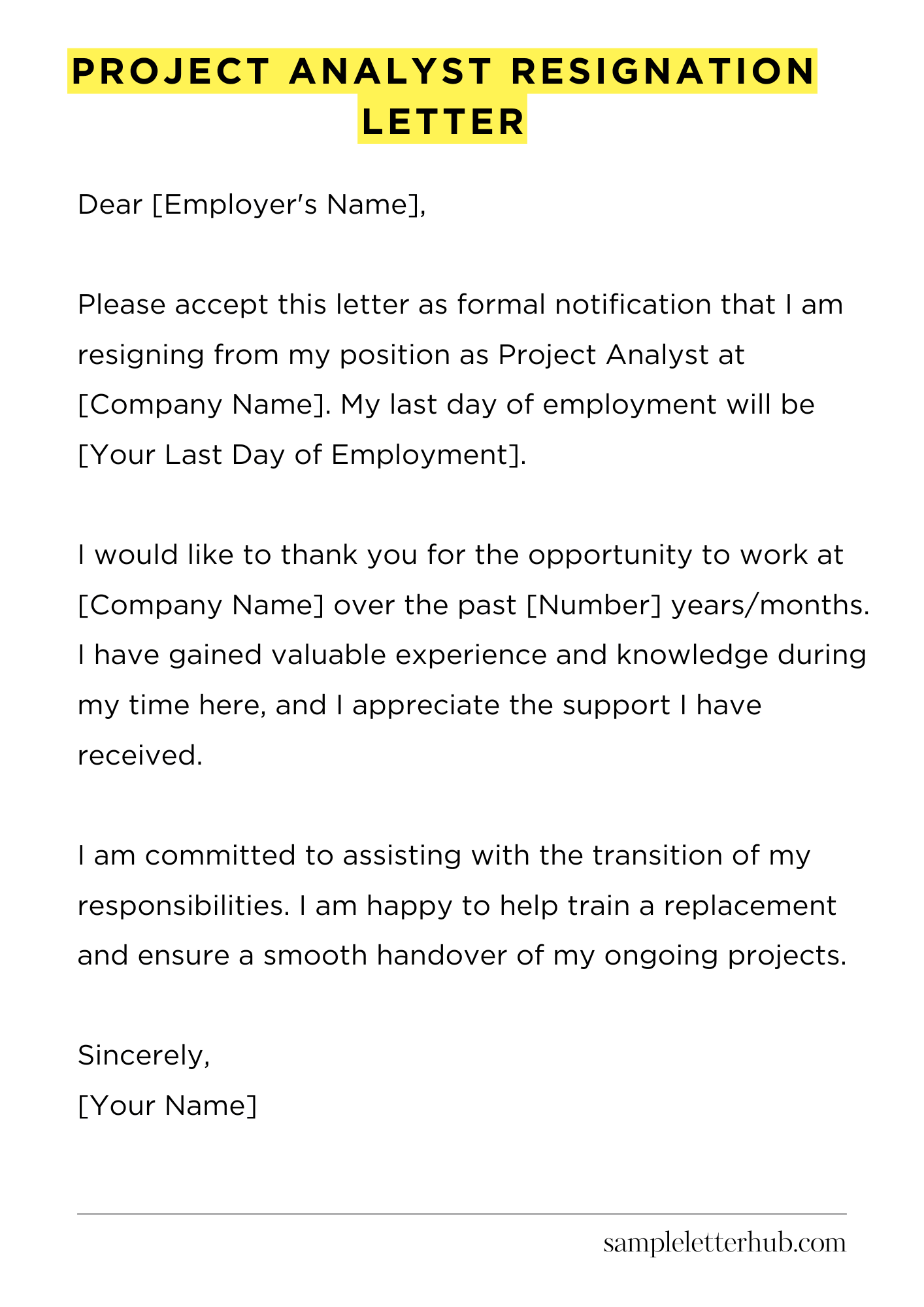
Dear [Employer’s Name],
Please accept this letter as formal notification that I am resigning from my position as Project Analyst at [Company Name]. My last day of employment will be [Your Last Day of Employment].
I would like to thank you for the opportunity to work at [Company Name] over the past [Number] years/months. I have gained valuable experience and knowledge during my time here, and I appreciate the support I have received.
I am committed to assisting with the transition of my responsibilities. I am happy to help train a replacement and ensure a smooth handover of my ongoing projects. Please let me know how I can be of assistance during this period.
I wish you and [Company Name] all the best in the future.
Sincerely,
[Your Name]
How to Write a Project Analyst Resignation Letter
1. Why is a Resignation Letter Necessary?
Leaving a job is a big step. And, a well-crafted resignation letter is absolutely essential. It’s more than just a formality. Think of it as your official notice to your employer. It creates a clear record of your departure. Moreover, it allows you to leave on good terms. You’ll want to preserve professional relationships, right? This letter serves as your formal record.
2. Essential Elements: What to Include
Okay, let’s get down to the nitty-gritty. Your letter should be concise. It needs to be professional. Start with a clear and direct statement of your intent. State your resignation. Include the date of your last day of employment. This is crucial for payroll and other administrative tasks. Next, express your gratitude for the opportunity.
Mention any specific experiences or skills you’ve gained. Briefly, mention the reasons for your departure, but keep it brief and positive. You don’t have to go into excessive detail. Offer to assist with the transition. Finally, end on a professional note. Reiterate your appreciation and wish the company well.
3. Crafting the Perfect Tone: Keep it Positive
The tone of your letter is incredibly important. Even if you’re unhappy, keep it positive. Avoid negativity. Do not air grievances. Instead, focus on expressing gratitude for the experience. Emphasize what you’ve learned. Even a brief, “I appreciate the opportunities I’ve been given,” can go a long way.
The key is to remain professional. You want to leave a good impression. Remember, the business world is small; your reputation matters. Your farewell should be graceful, not grudging.
4. Formatting and Delivery: Making it Official
Proper formatting is vital. Use a standard business letter format. Include your name, address, and the date. Address the letter to your direct supervisor or the appropriate HR representative. Use a clear and easy-to-read font, such as Times New Roman or Arial. Keep the letter concise; one page is usually enough.
Proofread your letter carefully before sending it. Check for any errors in grammar and spelling. Finally, deliver the letter in the manner your company prefers. This usually includes a physical copy to your supervisor and HR.
5. Examples and Templates: Ready to Go!
Need some help getting started? Here’s a basic template you can adapt. Remember to customize it with your specific details. Begin by stating your intent to resign, followed by your last day of employment. Express your gratitude. Mention any positive experiences. Offer assistance with the transition.
End by reiterating your thanks. With a template, it simplifies the writing process. Remember to keep it clear, concise, and professional. With a little effort, you can create a resignation letter that reflects well on you. Now, it’s time to start writing!
FAQs about Project Analyst Resignation Letter
What is the primary purpose of a Project Analyst resignation letter?
The primary purpose of a Project Analyst resignation letter is to formally notify your employer of your intention to leave your position. It serves as an official record of your departure and helps to initiate the handover process.
Additionally, it provides an opportunity to express gratitude, state your reason for leaving (optional), and ensure a smooth transition for your employer and colleagues.
What key information should be included in a Project Analyst resignation letter?
A well-written resignation letter should include your official resignation date, your name and the position you hold. It can be more effective to include a brief statement of your intention to resign, expressed politely.
Optional information includes a concise reason for leaving (if you wish to share it), a thank you for the opportunity, and an offer to assist with the transition process, such as training your replacement or completing outstanding tasks.
How should I format my Project Analyst resignation letter?
The format of your resignation letter should be professional and easy to read. Typically, it should be a business letter format. Include your contact information (name, address, email, and phone number) at the top, followed by the date, and your manager’s or HR department’s contact information.
Use a formal salutation (e.g., “Dear [Manager’s Name]”), state your intention to resign clearly, and conclude with a professional closing (e.g., “Sincerely” or “Best regards”), and your signature.
Is it necessary to provide a reason for resigning in the letter?
While not strictly required, providing a reason for your resignation is often a good practice. However, you are not obligated to disclose detailed personal information.
A general statement, such as “to pursue other opportunities,” “for personal reasons,” or “to accept a new position,” is sufficient. Ensure the language used is professional and avoids negativity, as the letter will become a part of your employment record.
How much notice should I give in my Project Analyst resignation letter?
The amount of notice you should give is usually specified in your employment contract or company policy. Typically, it ranges from two to four weeks. Always adhere to the required notice period to maintain a professional reputation and ensure a smooth transition. If your contract doesn’t specify, two weeks is a generally accepted standard.
It’s always best to check your employment agreement or consult with your HR department.
Related:
Resignation letter due to rude boss
Resignation letter moving to another state
Resignation letter due to illness of family member
Resignation letter due to study