

A Media Specialist resignation letter is a formal document. It informs your employer that you are leaving your job. The letter states your last day of employment. It also helps you depart professionally.
Writing a resignation letter can feel tricky. We’ve got you covered. This article offers several templates. They’re designed for Media Specialists like you. These examples will help you craft your own perfect letter.
Need to say goodbye to your current role? Explore the samples. They cover different situations and styles. Find the one that suits your needs. Then, tailor it to your specific circumstances.
Media Specialist Resignation Letter
Below is a sample of a Media Specialist Resignation Letter:
[Your Name]
[Your Address]
[Your Phone Number]
[Your Email Address]
[Date]
[Employer’s Name]
[Company Name]
[Company Address]
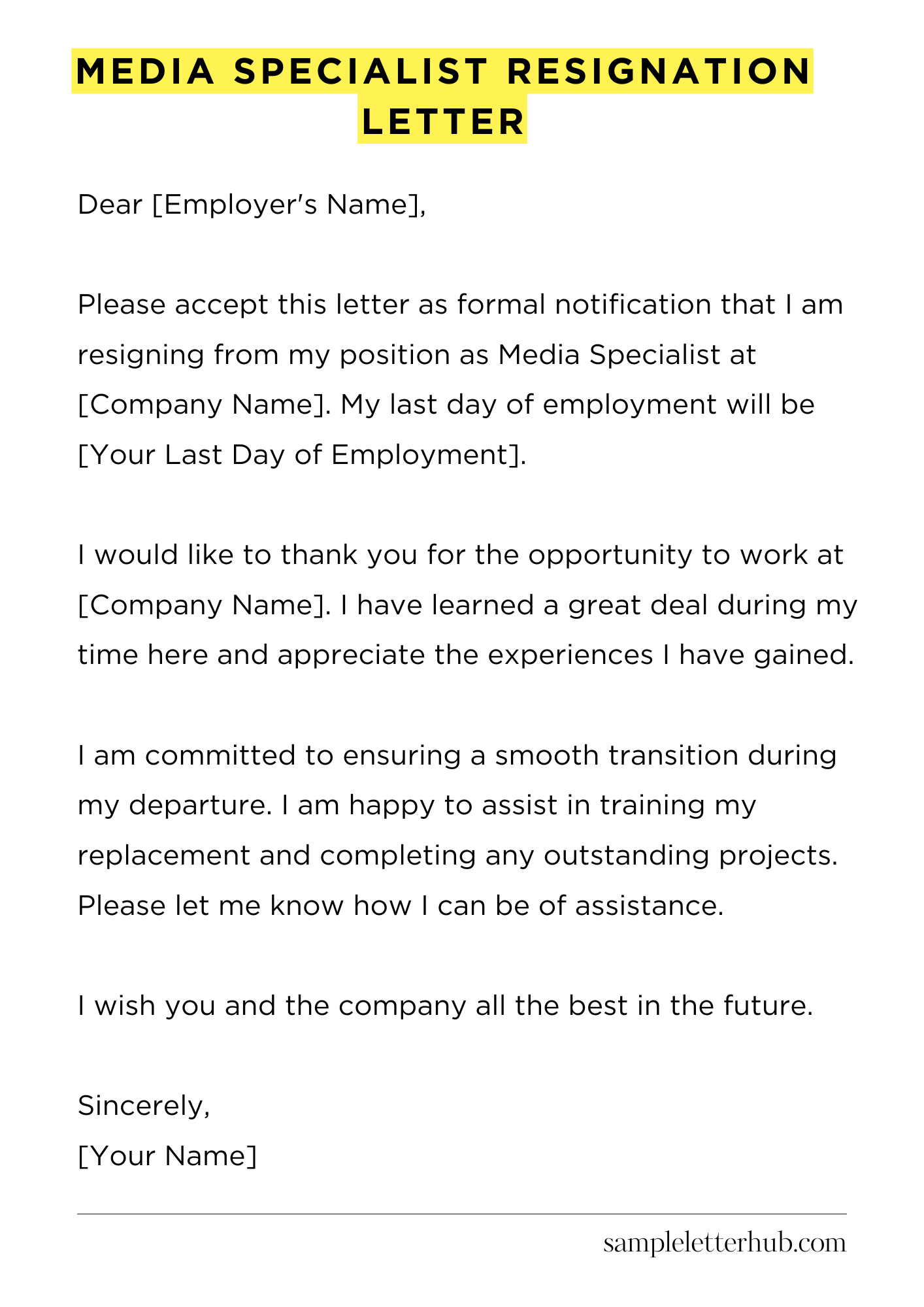
Dear [Employer’s Name],
Please accept this letter as formal notification that I am resigning from my position as Media Specialist at [Company Name]. My last day of employment will be [Your Last Day of Employment].
I would like to thank you for the opportunity to work at [Company Name]. I have learned a great deal during my time here and appreciate the experiences I have gained.
I am committed to ensuring a smooth transition during my departure. I am happy to assist in training my replacement and completing any outstanding projects. Please let me know how I can be of assistance.
I wish you and the company all the best in the future.
Sincerely,
[Your Name]
How to Write a Media Specialist Resignation Letter
1. Why Resign and Why Bother With a Letter?
So, you’re ready to move on. Maybe you’ve got a better offer, or perhaps you’re simply burnt out. Whatever the reason, resigning from your role as a Media Specialist is a big step.
Now, you need to write a resignation letter, right? Absolutely! You might be thinking it’s just a formality, a silly piece of paper. Wrong. A well-crafted resignation letter is more important than you realize. It’s your official record of leaving the company. It protects you legally. It maintains your professional reputation.
Most importantly, it can help secure a positive reference for future opportunities. Consider it a bridge, not a barrier, as you transition into your next adventure.
2. Essential Elements: What to Include
Okay, let’s get down to the nitty-gritty. What needs to be in this letter? First, keep it concise. Clarity is key. Begin with a clear statement of your resignation. State your name and your current title: Media Specialist. Then clearly state your last day of employment.
Make sure this date aligns with your employment contract or any company policies. Be aware of your notice period! Next, express your gratitude. Briefly acknowledge your experience and any positive aspects of your time at the company. This shows you’re not just leaving; you appreciate the opportunity.
Finally, and this is optional but often appreciated: Offer to assist with the transition. Offer to help train your replacement, or even help with documentation. This paints a picture of you as a dedicated and professional employee right until the very end. Your signature at the end is absolutely mandatory.
3. Structure is Key: Formatting Your Letter
Appearance matters. Your letter should look professional. Start with your contact information (name, address, phone number, email address), and the date at the top left (or right, as per preference). Next, address the letter to your direct supervisor or HR, depending on company policy.
Use a professional salutation like “Dear [Supervisor’s Name]”. Keep paragraphs short and to the point. No rambling. No emotional outbursts. Use a standard business font like Times New Roman or Arial, size 12.
Proofread, proofread, and proofread again! Check for typos, grammatical errors, and ensure the tone is appropriate. A clean, well-formatted letter reflects well on you. Always.
4. Tone and Language: What to Say (and Not Say)
The tone of your letter should be professional and positive. Avoid negativity. Do not air grievances or complaints. Leave that for exit interviews, if any. Focus on the positive aspects of your employment, or simply state that you are pursuing other opportunities. Be polite, even if you’re leaving because you can’t stand the place.
Phrases like “I have enjoyed my time here” or “I am grateful for the opportunities” go a long way. Avoid personal attacks or harsh criticism of colleagues or the company. You’re leaving, remember?
There’s no point in burning bridges. Focus on moving forward. Simple, clear language is always best. Don’t try to be overly creative; let the facts speak for themselves. You want to make a lasting impression.
5. After the Letter: What Comes Next
Congratulations, you’ve written your letter! Now, deliver it. The best practice is to give it to your supervisor directly, and then potentially to HR. Follow company protocol. After submitting your letter, be prepared for a response. Expect an exit interview. Be professional during this process.
Then, take all your personal items and say goodbye (or, “see you later”) and keep the positive outlook you have. Be prepared to answer questions about your reasons for leaving, and your future plans. If you offered to help with the transition, be prepared to follow through.
The professional you is on display now! Remain positive and cooperative. Leaving on good terms is crucial. Your reputation is incredibly valuable, both in this role and for the long term. This is your chance to close the chapter on a good note. Good luck with your next journey!
FAQs about Media Specialist resignation letter
Why is a resignation letter important for a Media Specialist?
A resignation letter serves as a formal, written notice of your intent to leave your position. It’s crucial for several reasons. Primarily, it documents the official end date of your employment, protecting both you and your employer.
It also allows you to express gratitude, which is vital for maintaining a positive professional relationship. Furthermore, the letter creates a formal record of your departure, which can be useful for references or future employment verifications.
What key elements should be included in a Media Specialist resignation letter?
A comprehensive resignation letter should include: your formal intent to resign, a clear and concise statement of your resignation, the effective date of your resignation, an expression of gratitude for the opportunity to work at the company, a brief and professional explanation (optional) of the reason for leaving, and your contact information.
It is generally advised to avoid negative or overly detailed explanations.
How should a Media Specialist address their letter and to whom should it be sent?
The letter should be addressed formally to your direct supervisor or the Human Resources department, depending on company policy. Always use the correct title and name if known. If you’re unsure, consulting with colleagues or checking company directories can help you address the letter correctly. It is also important to consider if your direct superior needs to be informed too.
What tone and language are most appropriate for a Media Specialist resignation letter?
The tone should be professional, polite, and respectful. Use clear, concise language. Avoid any negativity or criticism of your current employer or colleagues. Expressing gratitude for the opportunity to work there and highlighting positive experiences is always recommended. Maintaining a respectful tone allows for a smoother transition.
Should a Media Specialist offer to help with the transition after resigning?
Offering assistance with the transition is generally a good practice. It demonstrates professionalism and a commitment to ensuring a smooth handover of your responsibilities.
You can offer to train your replacement, document ongoing projects, or assist in any way that facilitates the company’s continued operations. However, this is optional, and the extent of your assistance may depend on your time constraints and employer’s needs.
Related:
Resignation letter due to rude boss
Resignation letter moving to another state
Resignation letter due to illness of family member
Resignation letter due to study