

A “Junior Web Developer resignation letter” is a formal document. It informs your current employer that you are quitting. The letter states your official last day of employment. It’s the first step in leaving your job professionally.
Need to resign from your Junior Web Developer role? Writing a resignation letter can feel tricky. Don’t worry, it doesn’t have to be. We’ve got you covered.
We’ll share examples and templates. You can customize them. This makes writing your own letter a breeze. Find the perfect words to move on to your next opportunity.
Junior Web Developer Resignation Letter
Below is a sample of a Junior Web Developer Resignation Letter:
[Your Name]
[Your Address]
[Your Phone Number]
[Your Email Address]
[Date]
[Employer’s Name]
[Employer’s Title]
[Company Name]
[Company Address]
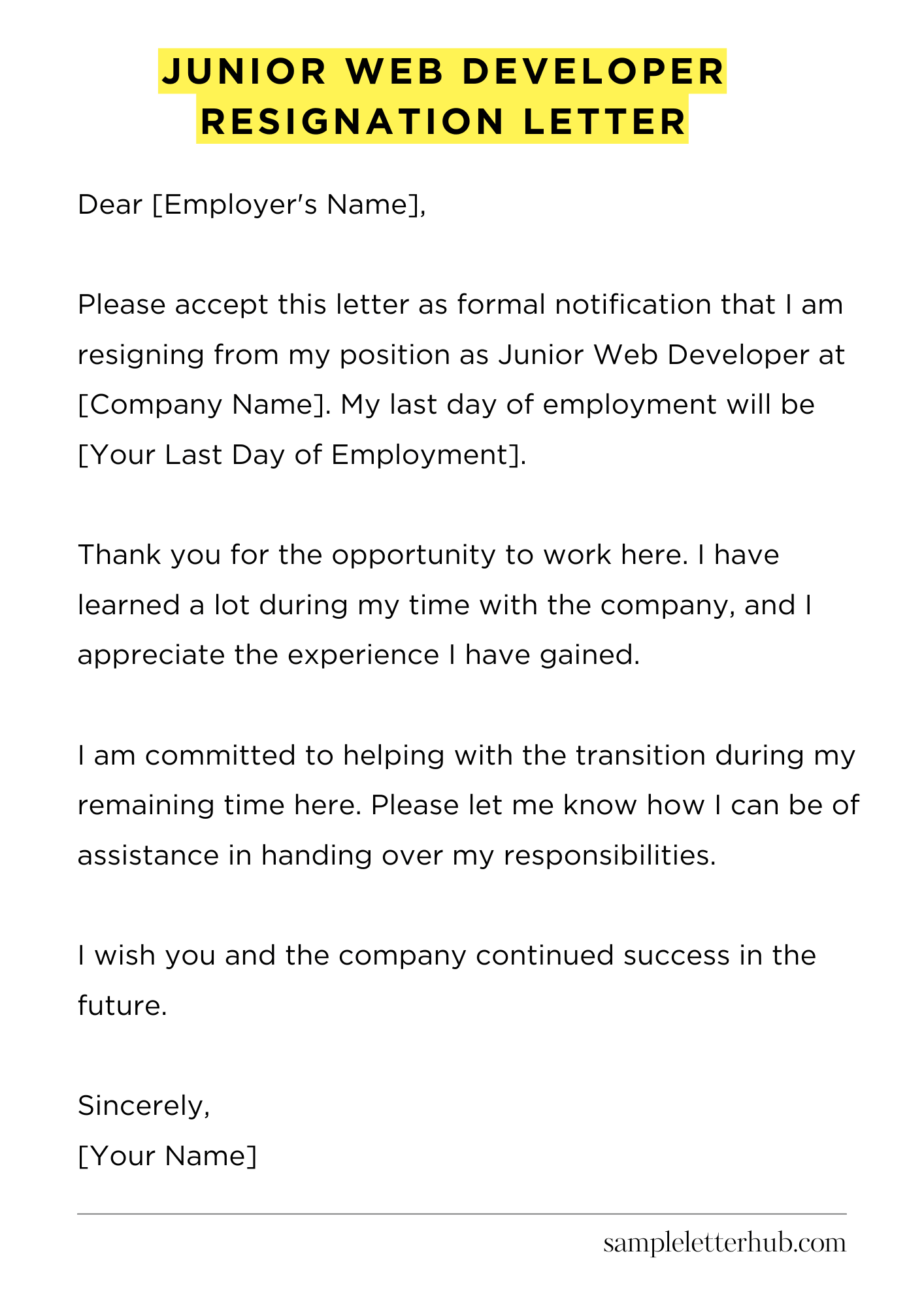
Dear [Employer’s Name],
Please accept this letter as formal notification that I am resigning from my position as Junior Web Developer at [Company Name]. My last day of employment will be [Your Last Day of Employment].
Thank you for the opportunity to work here. I have learned a lot during my time with the company, and I appreciate the experience I have gained.
I am committed to helping with the transition during my remaining time here. Please let me know how I can be of assistance in handing over my responsibilities.
I wish you and the company continued success in the future.
Sincerely,
[Your Name]
How to Write a Junior Web Developer Resignation Letter
1. Why Resign, And Why Does It Matter?
So, you’ve decided to move on. That’s a big decision, right? Perhaps you’ve landed a better offer. Maybe you’re seeking a different environment or a new challenge. It’s also possible you are leaving for personal reasons. Whatever the motivation, the resignation letter is your official departure notice.
This document serves as a formal declaration to your employer. It’s important to get it right. It’s also a key step in professional etiquette. Why does it matter? It sets the tone for your exit. It preserves relationships. It’s a bridge, not a scorched-earth policy. A well-written letter can leave a positive lasting impression. This could prove invaluable in the future.
2. The Essential Components: What to Include.
A good resignation letter is concise and professional. You should keep it simple and straightforward. Think of it as a roadmap of your departure. First, include your name, address, and the date. Next, identify the recipient. Use their name and title (e.g., “Mr. John Smith, Web Development Manager”).
Then, get to the point. State your intent to resign, and make it clear. Next, state your last day of employment. This is crucial for the company to manage your workload and other responsibilities. Show a little gratitude. A simple thank you for the opportunity goes a long way.
Briefly mention any projects or experiences you appreciate. It will be helpful to offer assistance during the transition. Offer to help train a replacement or complete outstanding tasks. Finally, end with a polite closing, like “Sincerely” or “Best regards”, followed by your typed name.
3. Crafting the Perfect Tone: Keep it Professional.
The tone of your letter is incredibly important. You’re leaving, but you want to maintain a professional relationship. Avoid negativity at all costs. Don’t use the letter as an opportunity to complain. Even if you have criticisms, save them for an exit interview (if there is one). Instead, focus on positive and neutral statements.
Use a professional and polite tone throughout. Proofread the letter carefully. Check for grammar errors and typos. These small things can reflect on your level of professionalism. Remember, this letter is a reflection of you.
4. Sample Template: A Practical Example.
Let’s look at a simple template you can adapt. Start with your contact information (Name, Address, Phone Number, Email). Now, add the date. Next, add the recipient’s details (Name, Title, Company Name, Company Address). Then, the body of the letter. You can start with: “Dear [Manager’s Name],” or “Dear Mr./Ms. [Last Name],”
Then, the content:
“Please accept this letter as formal notification that I am resigning from my position as Junior Web Developer at [Company Name]. My last day of employment will be [Your Last Day].
Thank you for the opportunity to work at [Company Name]. I have enjoyed my time here and learned a lot. I am happy to assist in the transition process. I am available to help train my replacement and complete any outstanding tasks before my departure.
Sincerely,
[Your Typed Name]”
Adjust it to fit your specific circumstances. Personalize it slightly.
5. Beyond the Letter: Next Steps After Submission.
You’ve written the letter, and now it’s time to submit it. Where to go next? Hand it in to your manager. Ensure you follow your company’s policy for resignations. Keep a copy for your records. Be prepared to discuss your resignation with your manager. Be professional and ready to answer any questions.
You will likely be asked about the reasons for your departure. Be brief and honest. During your remaining time, focus on a smooth transition. Complete your responsibilities to the best of your ability.
Be helpful to those who are taking over your work. Remember, how you leave can be just as important as how you arrived. Good luck with your next endeavor!
FAQs about Junior Web Developer Resignation Letter
What is the most important information to include in a Junior Web Developer resignation letter?
The most crucial elements are a clear statement of your resignation, your last day of employment, and a sincere expression of gratitude for the opportunity. You should also include your name, contact information, and the date.
While not mandatory, it’s beneficial to briefly mention the reason for leaving (e.g., career advancement, better opportunities) if you feel comfortable, but avoid negative comments about your current employer.
Should I provide a reason for resigning in my Junior Web Developer resignation letter?
While not strictly required, providing a brief, professional reason for leaving can be beneficial. It helps your employer understand your decision and potentially improve their retention strategies.
You can use general phrases such as “pursuing other opportunities” or “seeking career growth.” Avoid going into excessive detail or including any negative feedback about your current workplace. Always keep the tone positive and professional.
How much notice should a Junior Web Developer give when resigning?
The standard notice period is typically two weeks, as is customary in most professional settings. However, it’s essential to review your employment contract or company handbook, which might specify a longer notice period.
If no specific notice period is outlined, two weeks is generally the expected minimum. Adhering to the agreed-upon timeframe demonstrates professionalism and allows for a smooth transition.
What tone and language should I use in a Junior Web Developer resignation letter?
Maintain a professional and respectful tone throughout the letter. Use clear, concise language and avoid any negativity or personal attacks. Express your gratitude for the experience and opportunities provided by the company.
Focus on your future, not on past issues. Proofread carefully to eliminate any errors in grammar or spelling, as this reflects on your professionalism and attention to detail.
Should I offer assistance with the transition in my Junior Web Developer resignation letter?
Offering assistance with the transition is a thoughtful gesture and often appreciated. You can state your willingness to help train your replacement, document your work, or answer any questions during your remaining time.
This demonstrates your commitment to a smooth handover and leaves a positive impression, increasing your chances of a favorable reference. However, do not over promise and be realistic about your availability.
Related:
Resignation letter due to rude boss
Resignation letter moving to another state
Resignation letter due to illness of family member
Resignation letter due to study