

Facing a career change? Thinking of leaving your role as an Admissions Advisor? You’ll need a formal resignation letter. This document officially notifies your employer of your departure. It outlines your last day of employment.
Writing a resignation letter can feel daunting. But it doesn’t have to be! We’re here to help make the process smooth. We’ve compiled various templates and examples. These samples cover different situations. They provide a solid foundation for your own letter.
Ready to start crafting your resignation? Explore the options. Adapt them to fit your specific needs. Let’s make this step as easy as possible!
Admissions Advisor Resignation Letter
Below is a sample of a Admissions Advisor Resignation Letter:
[Your Name]
[Your Address]
[Your Phone Number]
[Your Email Address]
[Date]
[Admissions Advisor’s Manager Name]
[Admissions Department]
[University Name]
[University Address]
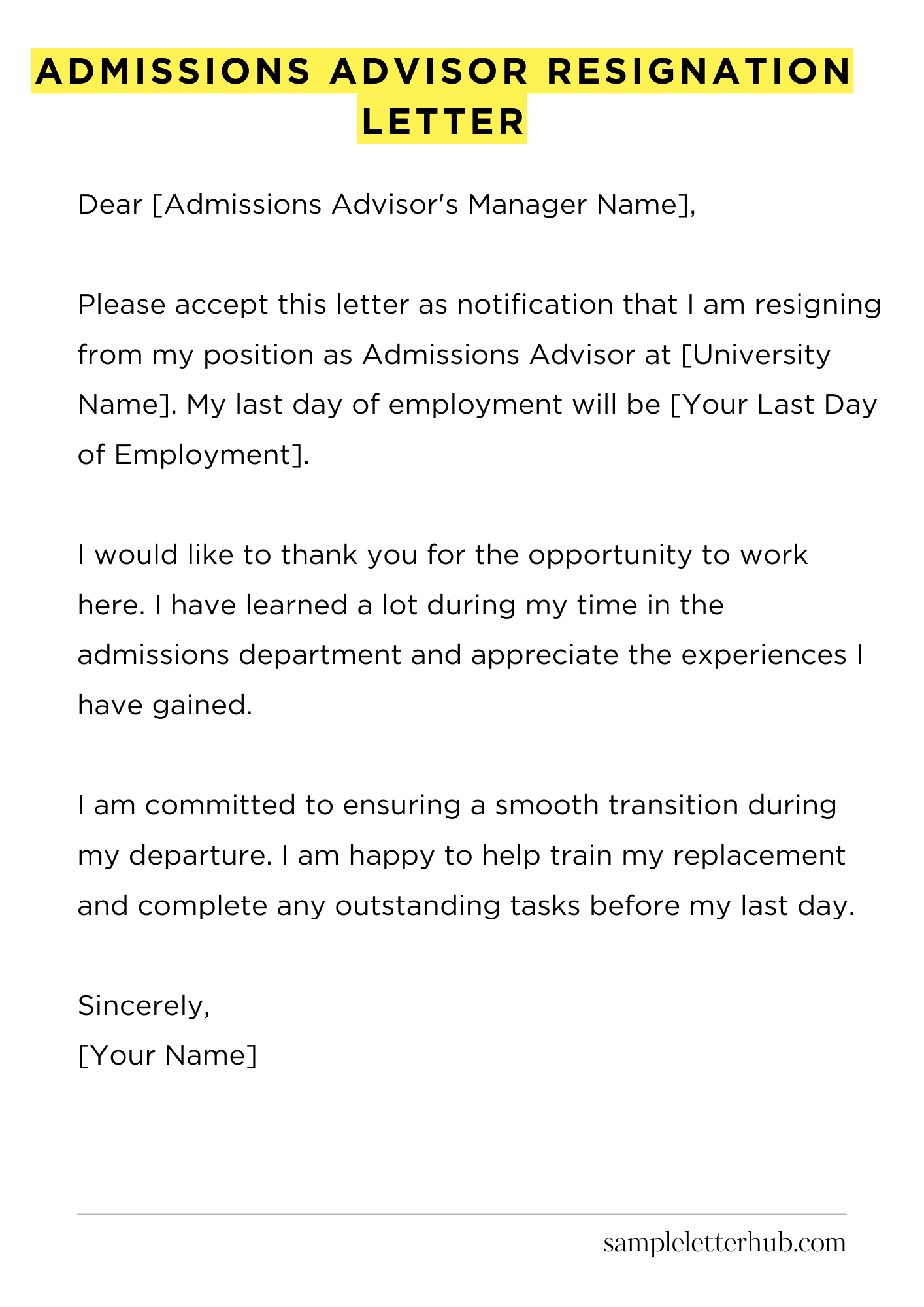
Dear [Admissions Advisor’s Manager Name],
Please accept this letter as notification that I am resigning from my position as Admissions Advisor at [University Name]. My last day of employment will be [Your Last Day of Employment].
I would like to thank you for the opportunity to work here. I have learned a lot during my time in the admissions department and appreciate the experiences I have gained.
I am committed to ensuring a smooth transition during my departure. I am happy to help train my replacement and complete any outstanding tasks before my last day.
I wish you and the university all the best in the future.
Sincerely,
[Your Name]
How to Write Admissions Advisor Resignation Letter
1. Grasping the Basics: Why a Resignation Letter Matters
So, you’re moving on. That’s great! Resigning from your role as an Admissions Advisor is a significant step. And a well-crafted resignation letter? It’s absolutely crucial. Think of it as your official farewell, a documented record of your departure from the institution.
This is more than just a formality, it’s a professional courtesy. It ensures a smooth transition for both you and your former employer. A bad letter can cause issues down the road. It shows respect for your colleagues and provides an opportunity to leave a positive lasting impression.
2. Essential Elements: What to Include
Now, let’s get down to the practicalities. Your resignation letter needs a few key components. Start with the date. Then, clearly state your intent to resign, including your job title (Admissions Advisor). Next, the most important element: your effective date of resignation.
This is the date you are officially ending your employment. Keep it concise. Express your gratitude for the opportunity. You can briefly mention any positive experiences you’ve had. If you wish to give any reasons for leaving, keep it brief, professional and focused. Conclude with a polite closing, such as “Sincerely” or “Respectfully,” followed by your name and signature.
3. Formatting for Success: Structure and Tone
Good formatting adds a lot of value to your letter. Keep it clean and professional. Use a standard business letter format. The tone should be positive and respectful.
Avoid any negativity or complaints. Remember, you’re leaving a lasting impression. Keep it brief. Address the letter to your direct supervisor or the appropriate HR representative. Use clear and concise language. Proofread, proofread, and proofread again! Check for any spelling or grammatical errors. This shows attention to detail.
4. Crafting the Content: Sample Phrases and Examples
Let’s look at some examples you can use to compose your letter. For stating your resignation: “Please accept this letter as formal notification that I am resigning from my position as Admissions Advisor.” For expressing gratitude: “I am grateful for the opportunities I’ve had during my time at [Institution Name].”
For the effective date: “My last day of employment will be [Date].” You can even mention a willingness to assist with the transition: “I am happy to assist in training my replacement during my remaining time here.” Remember to adapt these phrases to your personal circumstances. Tailor it to the specific environment you are leaving.
5. After the Letter: Final Considerations and Next Steps
So, you’ve written the perfect resignation letter. Now what? Deliver it to the appropriate person, following your company’s policy. Make sure you keep a copy for your records. Be prepared for a conversation with your supervisor.
They may ask about your reasons for leaving. Prepare for this conversation beforehand. Be professional and positive. Finally, focus on a smooth transition. Be helpful to your colleagues. Your departure will reflect upon you, and upon your colleagues. Your aim is to ensure all is well upon your departure.
FAQs about Admissions Advisor resignation letter
How do I start my resignation letter as an Admissions Advisor?
Begin with a clear and concise statement of your intent to resign, including the effective date of your departure. Briefly state your position (Admissions Advisor) and the name of the institution. For example: “Please accept this letter as formal notification that I am resigning from my position as Admissions Advisor at [Institution Name], effective [Date].”
What key information should be included in an Admissions Advisor resignation letter?
Aside from the intent to resign and the effective date, include a brief expression of gratitude for the opportunity. It’s also helpful to offer assistance during the transition period. Briefly mention any handover plans, if applicable. Keep the tone professional and positive.
Should I provide a reason for my resignation in the letter?
While not mandatory, it is often considered a professional courtesy. You can provide a brief reason, such as pursuing a new opportunity or a change in career goals. Keep it concise and avoid negativity. If you choose not to provide a reason, that’s perfectly acceptable as well. “I am pursuing other opportunities” or “To explore new career interests” are acceptable statements.
How do I express gratitude in my resignation letter?
Expressing gratitude is important. Acknowledge the opportunity you were given and express appreciation for your time at the institution. You can mention specific experiences or people you’ve worked with.
For example: “I am grateful for the opportunities I have been given at [Institution Name] during my time here.” or “I would like to express my sincere gratitude for the experience I have gained while working at [Institution Name] as an Admissions Advisor”.
What should I do after submitting my resignation letter?
After submitting the letter, be prepared to discuss your resignation with your supervisor. Offer your assistance in the transition process, such as training your replacement or completing outstanding tasks. Be professional and cooperative throughout the transition period. Make sure you also collect any personal items and complete any necessary exit procedures.
Related:
Resignation letter due to rude boss
Resignation letter moving to another state
Resignation letter due to illness of family member
Resignation letter due to study