

So, you’re a Program Supervisor and you’re ready to move on. A Program Supervisor resignation letter is how you officially inform your employer of your departure. It’s a formal document. It clearly states your intention to leave your position. This letter is a crucial step in the process.
Feeling overwhelmed? Don’t worry, we’ve got you covered. We’ll provide a variety of resignation letter templates. These are tailored for Program Supervisors. Think of them as your secret weapon. They are designed to help you craft the perfect letter.
Ready to start writing? We’ll give you examples. You can adapt them to your specific situation. This guide simplifies the process. It helps you leave your job with professionalism.
Program Supervisor Resignation Letter
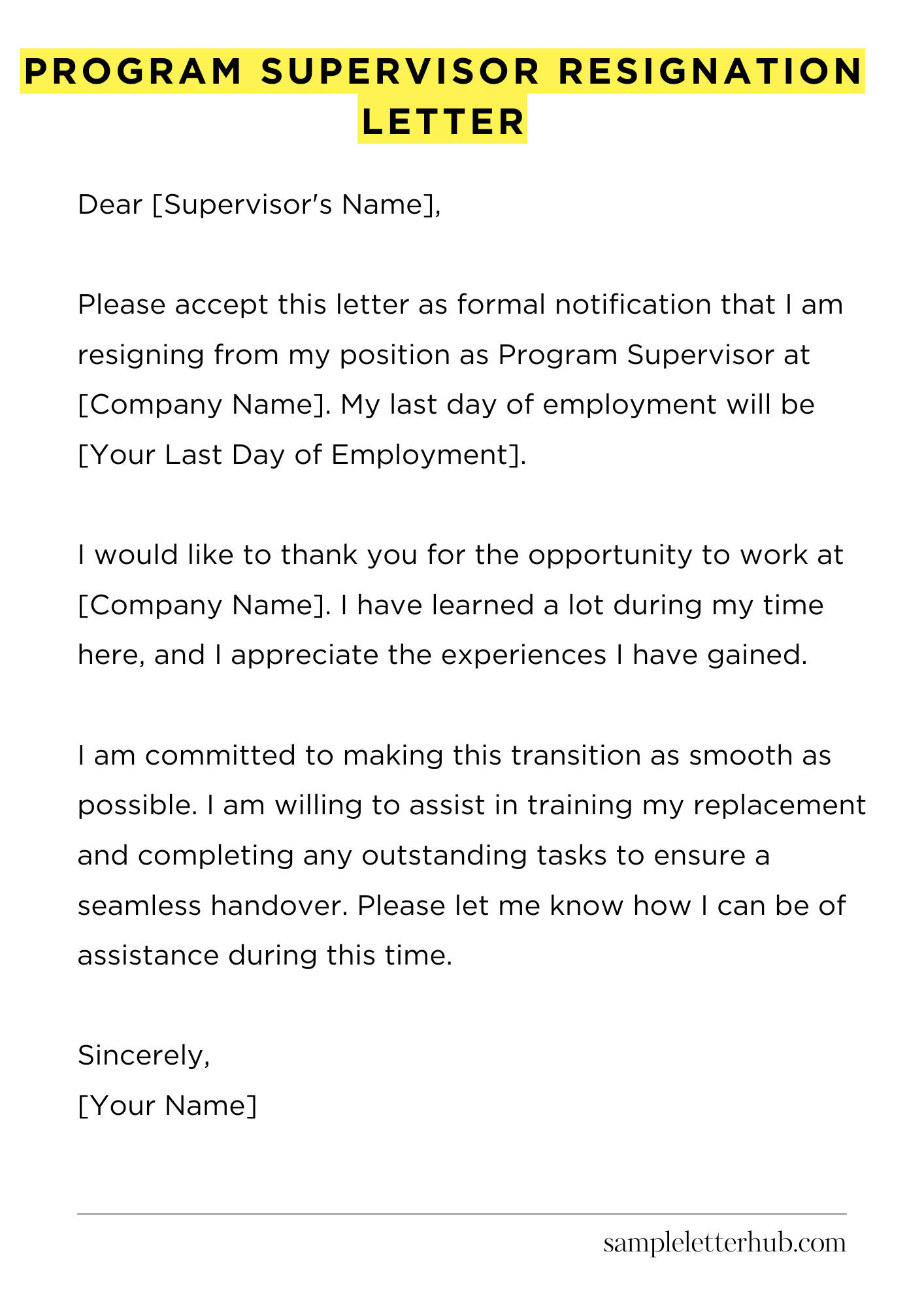
Below is a sample of a Program Supervisor Resignation Letter:
[Your Name]
[Your Address]
[Your Phone Number]
[Your Email Address]
[Date]
[Supervisor’s Name]
[Supervisor’s Title]
[Company Name]
[Company Address]
Dear [Supervisor’s Name],
Please accept this letter as formal notification that I am resigning from my position as Program Supervisor at [Company Name]. My last day of employment will be [Your Last Day of Employment].
I would like to thank you for the opportunity to work at [Company Name]. I have learned a lot during my time here, and I appreciate the experiences I have gained.
I am committed to making this transition as smooth as possible. I am willing to assist in training my replacement and completing any outstanding tasks to ensure a seamless handover. Please let me know how I can be of assistance during this time.
I wish you and [Company Name] all the best in the future.
Sincerely,
[Your Name]
How to Write Program Supervisor Resignation Letter
1. Why Resign Anyway?
So, you’re thinking about quitting your job as a Program Supervisor. This is a big decision, right? Sometimes, it is the right call! Maybe you found a better opportunity, or perhaps your current role isn’t the best fit. There could be numerous reasons, from a difficult work environment to personal growth aspirations.
Whatever the impetus, before you put pen to paper (or fingers to keyboard), take some time to reflect. Be absolutely sure that this resignation is the correct step. Think about everything. Consider all angles. Leaving a job requires a well-thought-out plan, starting with a clear understanding of *why* you’re leaving.
2. Essential Elements: What to Include
Now, let’s get down to the brass tacks: what should your resignation letter actually say? It’s more than just a quick goodbye. Your letter is a professional document, and you want to leave a good impression, regardless of your reasons for leaving.
- Your Name and Contact Information: Start with your basic details. This includes your name, address, phone number, and email. This is standard professional practice.
- Date: Always include the date you’re writing the letter.
- Recipient Information: Who are you addressing the letter to? Include their name and title, as well as the company address.
- Formal Salutation: Use a professional greeting, such as “Dear [Manager’s Name]”.
- Clear Statement of Resignation: The most important part! State your intention to resign. Be direct. Example: “Please accept this letter as formal notification that I am resigning from my position as Program Supervisor.”
- Effective Date of Resignation: State when your last day of employment will be. This should align with your employment contract or any company policies. Give adequate notice. This is courteous.
- Brief Reason (Optional, but Often Recommended): You aren’t *required* to give a reason, but it’s often a good idea to briefly mention why you’re leaving. You can keep it general, like, “I am pursuing other opportunities.” Or, “I have accepted a position at another company”. Keep it positive.
- Expression of Gratitude: Thank your employer for the opportunity. Acknowledge what you’ve learned or the experience you’ve gained.
- Offer of Assistance: Offer to help with the transition. This shows you are professional and cooperative. You might offer to train a replacement or assist with transferring your duties.
- Formal Closing: Use a professional closing such as “Sincerely,” or “Respectfully,” followed by your signature (if submitting a physical letter) and your typed name.
3. Formatting Your Letter: Making a Good Impression
The layout of your letter matters! Poor formatting can detract from your message. It’s a key part of your professionalism. Here’s a quick guide to formatting your resignation letter:
- Use a standard business letter format. This usually includes single spacing, left-aligned text, and block paragraphs (no indentation for the first line of each paragraph).
- Keep it concise. Aim for one page, if possible. Don’t ramble.
- Use a professional font. Times New Roman, Arial, or Calibri are all good choices.
- Proofread carefully! Check for spelling and grammatical errors. Errors damage your credibility.
4. Dos and Don’ts: Things to Remember
Navigating the resignation process requires a bit of finesse. Here are some key “dos” and “don’ts” to keep in mind:
- Do: Give adequate notice, typically two weeks, unless your contract specifies otherwise.
- Do: Be professional and respectful, even if you’re not happy with your job.
- Do: Keep your letter positive and forward-looking.
- Do: Keep a copy of your letter for your records.
- Don’t: Burn bridges. Avoid making negative comments about your employer or colleagues.
- Don’t: Resign via email without a formal letter (unless specifically instructed otherwise).
- Don’t: Include unnecessary details.
- Don’t: Expect immediate feedback or a response from your manager.
5. After the Letter: What Comes Next?
So, you’ve written and submitted your letter. Now what? Remember that the resignation letter is only the first step.
- Meet with your manager. Be prepared to discuss your departure.
- Follow company procedures. You’ll likely need to complete an exit interview.
- Complete any handover tasks. Help to make the transition as smooth as possible.
- Maintain professionalism until your last day. Remember that you are still representing yourself!
Resigning from any job can be complex, but by following these guidelines, you can ensure a smooth and professional transition. Good luck with your future endeavors!
FAQs about Program Supervisor resignation letter
How much notice should I give when resigning as a Program Supervisor?
The standard notice period for a Program Supervisor typically aligns with company policy or employment contracts. However, a minimum of two weeks is generally considered professional.
Longer notice periods, such as a month or more, might be necessary based on your specific contract or the seniority of your role, providing the organization ample time to find a replacement and ensure a smooth transition.
What key information should be included in a Program Supervisor resignation letter?
A well-crafted resignation letter for a Program Supervisor should include: a clear statement of your resignation, the effective date of your departure, a concise reason for leaving (optional but often beneficial), an expression of gratitude for the opportunity, and an offer to assist with the transition. It’s also wise to include your contact information for any follow-up.
Can I provide a reason for resigning in my letter? If so, what is the best approach?
Yes, you can provide a reason for resigning, but it’s not always required. If you choose to, keep it brief and professional. Common reasons include accepting a new opportunity, pursuing personal interests, or citing a specific issue such as wanting to work in a different industry. Avoid negative language or overly detailed complaints.
Focus on your future goals or the positive aspects of the change.
How should I handle outstanding projects and responsibilities in my resignation letter?
Your resignation letter should demonstrate your commitment to a smooth transition. Consider including a statement expressing your willingness to assist in training your replacement or transferring knowledge.
Briefly outline the steps you’ll take to complete pending projects, or, if handover is required, indicate your availability to support this. Suggest a clear timeline and offer to collaborate with your employer to make sure no gaps in coverage occur.
Should I ask for a letter of recommendation in my resignation letter?
It’s generally not necessary to explicitly request a letter of recommendation in your resignation letter. It is a good practice to ask for it after a formal meeting with your manager.
If you have a positive relationship with your supervisor, you can hint at a recommendation by mentioning your gratitude for the opportunity to work and learn. Following your resignation, you can separately and formally request a letter of recommendation.
Related:
Resignation letter due to rude boss
Resignation letter moving to another state
Resignation letter due to illness of family member
Resignation letter due to study