

A Field Engineer resignation letter is a formal document. It informs your employer that you are leaving your job. The letter states your last day of employment. It also helps to maintain a professional relationship.
Crafting a resignation letter can be tricky. This article offers guidance. We provide various templates and examples. These are tailored for Field Engineers.
Need to say goodbye? These samples make the process easier. Choose the one that suits your needs. Use them as a starting point. Let’s make writing your letter simple.
Field Engineer Resignation Letter
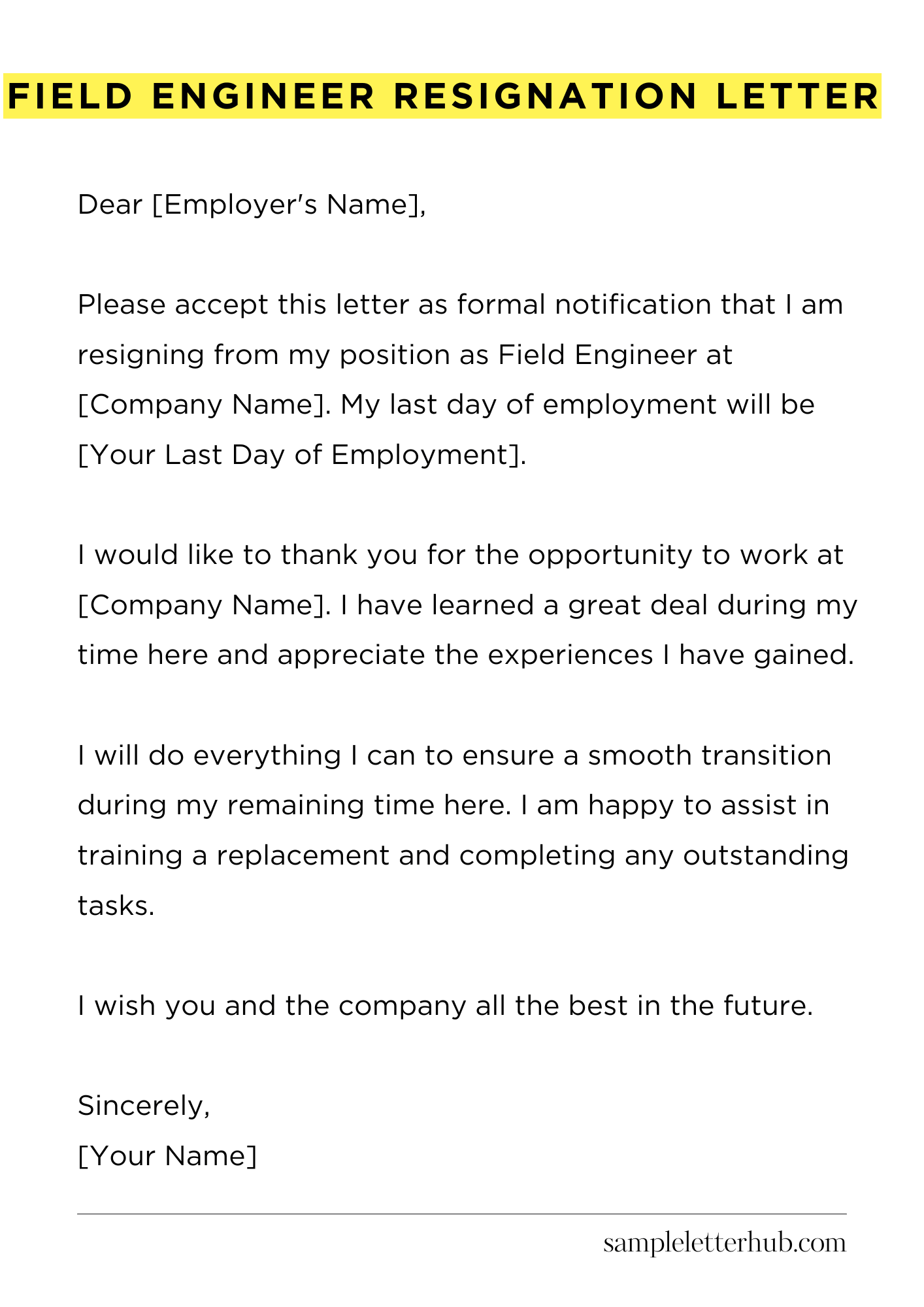
Below is a sample of a Field Engineer Resignation Letter:
[Your Name]
[Your Address]
[Your Phone Number]
[Your Email Address]
[Date]
[Employer’s Name]
[Employer’s Title]
[Company Name]
[Company Address]
Dear [Employer’s Name],
Please accept this letter as formal notification that I am resigning from my position as Field Engineer at [Company Name]. My last day of employment will be [Your Last Day of Employment].
I would like to thank you for the opportunity to work at [Company Name]. I have learned a great deal during my time here and appreciate the experiences I have gained.
I will do everything I can to ensure a smooth transition during my remaining time here. I am happy to assist in training a replacement and completing any outstanding tasks.
I wish you and the company all the best in the future.
Sincerely,
[Your Name]
How to Write a Field Engineer Resignation Letter
So, you’re moving on. Leaving the world of on-site troubleshooting, circuit board diagnostics, and the delightful mystery of intermittent network outages? Congratulations! Whether it’s a better opportunity, a career change, or just a need for a change of scenery, resigning from your Field Engineer position is a significant step.
To make this transition as smooth as possible, a well-crafted resignation letter is essential. It’s more than just a formality; it’s a professional courtesy that sets the stage for a positive departure.
1. Start with Clarity: The Basics
Your resignation letter should be concise and direct. The main purpose is to officially inform your employer of your decision to leave and to specify your last day of employment. Begin with a polite, professional tone. Include the date and the recipient’s name and title. This shows respect and attention to detail.
Next, clearly state your intent to resign from your position as Field Engineer. It’s also important to explicitly mention your last day of work. Make it easy for them. Keep it factual.
2. Expressing Gratitude: The Power of Thank You
Even if your time with the company wasn’t always perfect, expressing gratitude is highly recommended. It’s a good way to maintain a positive relationship. A simple “Thank you for the opportunity to have worked here” or “I appreciate the experience I’ve gained during my time at [Company Name]” goes a long way.
This acknowledgement demonstrates professionalism and reflects well on your character. It’s a small thing that leaves a big impact.
3. Providing Assistance: Ensuring a Smooth Transition
Offer your assistance in the transition process. This shows your commitment to a smooth handover. Mentioning your willingness to help train your replacement, complete any outstanding tasks, or transfer knowledge is a great asset. Consider offering to document procedures or provide contact information for ongoing projects.
This can benefit both the company and your own reputation. Consider what you can do. Doing this will leave a lasting positive impression.
4. Keep it Short and Sweet: Focus on the Essentials
Avoid unnecessary details or negativity in your resignation letter. It is a formal document and not a place to vent frustrations. Focus solely on the essential information: your resignation, your last day, expressions of gratitude, and your willingness to assist with the transition. Refrain from long-winded explanations for your departure.
Be clear, concise, and professional. This will make it easier for them to move on. Keep your writing clear, crisp and to the point.
5. Proofreading and Formatting: The Final Polish
Before submitting your letter, proofread it carefully for any grammatical errors or typos. Poorly written communication reflects poorly on you. Ensure your letter is formatted correctly, with a professional font and clear spacing. Consider printing the letter and signing it by hand, then sending it to your manager.
This adds a personal touch and reinforces the formality of the document. You want to finish strong. Get it right before sending it.
FAQs about Field Engineer Resignation Letter
What is the primary purpose of a Field Engineer resignation letter?
The primary purpose of a Field Engineer resignation letter is to formally notify your employer of your intention to leave your position. It serves as an official record of your departure and helps to initiate the handover process, ensuring a smooth transition for both you and the company.
What key information should be included in a Field Engineer resignation letter?
A well-crafted Field Engineer resignation letter should include your formal announcement of resignation, the effective date of your last day of employment, a brief expression of gratitude for the opportunity, and any relevant details regarding the handover of responsibilities or completion of ongoing projects.
It’s also often customary to include your contact information for future correspondence.
How much notice should a Field Engineer provide when resigning?
The required notice period for a Field Engineer resignation is typically outlined in your employment contract or company policy. Common notice periods range from two weeks to a month, but it’s crucial to adhere to the terms specified in your agreement to avoid any potential repercussions. Review your contract carefully.
Should a Field Engineer resignation letter include the reason for leaving?
While not mandatory, you can choose to briefly state your reason for leaving in your resignation letter. It is not necessary to elaborate in detail. This could be for a new opportunity, personal reasons, or other general explanations. If you choose to share your reason, keep it professional and concise.
How should a Field Engineer handle the handover of responsibilities upon resignation?
A responsible Field Engineer should facilitate a smooth transition by documenting processes, training colleagues, and ensuring that all ongoing projects are adequately addressed. Collaborating with your supervisor and team to create a handover plan and providing necessary support during the transition process are key steps to ensure minimal disruption.
Related:
Resignation letter due to rude boss
Resignation letter moving to another state
Resignation letter due to illness of family member
Resignation letter due to study