

A “Technical Director resignation letter” is a formal document. It is how you officially announce your departure. The letter informs your employer of your decision. It also states your last day of work.
Planning your exit can feel overwhelming. Don’t worry, we’ve got you covered. This article offers helpful templates. We’ll share several examples. You can adapt them to your specific situation.
These samples will guide you. Writing a professional resignation letter is now easy. Craft a clear and concise message. Smoothly transition to your next chapter.
Technical Director Resignation Letter
Below is a sample of a Technical Director Resignation Letter:
[Your Name/Address]
[Your Phone Number]
[Your Email Address]
[Date]
[Recipient Name/Title]
[Company Name]
[Company Address]
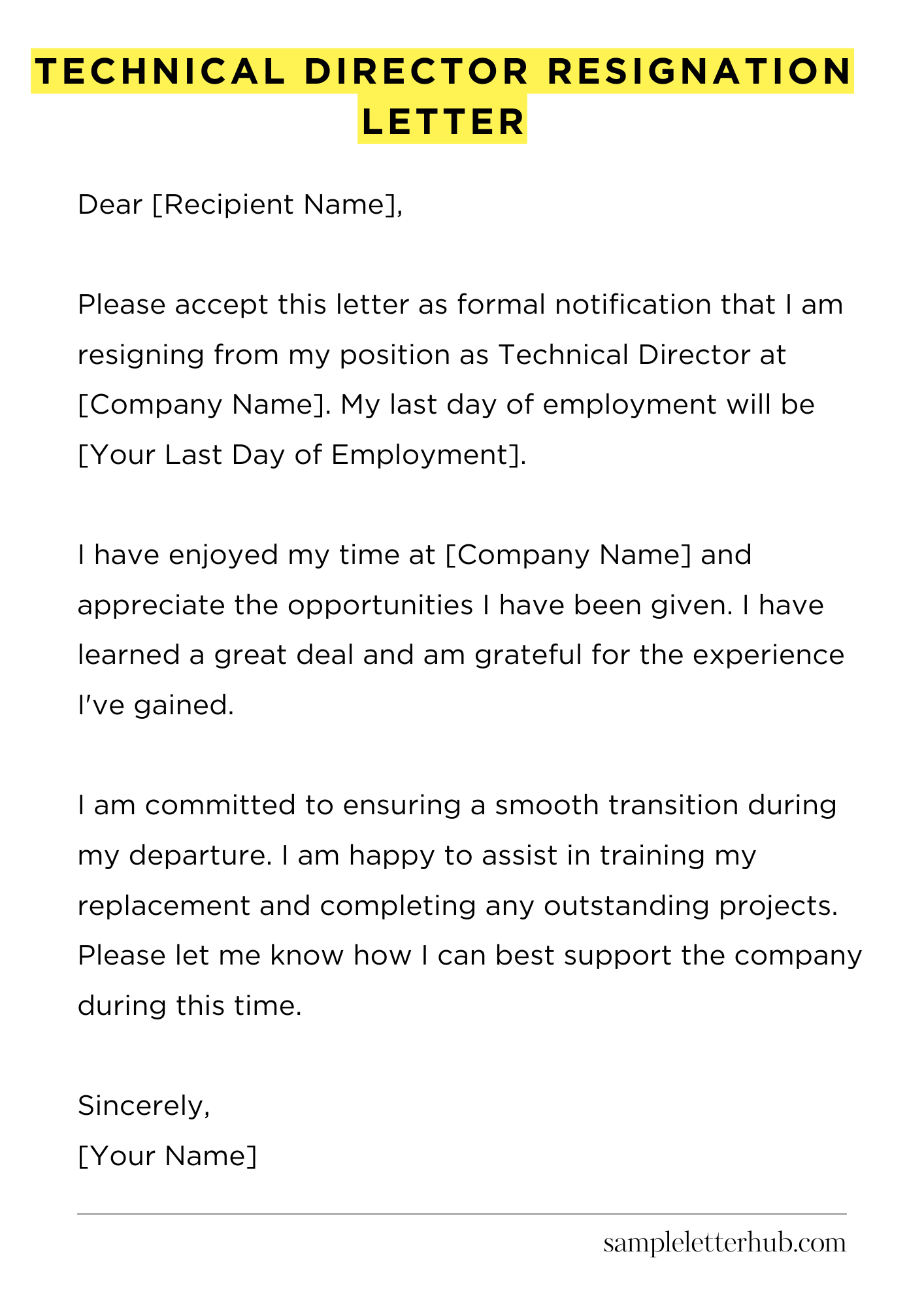
Dear [Recipient Name],
Please accept this letter as formal notification that I am resigning from my position as Technical Director at [Company Name]. My last day of employment will be [Your Last Day of Employment].
I have enjoyed my time at [Company Name] and appreciate the opportunities I have been given. I have learned a great deal and am grateful for the experience I’ve gained.
I am committed to ensuring a smooth transition during my departure. I am happy to assist in training my replacement and completing any outstanding projects. Please let me know how I can best support the company during this time.
I wish you and [Company Name] all the best for the future.
Sincerely,
[Your Name]
How to Write a Technical Director Resignation Letter
So, you’ve made a big decision. You are ready to move on from your role as a Technical Director. Congratulations on the new chapter! But before you grab your stuff and head out the door, there’s one important task: writing your resignation letter.
A well-crafted letter is crucial for several reasons. It helps maintain a professional relationship, provides a formal record, and ensures a smooth transition. Don’t underestimate its significance; this document is the official goodbye.
Step 1: Get the Basics Right
First things first. You need the essential information. Your letter should include your full name, the date you’re writing it, and the name and title of the person you are addressing it to (usually your direct supervisor).
Be sure to include your current job title as well. A clear and concise header sets the stage for the rest of the letter. Always use a formal business letter format.
Step 2: State Your Resignation Clearly
This is the most important part! State your intention clearly and directly. Avoid any ambiguity. You want there to be no misunderstanding about your decision.
Something like: “Please accept this letter as formal notification that I am resigning from my position as Technical Director, effective [Your Last Day of Employment].” Keep it straightforward and to the point. The simpler, the better, for conveying the message.
Step 3: Express Gratitude and Briefly Explain
Now, it’s time to be gracious. Thank your employer for the opportunity. You can say something like, “I would like to express my gratitude for the opportunities I have been given during my time here.” If you wish, and if the situation warrants, you can briefly mention why you are leaving.
Keep this part short and sweet. Reasons could include seeking new challenges, relocation, or personal considerations. Avoid negativity or a laundry list of complaints. Focus on the positives, if possible.
Step 4: Facilitate the Transition
Offer assistance with the transition. This is a sign of professionalism and shows you are committed to making the handover as smooth as possible. Indicate your willingness to assist in the handover process.
This might involve training your replacement, documenting your processes, or providing support. State that you are ready to help. Suggest: “I am happy to assist in training my replacement and ensuring a seamless handover of my duties.”
Step 5: Finalize and Proofread
Before sending, review everything carefully. Ensure there are no grammatical errors or typos. Double-check all dates and titles. Proofread your letter several times. Make sure the tone is polite and professional throughout.
Print a hard copy, sign it, and keep a copy for your records. The final step is to submit your resignation letter to the appropriate person, following company protocol. A well-written resignation letter will leave a lasting positive impression. This is your chance to depart with dignity. Best of luck!
FAQs about Technical Director Resignation Letter
What is the primary purpose of a Technical Director resignation letter?
The primary purpose of a Technical Director resignation letter is to formally notify the employer of the employee’s intent to leave their position. It serves as an official record of the resignation, the effective date, and provides an opportunity to express gratitude and/or offer assistance with the transition.
What key information should be included in a Technical Director resignation letter?
Essential components of a Technical Director resignation letter include a clear and concise statement of resignation, the effective date of departure, a brief expression of gratitude for the opportunity (optional), any information regarding assistance with the transition (e.g., training a replacement), and the Technical Director’s signature. Contact information can also be included.
How much notice should a Technical Director give when resigning?
The amount of notice a Technical Director should give varies depending on their employment contract and company policy. However, a standard notice period is typically two to four weeks. Reviewing the employment agreement is crucial to determine the required notice period. Providing ample notice allows for a smoother transition.
Should a Technical Director explain the reason for resigning in their letter?
While not mandatory, a Technical Director can briefly state the reason for their resignation in the letter. It’s often acceptable to provide a general reason, such as “pursuing other opportunities” or “seeking a new challenge.”
However, extensive details or negative comments about the employer are generally best avoided. The resignation letter is a professional document.
Can a Technical Director request a reference in their resignation letter?
Yes, it’s appropriate for a Technical Director to request a letter of recommendation or offer to serve as a reference in their resignation letter. This is a common practice and can be phrased politely, expressing their interest in maintaining a positive professional relationship with the company.
Related:
Resignation letter due to rude boss
Resignation letter moving to another state
Resignation letter due to illness of family member
Resignation letter due to study