

An Insurance Specialist resignation letter is a formal document. It informs your employer that you are leaving your job. The letter states your last day of employment. It also provides a clear reason for your departure.
Planning to resign from your Insurance Specialist role? Don’t worry about starting from scratch. We’ve got you covered. We’ll share several templates and examples. They are designed to help you.
These sample letters will guide you. You can easily adapt them to your specific needs. Writing your resignation letter will be a breeze. Say goodbye to stress and hello to a smooth transition!
Insurance Specialist Resignation Letter
Below is a sample of a Insurance Specialist Resignation Letter:
[Your Name]
[Your Address]
[Your Phone Number]
[Your Email Address]
[Date]
[Employer’s Name]
[Company Name]
[Company Address]
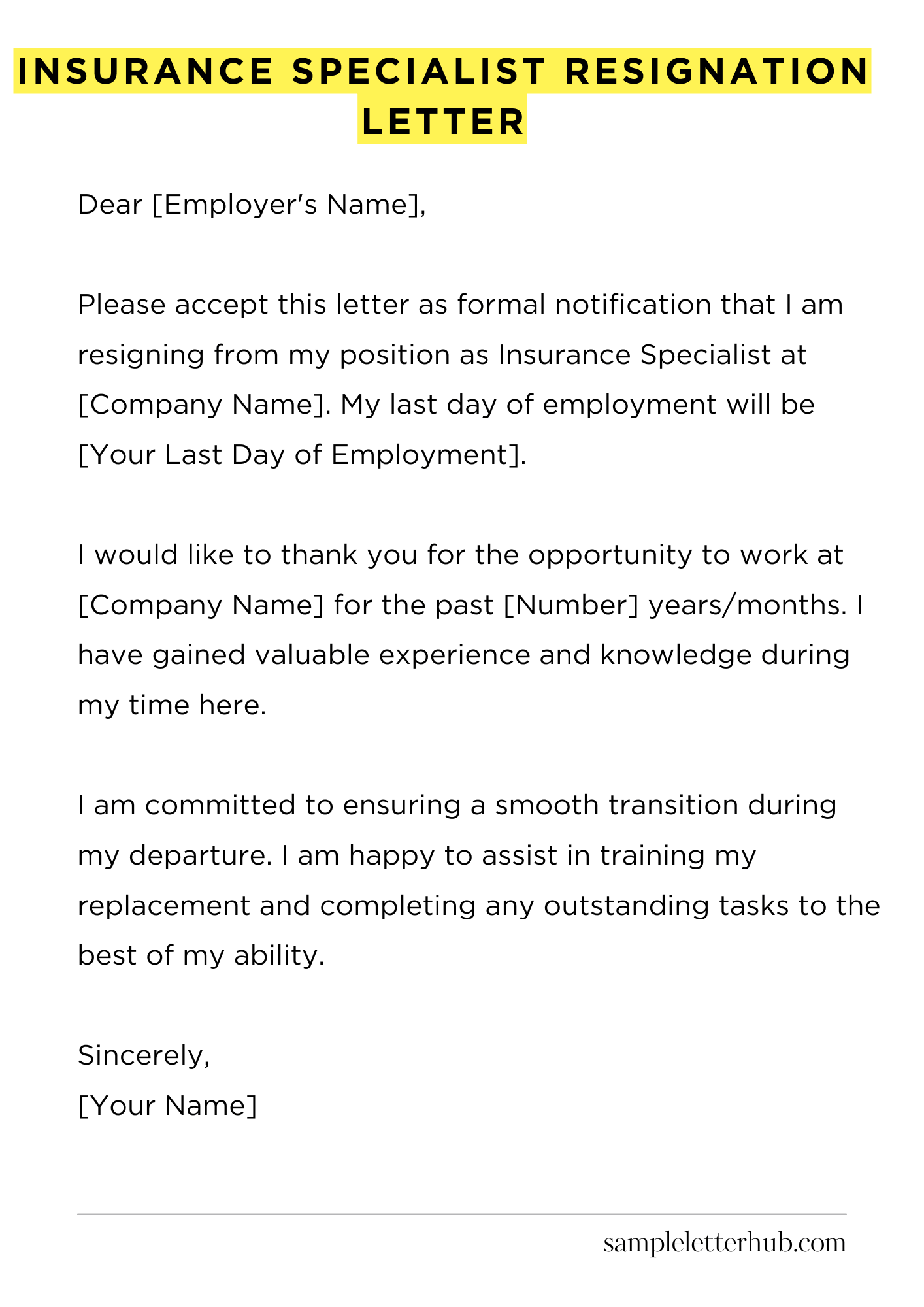
Dear [Employer’s Name],
Please accept this letter as formal notification that I am resigning from my position as Insurance Specialist at [Company Name]. My last day of employment will be [Your Last Day of Employment].
I would like to thank you for the opportunity to work at [Company Name] for the past [Number] years/months. I have gained valuable experience and knowledge during my time here.
I am committed to ensuring a smooth transition during my departure. I am happy to assist in training my replacement and completing any outstanding tasks to the best of my ability.
I wish [Company Name] all the best in the future.
Sincerely,
[Your Name]
How to Write an Insurance Specialist Resignation Letter
Leaving a job, even one you may not love, can be tricky. It’s a professional move, and you want to do it right. Resigning from your role as an Insurance Specialist demands a well-crafted resignation letter.
This document is a crucial step in ensuring a smooth transition. Your letter should reflect professionalism and respect. It must also clearly communicate your intentions. This guide offers a comprehensive approach.
1. Preparing Your Letter’s Foundation: Key Elements
Before you start typing, consider the essentials. Your resignation letter needs to be clear, concise, and professional. First and foremost, include your official resignation. State the date you’ll be leaving your position. Be clear about this. This is extremely important.
- Your Contact Information: Top left or right corner, with your name, address, phone number, and email.
- Date: The current date, directly below your contact info.
- Recipient’s Information: The name and title of your direct supervisor or HR manager. Include their address too.
- Salutation: Use a formal greeting like “Dear [Manager’s Name]”.
These basics create a foundation of professionalism.
2. The Core Message: Stating Your Resignation
The main purpose of your letter is to announce your departure. This section should be straightforward. Simply state that you are resigning from your position. Include the official job title. Specify the last day of your employment. Keep it concise.
Here’s a simple example: “Please accept this letter as formal notification that I am resigning from my position as Insurance Specialist, effective [Your Last Day of Employment].” This direct approach prevents ambiguity.
3. Expressing Gratitude: Showing Professionalism
Even if you’re leaving due to dissatisfaction, it’s wise to express gratitude. Acknowledge your time at the company. Thank them for the opportunities and experiences you gained. This demonstrates maturity and professionalism. Briefly mention something positive about your employment.
For example, you could say: “I am grateful for the opportunities I’ve had at [Company Name] and for the experience I’ve gained during my time here.” This fosters positive relationships.
4. Offering Assistance: The Bridge to a Smooth Transition
Offer assistance with the transition process. This shows consideration for your employer. State your willingness to help train your replacement. You might offer to document your processes. Also, you can complete any outstanding tasks. This demonstrates your commitment and integrity. Be specific about what help you can offer.
Consider this: “I am happy to assist in training my replacement and ensuring a smooth handover of my responsibilities.”
5. Closing and Formalities: Finishing Strong
Conclude your letter with a professional closing. Use a formal closing, like “Sincerely,” or “Respectfully,” followed by your typed name. If you’re sending a physical copy, leave space for your signature above your typed name. Consider printing the letter on professional paper if you have access to it.
Remember to proofread the entire letter. Check for any errors in grammar or spelling. A well-written letter reinforces your professionalism and leaves a lasting positive impression.
FAQs about Insurance Specialist Resignation Letter
What is the primary purpose of a resignation letter for an Insurance Specialist?
The primary purpose of a resignation letter for an Insurance Specialist is to formally notify their employer of their intent to leave the company. It serves as an official record of the employee’s departure and allows for a smooth transition, including the handover of responsibilities and final administrative procedures like payroll and benefits.
What key information should be included in a resignation letter for an Insurance Specialist?
A resignation letter for an Insurance Specialist should include: a clear statement of resignation, the effective date of the resignation, a brief expression of gratitude for the employment opportunity (optional, but often included), and, if applicable, the reason for leaving (also optional).
The employee should also confirm the return of company property and offer assistance during the transition period.
How much notice should an Insurance Specialist give when resigning?
The amount of notice an Insurance Specialist should provide typically depends on their employment contract, company policy, and local labor laws. A standard notice period is usually two weeks, but it’s important to review the employment agreement to determine the specific requirement.
Providing more notice, if possible, is often appreciated and can help maintain a positive relationship with the employer.
Should an Insurance Specialist include the reason for resignation in the letter?
Including the reason for resignation is optional. While it’s generally recommended to keep the letter concise and professional, an Insurance Specialist may choose to briefly state the reason, especially if it relates to a specific career opportunity, personal circumstances, or a desire for a change.
However, it’s generally best to keep the explanation brief and avoid negative comments about the company or colleagues.
What is the proper format for an Insurance Specialist’s resignation letter?
The standard format for a resignation letter for an Insurance Specialist is a formal business letter. It should include the employee’s contact information, the date, the employer’s contact information (typically the HR department or the immediate supervisor), a professional salutation (e.g., “Dear [Manager’s name]”), the body of the letter, a closing (e.g., “Sincerely”).
Related:
Resignation letter due to rude boss
Resignation letter moving to another state
Resignation letter due to illness of family member
Resignation letter due to study