

A manager resignation letter is a formal document. It announces your departure from a managerial role. Its main purpose is to officially inform your employer about your leaving. It also provides your last day of employment.
Are you a manager looking to move on? We’ve got you covered. This article offers ready-made templates. We also provide various examples. These samples will help you craft your own professional resignation letter.
Writing a resignation letter can feel tricky. We aim to simplify the process. Use our templates as a guide. They are designed to make it easy for you. Write your letter confidently and efficiently.
Manager Resignation Letter
Below is a sample of a Manager Resignation Letter:
[Your Name]
[Your Address]
[Your Phone Number]
[Your Email Address]
[Date]
[Manager’s Name]
[Manager’s Title]
[Company Name]
[Company Address]
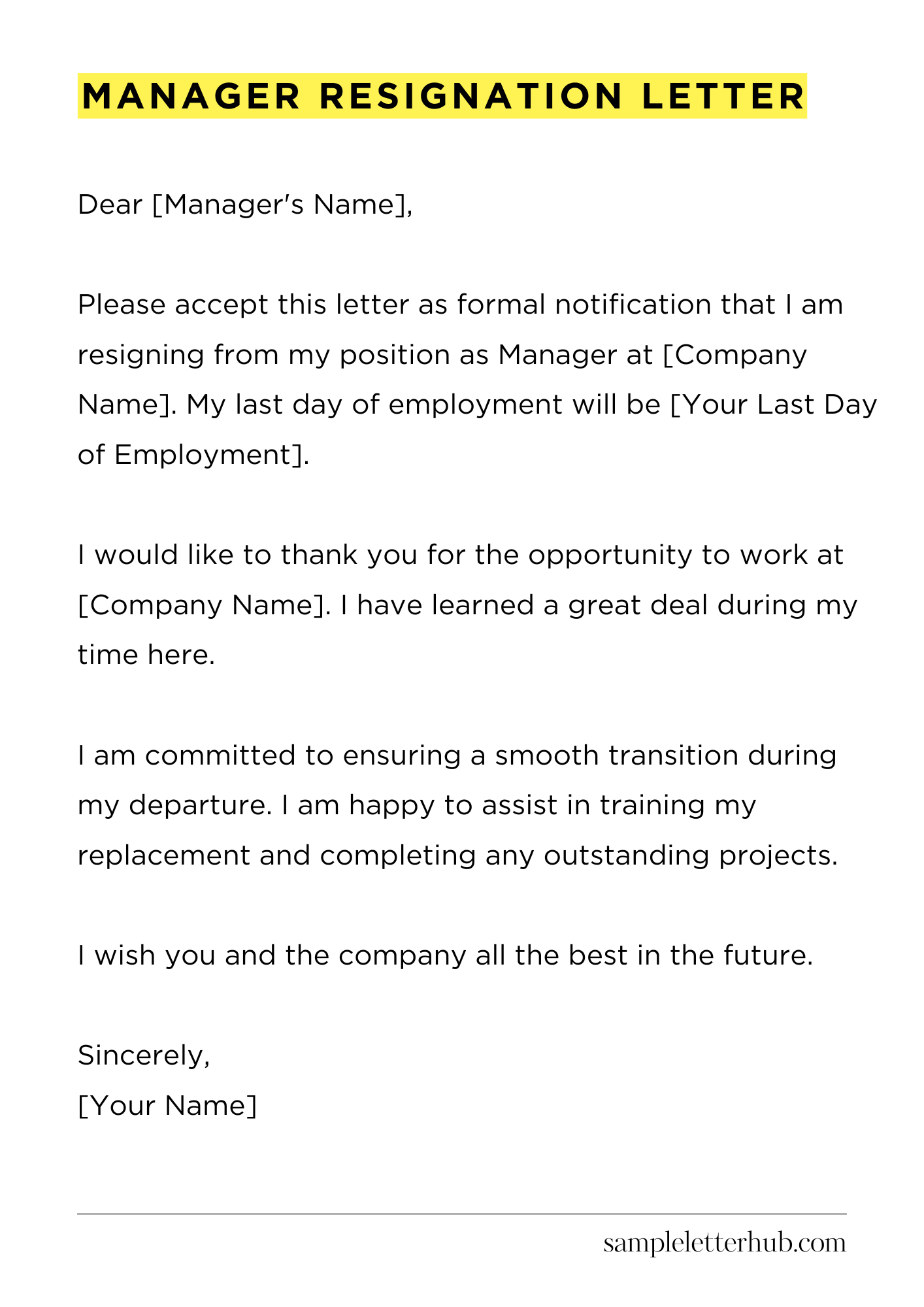
Dear [Manager’s Name],
Please accept this letter as formal notification that I am resigning from my position as Manager at [Company Name]. My last day of employment will be [Your Last Day of Employment].
I would like to thank you for the opportunity to work at [Company Name]. I have learned a great deal during my time here.
I am committed to ensuring a smooth transition during my departure. I am happy to assist in training my replacement and completing any outstanding projects.
I wish you and the company all the best in the future.
Sincerely,
[Your Name]
How to Write Manager Resignation Letter
So, you’re moving on! Congratulations on your next chapter. Leaving a manager position requires a thoughtful and professional approach. This is crucial. It sets the tone for your departure and can impact your future career. Writing a manager resignation letter isn’t just about saying “I quit.” It’s about closing this chapter properly.
1. Keep it Concise and Clear
Firstly, brevity is key. Get straight to the point. Your letter should be easy to understand. You don’t need a novel. State your intention to resign clearly. Mention your last day of employment. This is the bare minimum, the absolute foundation.
For example: “Please accept this letter as formal notification that I am resigning from my position as Manager, effective [Your Last Day of Employment].” See? Simple.
2. Express Gratitude
Always show appreciation. This is important, no matter the situation. Thank your employer for the opportunity. You can mention specific positive experiences, if you wish. This adds a personal touch. Even a simple “Thank you for the opportunities I’ve been given during my time here” works perfectly. Remember, maintaining a positive tone is beneficial.
3. Provide Necessary Information (If Applicable)
Next, consider what information to include. This depends on your situation. Will you assist with the transition? Offer to help train your replacement. This is usually very helpful. Providing details about handover plans shows professionalism. If you have any ongoing projects, offer a brief summary or documentation.
An example of this is : “I am happy to assist with the transition of my duties and am available to help train my replacement. I will also provide summaries of ongoing projects.”
4. Maintain Professionalism
Now, keep it professional throughout. Avoid negativity. Don’t air any grievances. Even if you’re unhappy, this is not the place. Refrain from overly emotional language. Stick to facts and a courteous tone. Remember, the letter is a reflection of you. It’s a permanent record.
Proofread carefully. Check for any grammatical errors or typos. This small act really does make a massive difference. Make sure it’s the best you can present.
5. Finalize and Deliver
Finally, finish with a professional closing. Use “Sincerely,” or “Regards,” followed by your name. Deliver the letter according to your company’s policy. Usually, this means delivering it to your direct supervisor or HR. It’s always best to deliver a physical copy, even if you follow up with an email. Once submitted, your resignation is official.
Writing a manager resignation letter is a chance to leave a lasting, positive impression. Do it right, and it will serve you well in the future.
FAQs about Manager Resignation Letter
What is the primary purpose of a manager resignation letter?
The primary purpose of a manager resignation letter is to formally notify an employer of an employee’s intent to leave their position. It serves as an official record of the resignation, the last day of employment, and often, a brief statement of gratitude or explanation. It’s crucial for legal and professional reasons.
What key elements should be included in a manager resignation letter?
A manager resignation letter should include: a clear and concise statement of resignation, the effective date of the resignation (last day of employment), the manager’s name and title, the company name, a professional closing, and the manager’s signature.
It’s also often customary to express gratitude for the opportunity and briefly state a reason for leaving, though this is not always mandatory.
How much notice should a manager provide when resigning?
The amount of notice a manager should provide typically depends on company policy and any employment contracts. However, as a general rule, a manager should aim to provide at least two weeks’ notice. In some situations, especially for senior management roles, a longer notice period of a month or more may be expected.
Is it necessary to provide a reason for resignation in the letter?
While not strictly required, providing a brief and professional reason for resignation can be beneficial. It helps the employer understand the context of the departure. It is acceptable to keep the reason brief and focus on the future such as a new opportunity. Avoid going into excessive detail or negative commentary, as this can damage your professional reputation.
What are some tips for writing a professional manager resignation letter?
Some tips for writing a professional manager resignation letter include: using a professional tone, being clear and concise, being positive and respectful, proofreading carefully for errors, and keeping a copy for personal records. It is also good to offer assistance during the transition period, such as offering to train a replacement or complete ongoing tasks before departure.
Related:
Resignation letter due to rude boss
Resignation letter moving to another state
Resignation letter due to illness of family member
Resignation letter due to study