

So, you’re a Senior Associate Consultant ready to move on. A resignation letter is your official goodbye. It formally informs your employer of your departure. This document starts the process of your leaving. It’s a key step in ending your employment professionally.
Crafting the perfect letter can feel tricky. Don’t worry, we’ve got you covered. We’ll provide you with helpful examples. You’ll find templates and samples right here. Use these to tailor your own letter.
Need to express your reasons for leaving? Want to thank your colleagues? These templates will help. Make your Senior Associate Consultant resignation a smooth transition.
Senior Associate Consultant Resignation Letter
Below is a sample of a Senior Associate Consultant Resignation Letter:
[Your Name]
[Your Address]
[Your Phone Number]
[Your Email Address]
[Date]
[Hiring Manager Name] (If known, otherwise use title)
[Hiring Manager Title]
[Company Name]
[Company Address]
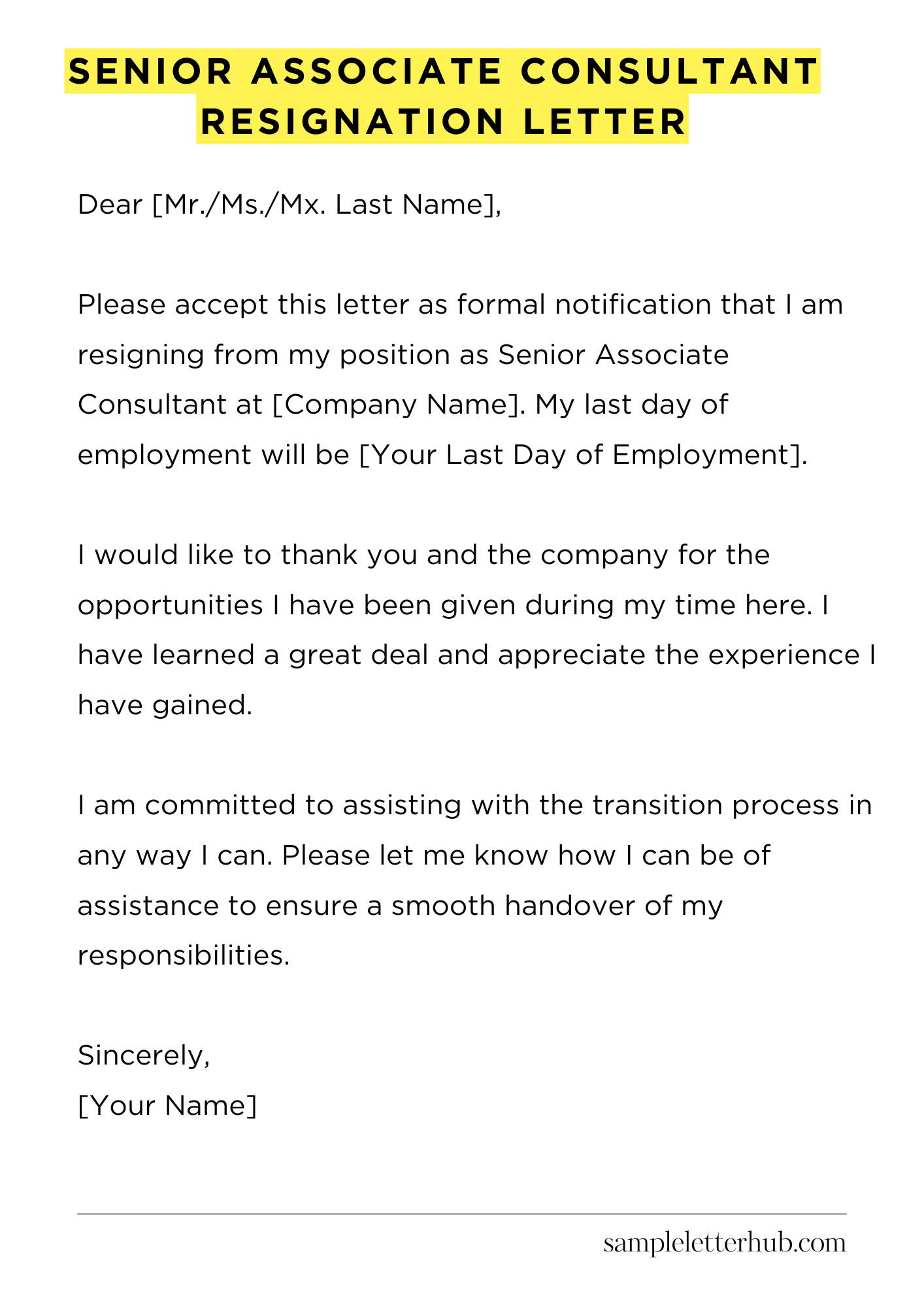
Dear [Mr./Ms./Mx. Last Name],
Please accept this letter as formal notification that I am resigning from my position as Senior Associate Consultant at [Company Name]. My last day of employment will be [Your Last Day of Employment].
I would like to thank you and the company for the opportunities I have been given during my time here. I have learned a great deal and appreciate the experience I have gained.
I am committed to assisting with the transition process in any way I can. Please let me know how I can be of assistance to ensure a smooth handover of my responsibilities.
I wish you and [Company Name] all the best for the future.
Sincerely,
[Your Name]
How to Write Senior Associate Consultant Resignation Letter
Resigning from a Senior Associate Consultant position? It’s a big step. A well-crafted resignation letter is critical for ensuring a smooth transition and maintaining a professional relationship with your employer. Let’s delve into the essential components.
1. Get Started Right: The Basics
Your letter should begin with the date and your contact information. Keep it simple. Next, include the recipient’s information: their name, title, and the company address.
This shows respect and attention to detail. The tone should always be professional and polite. Always state your intention clearly: “I am writing to formally resign from my position as Senior Associate Consultant at [Company Name], effective [Your Last Day of Employment].” This is absolutely necessary. Clarity is key here.
2. Express Your Gratitude: Show Appreciation
Don’t just jump straight into the resignation. Show some gratitude. Briefly acknowledge your experience at the company. Mention something positive you learned or a specific project you enjoyed working on.
Something like, “I am grateful for the opportunities I’ve had at [Company Name] over the past [Number] years/months.” This small gesture speaks volumes about your character. It’s about building bridges, not burning them.
3. The Details: Providing Assistance with Transition
Offer assistance with the transition. This is crucial for maintaining a positive relationship. Suggest helping with the handover of your responsibilities. You could offer to train your replacement or assist in any other way possible. It demonstrates your commitment and professionalism, even as you leave.
This demonstrates your commitment and professionalism. State something like, “I am committed to ensuring a smooth transition and am happy to assist in any way possible to help with the transfer of my responsibilities.”
4. Keep It Concise: Avoid Unnecessary Details
Avoid any negativity or personal complaints in your letter. This isn’t the place for them. Focus on the positive and keep the tone professional. The purpose of the letter is to resign gracefully. Refrain from going into lengthy explanations for your decision. A brief, polite reason, if you feel compelled to include one, is sufficient.
Keep it short and to the point. Focus on what matters most: your resignation, your gratitude, and your willingness to help.
5. Formal Closing: Finalize and Confirm
End your letter with a formal closing and your signature. Use a professional closing like “Sincerely,” or “Respectfully,” followed by your typed name. Then, sign the letter physically (if possible). Also, it’s good practice to reiterate your contact information for any follow-up questions. Your contact details, again.
Make a copy of the letter for your records. Consider hand-delivering the letter to your manager or HR, or send it via email with a read receipt requested. Acknowledge receipt to stay on the good side!
FAQs about Senior Associate Consultant resignation letter
A Senior Associate Consultant resignation letter is a formal document that serves as an official notice of your intention to leave your position. Understanding the common questions surrounding this process can help you navigate it smoothly.
What is the typical notice period required in a Senior Associate Consultant resignation letter?
The notice period for a Senior Associate Consultant typically varies depending on your employment contract, company policy, and local labor laws. However, a common standard is two to four weeks. It is crucial to review your employment agreement to determine the exact notice period required by your employer.
Failing to provide adequate notice could have implications such as forfeiting unused vacation time or impacting your eligibility for future employment with the company or affiliated organizations.
What key information should be included in a Senior Associate Consultant resignation letter?
A well-crafted resignation letter should include your formal statement of resignation, the effective date of your departure, your official title, and a brief and professional expression of gratitude for the opportunity. You may optionally mention the reason for your departure, but this is not always necessary.
It is also wise to offer assistance during the transition period, such as assisting with the handover of your responsibilities. Finally, make sure to proofread the letter carefully for clarity and accuracy before submitting it.
How should I deliver my Senior Associate Consultant resignation letter?
It’s generally recommended to deliver your resignation letter to your direct supervisor or the appropriate HR representative in person, if possible.
If a face-to-face meeting isn’t feasible, sending the letter via email is an acceptable alternative. Always obtain confirmation that the letter has been received. Maintain a copy of your resignation letter and any related communication for your records.
Can I provide a reason for resigning in my Senior Associate Consultant resignation letter?
While not mandatory, you can include a brief, professional reason for your resignation. Keep it concise, and avoid negativity. Reasons can include pursuing another opportunity, seeking career advancement, or a change in personal circumstances. If you choose to provide a reason, phrase it positively and focus on your future goals.
Focus on stating your intent to resign, and the effective date, while briefly conveying your reason for leaving.
What should I do after submitting my Senior Associate Consultant resignation letter?
After submitting your letter, prepare to work through your notice period. Cooperate with your employer during the transition, complete any outstanding tasks, and assist in the handover of your responsibilities. Maintain a professional attitude, and be prepared to answer questions and provide information to your colleagues.
Ensure that you have a smooth exit and maintain positive relationships for future professional references. Finally, be sure to retrieve any personal belongings and settle any outstanding company matters.
Related:
Resignation letter due to rude boss
Resignation letter moving to another state
Resignation letter due to illness of family member
Resignation letter due to study