

Ready to move on from your administrative role? An “Administrativo resignation letter” is your official way of informing your employer that you’re leaving your job. It’s a formal document that officially marks the end of your employment. Its purpose is to communicate your departure clearly and respectfully.
Writing a resignation letter can feel daunting. We’re here to help! We’ve prepared several examples of “Administrativo resignation letter” to guide you. Use these samples as inspiration and customize them to fit your specific situation.
Need to say goodbye with grace? Explore the various templates and samples we’ve put together. Craft a letter that reflects your professionalism and leaves a positive lasting impression.
Administrativo Resignation Letter
Below is a sample of a Administrativo Resignation Letter:
[Your Name]
[Your Address]
[Your Phone Number]
[Your Email Address]
[Date]
[Employer’s Name]
[Employer’s Title]
[Company Name]
[Company Address]
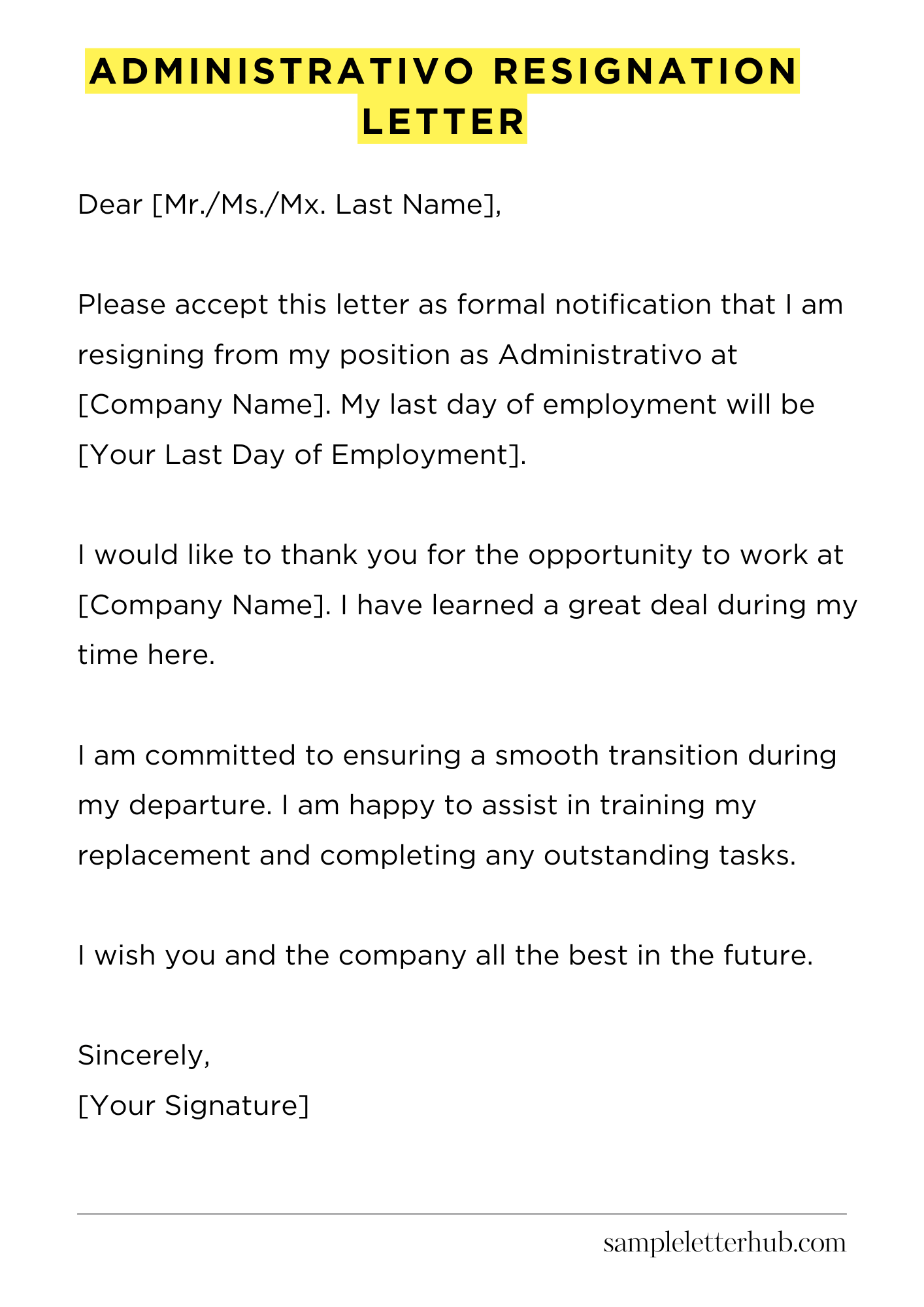
Dear [Mr./Ms./Mx. Last Name],
Please accept this letter as formal notification that I am resigning from my position as Administrativo at [Company Name]. My last day of employment will be [Your Last Day of Employment].
I would like to thank you for the opportunity to work at [Company Name]. I have learned a great deal during my time here.
I am committed to ensuring a smooth transition during my departure. I am happy to assist in training my replacement and completing any outstanding tasks.
I wish you and the company all the best in the future.
Sincerely,
[Your Signature]
How to Write an Administrativo Resignation Letter
So, you’re moving on! Writing a resignation letter, especially an “administrativo” one, might seem straightforward. But getting it right ensures a smooth transition and leaves a positive impression. This guide breaks down the essential steps to craft a professional and effective letter.
1. Start with the Basics: Formatting and Details
First things first: formatting. Your Administrativo resignation letter is a formal document. Use a standard business letter format. This is crucial. This will help you keep things professional. At the top left, include your full name, address, phone number, and email address. Below that, on the right, include the date.
Next, list the recipient’s information: their name, title, and the company’s address. Use a clear, easy-to-read font like Times New Roman or Arial. Keep it simple and professional, about 1-inch margins on all sides is helpful.
Ensure the date is the day you intend to deliver the letter, not the day you’re thinking about it.
2. The Core of the Matter: Your Statement of Resignation
This is the heart of your letter. It’s important to state your intention clearly and directly. Begin with a formal salutation, like “Dear [Recipient’s Name].”
Then, in the body of the letter, state your resignation unequivocally. A good starting point would be: “Please accept this letter as formal notification that I am resigning from my position as [Your Job Title] at [Company Name], effective [Your Last Day of Employment].” This statement leaves no room for misunderstanding.
Keep the language professional and concise. Focus on the facts.
3. Expressing Gratitude (Optional, but Recommended)
While you’re not required to, expressing gratitude is generally a good idea. Consider including a brief statement thanking your employer for the opportunity. This shows professionalism and respect. You can acknowledge the experience you gained or the relationships you built.
Something like, “I am grateful for the opportunities I have been given during my time at [Company Name].” However, keep it brief and genuine. Don’t overdo it, sincerity matters.
A simple thank you can go a long way.
4. Addressing the Transition: Assistance and Handover
Consider offering assistance with the transition. This is not only courteous but can also make a good impression. Indicate your willingness to help train your replacement, complete any outstanding tasks, or assist in the handover process.
For example: “I am committed to ensuring a smooth transition and am happy to assist in training my replacement or completing any pending projects before my departure.” This highlights your professionalism and commitment.
Consider what you can do to leave the role in good shape.
5. Concluding and Closing: A Final Touch
End the letter with a professional closing. Use “Sincerely,” “Best regards,” or a similar closing followed by your full name. If you’re sending a hard copy, sign your name above your typed name. If sending electronically, simply typing your full name is fine. Review the entire letter carefully before sending it.
Check for any errors in grammar or spelling. Ensure all the information is accurate and clear. Remember, this letter is a reflection of you, so make it a good one.
Proofread carefully. Now you’re ready to submit it.
FAQs about Administrativo resignation letter
What is the primary purpose of an Administrativo resignation letter?
The primary purpose of an Administrativo resignation letter is to formally notify your employer, typically the administrative or management personnel within an organization, of your intent to leave your position. It serves as a legal record and provides a clear date for your departure, ensuring a smooth transition process and officially ending your employment.
What key components should be included in an Administrativo resignation letter?
A well-crafted Administrativo resignation letter should include your formal announcement of resignation, the effective date of your departure, a concise statement of your reason for leaving (optional but often included for context), an expression of gratitude for the opportunity to work at the organization, and a willingness to assist with the transition process if needed.
It should also include your name, job title, and the date the letter is written.
How much notice should I provide in my Administrativo resignation letter?
The amount of notice required is generally outlined in your employment contract or company policy. However, a standard practice is to provide at least two weeks’ notice, unless a different timeframe is stipulated. Providing adequate notice is professional and allows for a more seamless handover of your responsibilities.
Can I include a reason for my resignation in the Administrativo resignation letter, and should I?
Yes, you can include a brief reason for your resignation in the letter. While not always mandatory, it can be beneficial. It helps provide context, and in some cases, it can allow your employer to understand your perspective or identify areas for improvement. Keep the reason concise and professional; avoid negativity or complaints.
How should I deliver my Administrativo resignation letter?
The standard practice is to deliver your resignation letter in writing. Typically, this is done by submitting a hard copy to your supervisor or the designated Human Resources representative.
You may also provide a digital copy (via email), but it’s important to follow your company’s policy on resignation procedures. In some cases, a meeting might be a good idea for the official presentation of the letter, but this depends on the company culture.
Related:
Resignation letter due to rude boss
Resignation letter moving to another state
Resignation letter due to illness of family member
Resignation letter due to study