

Leaving a publishing role? You’ll need a publisher resignation letter. This document formally announces your departure. It’s crucial for a smooth transition. The letter ensures all parties are informed. It helps to clarify your last day.
This can seem daunting. Don’t worry, we’re here to help. We’ve gathered some great examples. You can use these templates. These samples cover various situations. Find one that fits your needs.
Writing a resignation letter doesn’t have to be hard. We’ll give you a variety of options. Adapt them to fit your specific situation. Let’s make this process easy for you. You’ve got this!
Publisher Resignation Letter
Below is a sample of a Publisher Resignation Letter:
[Your Name]
[Your Address]
[Your Phone Number]
[Your Email Address]
[Date]
[Publisher’s Name]
[Publisher’s Title]
[Publisher’s Company]
[Publisher’s Company Address]
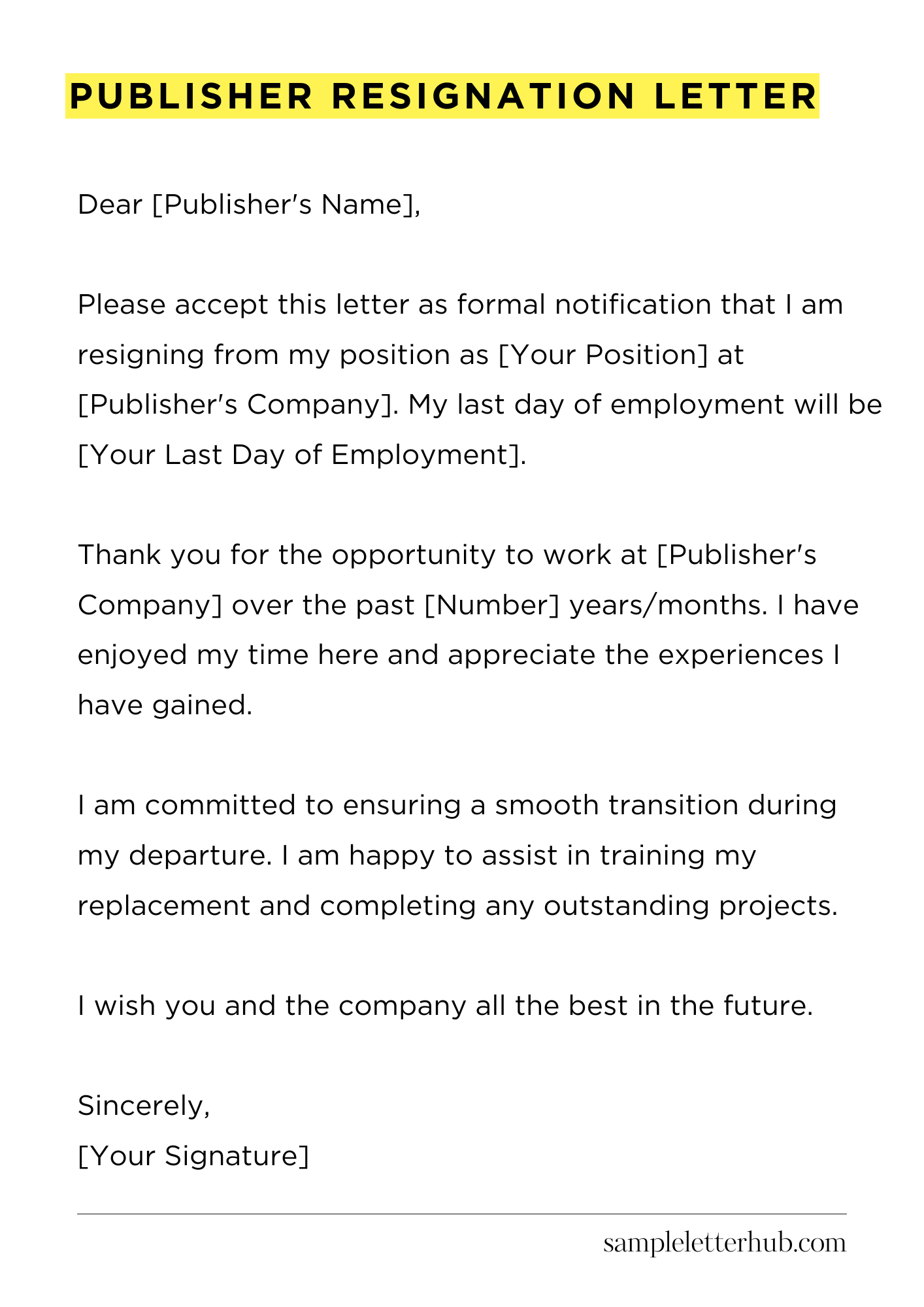
Dear [Publisher’s Name],
Please accept this letter as formal notification that I am resigning from my position as [Your Position] at [Publisher’s Company]. My last day of employment will be [Your Last Day of Employment].
Thank you for the opportunity to work at [Publisher’s Company] over the past [Number] years/months. I have enjoyed my time here and appreciate the experiences I have gained.
I am committed to ensuring a smooth transition during my departure. I am happy to assist in training my replacement and completing any outstanding projects.
I wish you and the company all the best in the future.
Sincerely,
[Your Signature]
How to Write a Publisher Resignation Letter
Why a Good Resignation Letter Matters
Resigning from a publishing role, like any professional position, requires a thoughtful approach. You want to leave on a good note, right? The letter serves as a crucial piece of official documentation. It formally communicates your intent to depart. Plus, it solidifies your professional reputation.
Think of it as your final impression, not just a farewell. A well-written letter can open doors in the future. It’s also important for legal and administrative purposes. It sets the tone for your departure. This can make the transition smooth for everyone. A bad letter can cause problems.
Essential Components: What to Include
Your resignation letter needs key elements. You need to get them right. Start with a clear and concise opening. State your intention to resign. Specify your last day of employment.
Use a formal and respectful tone. Be straightforward; there is no need for beating around the bush. Next, express your gratitude for the opportunity. Mention specific experiences or skills you’ve gained. Acknowledge your team, your colleagues, or any mentors who have helped you grow. This can show that you cared.
Briefly explain why you are leaving, if you choose to. Always keep it professional. Finally, offer assistance during the transition. Offer to help train your replacement. Offer to help in any way you can to ensure a smooth hand-off. This shows responsibility.
Crafting the Right Tone: Be Professional
Maintaining a professional tone is paramount. You are a professional, right? Even if you have had negative experiences, avoid any negative language. Stay positive and focus on the future. The tone you set in your letter will shape your legacy. Keep it concise. Avoid excessive detail or emotional language.
Make it easy to read. Proofread your letter carefully for any grammatical errors or typos. Double-check everything. This reflects your attention to detail. This also shows respect for the recipient. Remember, this letter is a reflection of you.
Structuring Your Letter: The Format
Organization is important for the reader. Follow a standard business letter format. Start with your contact information. Include your name, address, phone number, and email. Then, add the date of the letter. This is followed by the recipient’s information.
List the publisher’s name, their title, and the publishing house’s address. Use a proper salutation, such as “Dear [Publisher’s Name].” Write the body of your letter in clear paragraphs. Include each of the core elements we discussed earlier.
Conclude with a professional closing. Use “Sincerely,” “Best regards,” or a similar sign-off. Sign your name above your typed name. Keep it simple and easy to understand.
Before You Send: Proofreading and Review
Before you click send, double-check everything. You should reread your resignation letter carefully. Check for any errors in grammar or spelling. Also, make sure the formatting is correct. Ask a friend or colleague to review it for you. This fresh perspective can help you catch anything you might have missed.
Ensure that all the key details are included. Confirm that the tone is professional and positive. Make any final edits or revisions based on feedback. Keep the letter in your records for your reference. When you’re confident it’s perfect, send it through the appropriate channels. Remember to keep a copy for yourself.
FAQs about Publisher resignation letter
How do I write a Publisher resignation letter?
A Publisher resignation letter should be concise, professional, and clearly state your intention to resign. Include your name, the date, your official job title, and the date of your last day of employment. Briefly express your gratitude for the opportunity, but avoid overly emotional language. You should also ensure you follow any internal company policy on submitting your resignation.
What should I include in a Publisher resignation letter?
Your resignation letter should include: your name, the date you are writing the letter, your current job title, a clear statement of your resignation, the date of your last day of employment, a brief expression of gratitude (optional), and your signature. It’s also wise to include your contact information for any necessary follow-up.
How much notice should I give when resigning as a Publisher?
The amount of notice you should give typically depends on your employment contract or company policy. However, a general rule of thumb is to provide at least two weeks’ notice. Consider how long it may take to transfer your responsibilities and the needs of your employer. Longer tenures may require a more extended notice period.
Can I provide a reason for resigning in my resignation letter as a Publisher?
While not strictly necessary, you can briefly mention a reason for your resignation in your letter, but it’s not compulsory. You can opt for a general statement like “seeking new opportunities” or “pursuing other interests.” If you prefer to keep your reasons private, it’s perfectly acceptable to simply state your resignation.
\Any specific reasons can be discussed later in an exit interview if your company conducts them.
Should I hand-deliver or email my Publisher resignation letter?
The preferred method of submitting your resignation letter often depends on your company’s norms. Emailing the letter is standard practice in many modern workplaces. However, handing in a printed copy to your direct supervisor is a professional approach, allowing you to have a face-to-face conversation.
Check with your HR department or review company policy to know the right method for submitting your resignation.
Related:
Resignation letter due to rude boss
Resignation letter moving to another state
Resignation letter due to illness of family member
Resignation letter due to study