

So, you’re moving on from your Desktop Support Analyst role? A resignation letter is your official goodbye. It formally informs your employer of your departure. This document outlines your last day of employment. It’s a crucial step in a professional exit.
Writing a resignation letter can feel daunting. We get it. That’s why we’re here to help. This article provides you with helpful templates. You can adapt these examples to fit your situation. We have various samples for different scenarios.
Whether you’re looking for a simple notice or something more specific, we’ve got you covered. These templates will help you craft the perfect letter. Make your transition smoother. Say farewell with grace and professionalism.
Desktop Support Analyst Resignation Letter
Below is a sample of a Desktop Support Analyst Resignation Letter:
[Your Name]
[Your Address]
[Your Phone Number]
[Your Email Address]
[Date]
[Employer’s Name]
[Company Name]
[Company Address]
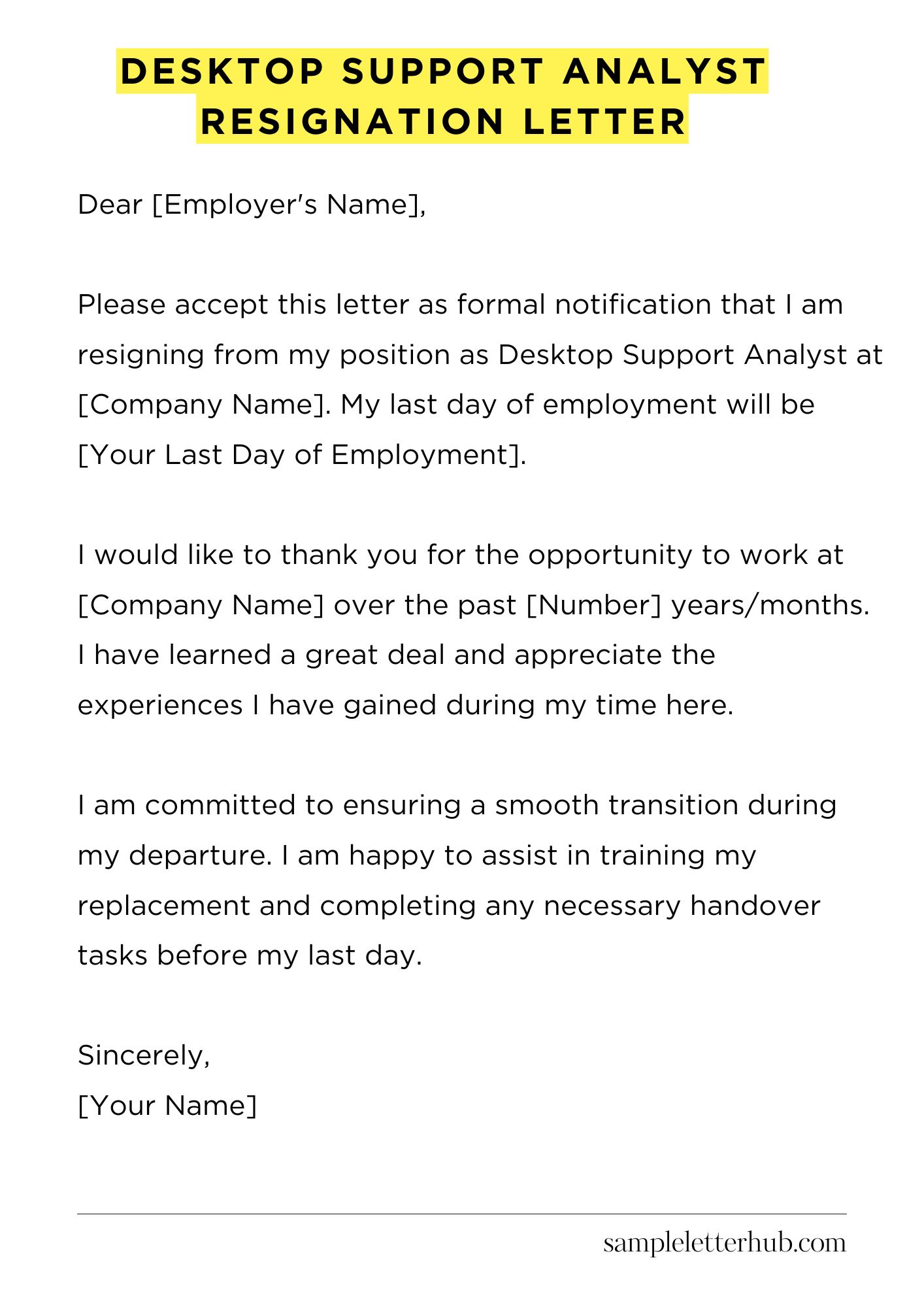
Dear [Employer’s Name],
Please accept this letter as formal notification that I am resigning from my position as Desktop Support Analyst at [Company Name]. My last day of employment will be [Your Last Day of Employment].
I would like to thank you for the opportunity to work at [Company Name] over the past [Number] years/months. I have learned a great deal and appreciate the experiences I have gained during my time here.
I am committed to ensuring a smooth transition during my departure. I am happy to assist in training my replacement and completing any necessary handover tasks before my last day.
I wish you and [Company Name] all the best for the future.
Sincerely,
[Your Name]
How to Write a Desktop Support Analyst Resignation Letter
1. Why Resigning Requires a Letter
Leaving a job, even one you may not have enjoyed, is a professional affair. You always need a formal resignation letter. Think of it as a bridge, ensuring you leave on good terms.
A well-crafted letter signifies respect for your employer and the role you held. This simple document helps with reference checks in the future. It also prevents any misunderstandings about your departure date. This is critical for payroll and your final tasks.
2. Essential Components of Your Letter
Your resignation letter doesn’t need to be long or complicated. The core elements are straightforward, but essential. First, include your name and the date at the top. Next, state your intention clearly and directly. The most important thing is to announce that you are resigning from your position.
Next, specify your last day of employment. Be sure to align this with your employment contract or company policy. Finally, you should include a brief expression of gratitude for the opportunity. Keep it short and sweet, a simple ‘Thank you’ can work. It is also good to offer assistance during the transition if you’re willing to help. Lastly, include your signature.
3. Crafting the Perfect Opening and Closing
Starting strong sets the tone. Open your letter with a polite and professional greeting. “Dear [Manager’s Name],” is standard. Next, make your intention immediately clear: “I am writing to inform you that I am resigning from my position as Desktop Support Analyst.” In closing, express gratitude and perhaps offer assistance.
Consider a sentence like, “Thank you for the opportunity to have worked here. I am happy to assist with the transition of my responsibilities.” End with “Sincerely,” or “Regards,” and then sign your name. A professional font like Times New Roman or Arial also works.
4. Navigating Sensitive Issues: What to Include and Exclude
Resignation letters are not the place for venting or complaints. Keep your tone positive, professional, and concise. Avoid discussing the reasons for your departure in detail. If you are moving on because of a better job, or for personal reasons, you do not need to say. Focus on the positive aspects of your employment, or simply state that you are pursuing other opportunities.
Do not criticize colleagues, the company, or your manager. Your letter serves a formal purpose, not a therapy session.
5. Formatting and Proofreading: The Final Polish
Before you send your letter, take a moment to format and proofread it. Ensure your letter is correctly formatted. Ensure the date, your name, and the recipient’s information are accurate. Use a professional font and layout, with clear paragraphs and proper spacing. Proofread carefully for any spelling or grammatical errors.
A single mistake can undermine your professionalism. It’s always a good idea to have a friend or colleague review your letter before you submit it. Double-check everything. Once you are happy, save a copy for your records, and submit it.
FAQs about Desktop Support Analyst Resignation Letter
What is the most important information to include in a Desktop Support Analyst resignation letter?
The most important information includes a clear and concise statement of your resignation, the effective date of your departure, and a professional expression of gratitude for the opportunity.
It is also common to briefly state the reason for leaving (e.g., career advancement, personal reasons), though this is often kept brief and positive. Contact information, if you are happy to be contacted about future opportunities.
What is the appropriate format for a Desktop Support Analyst resignation letter?
The format should be professional and straightforward. Use a standard business letter format, including your name, address, and contact information at the top (or in a header/footer), followed by the date, the recipient’s name and title, and the company address.
Start with a formal salutation (e.g., “Dear [Manager’s Name]”), then the body of the letter, and conclude with a professional closing (e.g., “Sincerely,” or “Respectfully,”) and your typed name. Sign the letter manually if possible.
How much notice should a Desktop Support Analyst give when resigning?
The standard notice period is typically two weeks. However, this can vary depending on your employment contract, company policy, and local labor laws. Review your employment agreement to understand the required notice period. Giving more than the minimum required notice is often appreciated and can help maintain a positive relationship with your employer.
Should I provide a reason for leaving in my resignation letter as a Desktop Support Analyst?
While not mandatory, it’s generally a good practice to briefly state the reason for leaving. You can keep it brief and positive, focusing on career advancement, a new opportunity, or personal reasons.
Avoid providing overly negative or detailed explanations, and maintain a professional tone. If the reason is a conflict, consider whether you would like to elaborate, but in general, don’t.
Can I provide a reference in my Desktop Support Analyst resignation letter?
It’s appropriate and often beneficial to offer to assist with the transition of your responsibilities. This could involve training your replacement, documenting procedures, or otherwise helping to ensure a smooth handover. Offering yourself as a reference is a polite way of expressing appreciation for your time in the role.
Related:
Resignation letter due to rude boss
Resignation letter moving to another state
Resignation letter due to illness of family member
Resignation letter due to study