

A specialist resignation letter is a formal document. It announces your decision to leave a specific role. Its main purpose is to officially inform your employer of your departure. It often includes your last day of employment.
Writing a resignation letter can feel daunting. We’re here to help. This article offers various templates. You can customize them to fit your situation. We have different examples. These samples will ease the writing process.
Need a letter for a new job? Planning a career change? Consider these as your starting point. Use these samples for inspiration. Make your resignation clear and concise.
Specialist Resignation Letter
Below is a sample of a Specialist Resignation Letter:
[Your Name]
[Your Address]
[Your Phone Number]
[Your Email Address]
[Date]
[Recipient’s Name]
[Recipient’s Title]
[Company Name]
[Company Address]
Dear [Recipient’s Name],
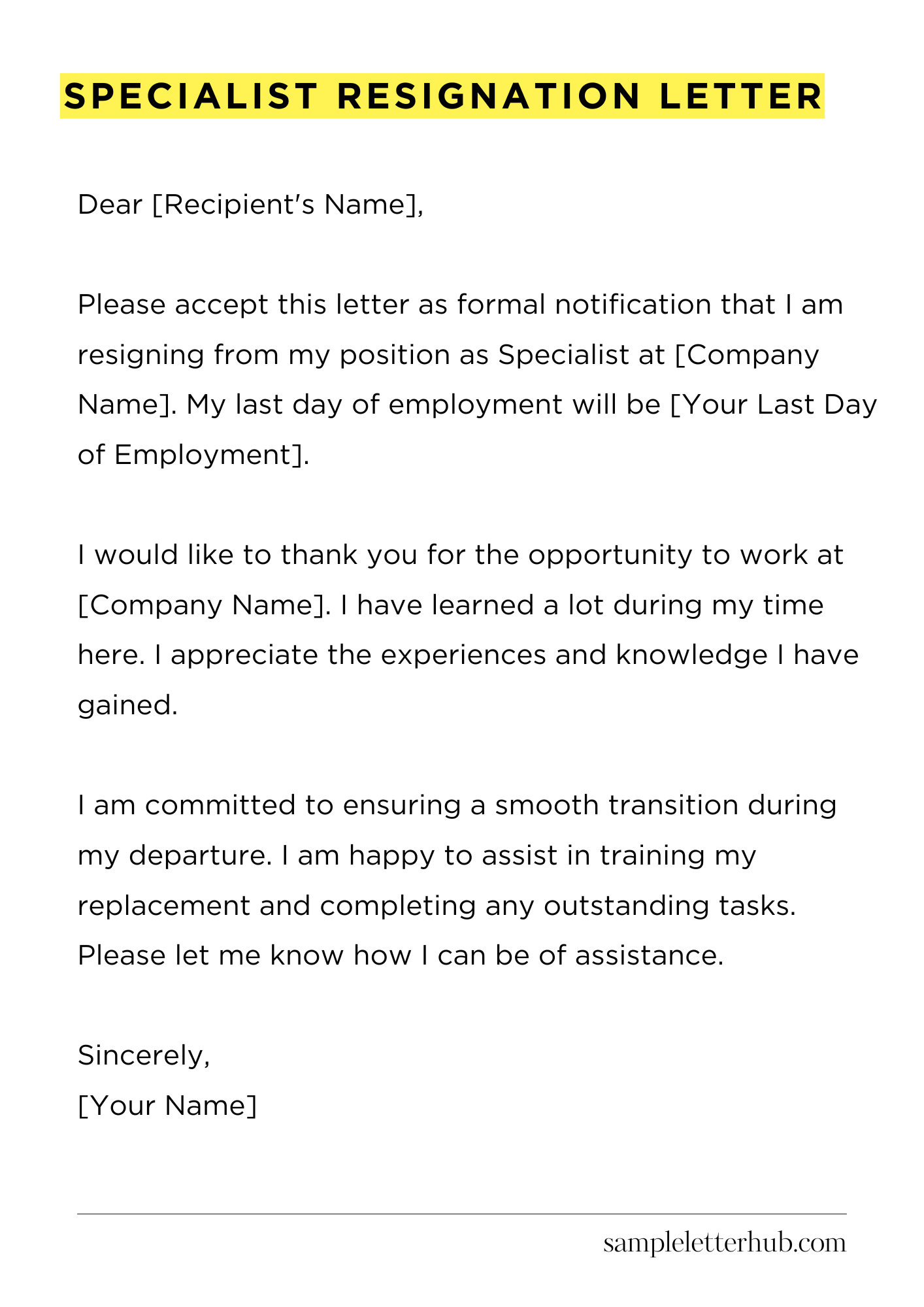
Please accept this letter as formal notification that I am resigning from my position as Specialist at [Company Name]. My last day of employment will be [Your Last Day of Employment].
I would like to thank you for the opportunity to work at [Company Name]. I have learned a lot during my time here. I appreciate the experiences and knowledge I have gained.
I am committed to ensuring a smooth transition during my departure. I am happy to assist in training my replacement and completing any outstanding tasks. Please let me know how I can be of assistance.
I wish you and [Company Name] all the best in the future.
Sincerely,
[Your Name]
How to Write a Specialist Resignation Letter
Know the Basics Before You Begin
Resigning from a specialist role requires a thoughtful approach. First off, you need a letter! It’s the professional and accepted way to do things. Understand that this document isn’t just a formality. It’s a statement, and you want to ensure it’s a good one. Before you even touch a keyboard, think about your goals.
What are you hoping to achieve with this letter? Do you want to leave a positive impression? Are you aiming to maintain good relationships with former colleagues? This will influence the tone and content.
Always check your employment contract. Some contracts have specific clauses about resignation notice periods. Ensure you adhere to these terms. Failure to do so could lead to complications. Furthermore, consider your audience. Who will be reading this letter? Your direct supervisor? HR? Tailor your language appropriately. Keep it formal and professional.
Crafting the Core Components: What to Include
Okay, let’s get down to the nitty-gritty of what goes into this important letter. Start with the basics. Your name, the date, and the recipient’s name and title. These are non-negotiable!
Next, state your intention clearly. Use a straightforward sentence like: “Please accept this letter as formal notification that I am resigning from my position as [Your Job Title] at [Company Name].”
Next, include your last day of employment. This is crucial for planning purposes. Follow this with a brief, sincere expression of gratitude for the opportunity. Mentioning a specific experience or skill gained can be a nice touch.
For instance, “I’m grateful for the experience I’ve gained over the past [duration] years, particularly in [specific area].” Finally, close with a professional closing. “Sincerely” or “Respectfully” is perfectly acceptable, followed by your signature (if you’re printing the letter) and your typed name.
Level Up: Adding the Right Tone and Details
Beyond the core components, consider the tone. It should be respectful, even if your experience hasn’t been perfect. Avoid negativity or complaints. Think about your goals, remember? You want to leave a positive impression. You may want to offer to help with the transition.
This is not required, but it is a nice gesture and shows consideration for your colleagues and the company. Something like, “I am happy to assist in the handover process to ensure a smooth transition” demonstrates this.
If you’re comfortable, you might briefly mention your reason for leaving, but you don’t have to. Keep it brief. For example, “I am pursuing a new opportunity that aligns with my long-term career goals.” Remember the key is to stay positive and professional.
The Importance of Polishing and Proofreading
Once you’ve written your letter, take a step back and read it through. Then, read it again! Proofreading is essential. Check for spelling errors, grammatical mistakes, and any awkward phrasing. A poorly written letter undermines your professionalism. Ask a friend or colleague to review it as well. A fresh pair of eyes can often spot errors you missed.
Ensure the formatting is clean and easy to read. Use a professional font like Times New Roman or Arial. Keep the font size consistent. The goal is to make the letter look as polished and professional as you are.
The Aftermath: Handing It In and Moving On
Once you’re satisfied with your resignation letter, it’s time to submit it. Follow company protocols for submitting resignations. Usually, this means delivering it to your direct supervisor and possibly HR. Keep a copy of the letter for your records.
Be prepared for a conversation. Your supervisor might want to discuss your resignation. Be professional and respectful during any such conversation. Once you’ve submitted your letter, honor your notice period. Continue to perform your duties to the best of your ability until your last day.
This is your final chance to make a positive impression and leave on a good note. Remember, the way you leave a job is often remembered longer than the way you started.
FAQs about Specialist Resignation Letter
What information should I include in my specialist resignation letter?
Your specialist resignation letter should include your official resignation, the date of your last day of employment, a concise statement of your reason for leaving (optional but often included), and a brief expression of gratitude for the opportunity. It’s also professional to offer assistance with the transition process.
When should I submit my specialist resignation letter?
Ideally, you should submit your specialist resignation letter at least two weeks before your intended last day of employment. This standard timeframe allows your employer sufficient time to find a replacement and manage the transition effectively. Always adhere to any specific notice period outlined in your employment contract or company policy.
How can I maintain a professional tone in my specialist resignation letter?
To maintain a professional tone, be direct and clear in your wording. Avoid negativity or complaints about your job or employer. Express gratitude for the opportunity, and keep the letter concise and focused on the facts. Proofread carefully to avoid any grammatical errors or typos.
Should I provide a reason for my resignation in my specialist resignation letter?
Providing a reason for your resignation is optional, but it can be helpful. You can simply state you are pursuing another opportunity or personal reasons, or you can briefly mention the specific reason. Keep it brief and avoid going into excessive detail. Your goal is to be professional, not to air grievances.
How do I handle the resignation letter submission process?
Typically, you will submit your specialist resignation letter to your direct supervisor or Human Resources department. It’s often delivered in person if possible, followed by a digital copy (email). Always keep a copy of your resignation letter for your records. Be prepared to discuss your resignation in person if your supervisor requests a meeting.
Related:
Resignation letter due to rude boss
Resignation letter moving to another state
Resignation letter due to illness of family member
Resignation letter due to study