

So, you’re a Creative Manager, and you’re moving on? A Creative Manager resignation letter is your formal notice. It informs your employer that you’re leaving your position. It’s a key document for a smooth transition.
Writing this letter can feel tricky. You want to be professional. You also want to express your thoughts clearly. We’ve got you covered.
We’ll share some templates and examples. These will help you craft your own perfect letter. They are adaptable to your specific situation. Let’s get started.
Creative Manager Resignation Letter
Below is a sample of a Creative Manager Resignation Letter:
[Your Name]
[Your Address]
[Your Phone Number]
[Your Email Address]
[Date]
[Hiring Manager Name] (If known, otherwise use title)
[Hiring Manager Title]
[Company Name]
[Company Address]
Dear [Mr./Ms./Mx. Last Name],
Please accept this letter as formal notification that I am resigning from my position as Creative Manager at [Company Name]. My last day of employment will be [Your Last Day of Employment].
I am grateful for the opportunities I have been given during my time here. I have learned a great deal and appreciate the experience I have gained.
I am committed to making this transition as smooth as possible. I am happy to assist in training my replacement and completing any outstanding projects.
I wish you and the company all the best in the future.
Sincerely,
[Your Signature]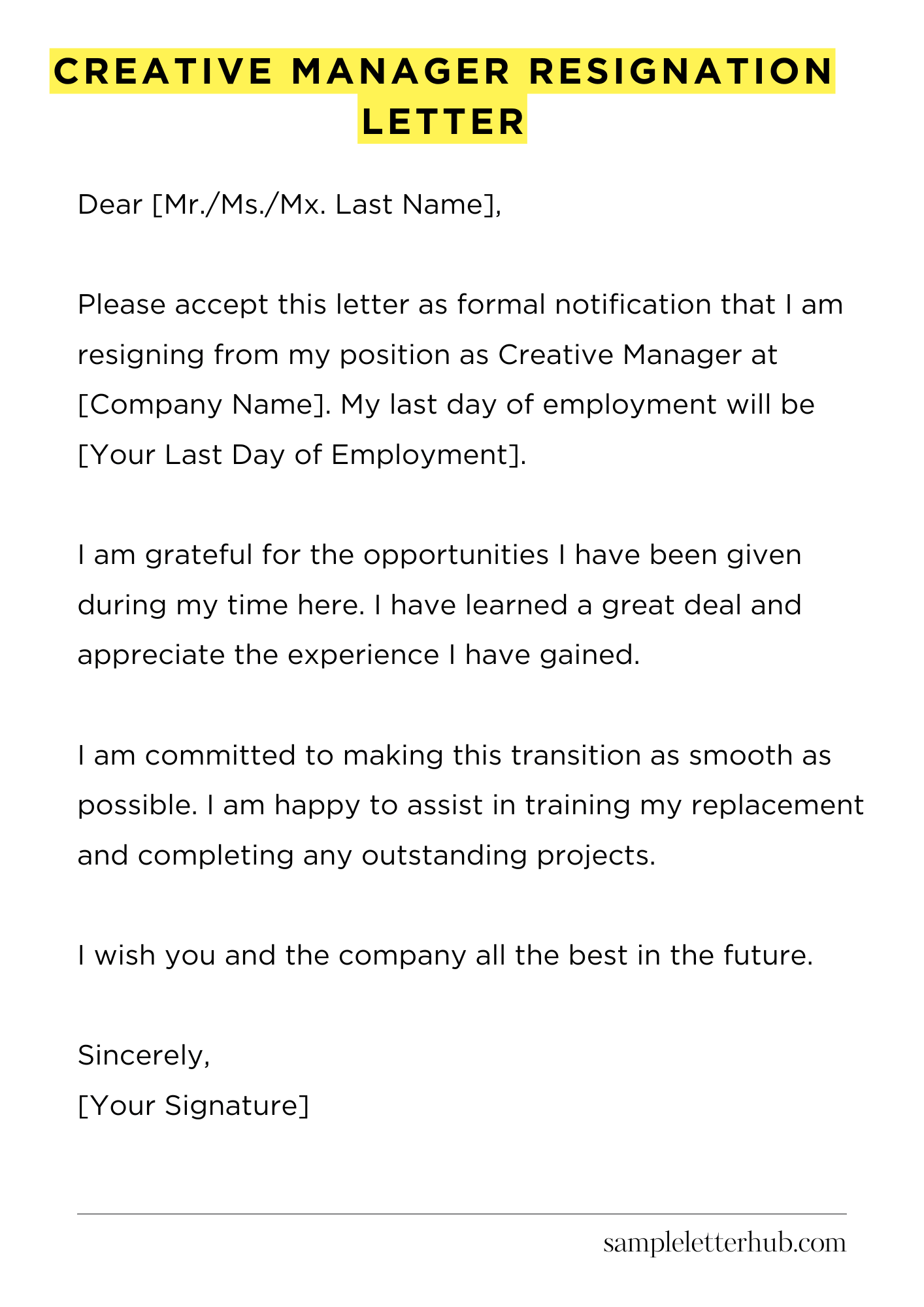
How to Write a Creative Manager Resignation Letter
Resigning from a creative manager role is a big step. It’s important to do it right. You need to show professionalism while clearly stating your intentions. You want to leave a good impression, even if you’re moving on to something new. Your resignation letter sets the stage for your departure.
1. Start with a Direct and Clear Statement
The first paragraph is crucial. Make sure your purpose is immediately clear. Don’t beat around the bush. State your resignation explicitly and specify the effective date.
A simple sentence works wonders. For example: “Please accept this letter as formal notification that I am resigning from my position as Creative Manager, effective [Date].” Keep it concise and to the point.
It helps in setting the tone right away. Don’t include any unnecessary fluff at this point.
2. Express Gratitude and Highlight Your Contributions
Now is a good time to show your appreciation. Briefly acknowledge the opportunities you’ve been given. Mention specific projects or experiences you’re grateful for.
Doing so adds a personal touch. For example, you could say: “I am grateful for the opportunities I’ve had to lead the creative team and contribute to the successful campaigns for [mention a specific client or campaign].”
This shows you’re leaving on good terms. Think of the things you’re proud of. Briefly touch on the skills you utilized. It subtly reinforces your value.
3. Provide Necessary Details and Offer Assistance
Next, offer assistance with the transition. Be prepared to help with the handover process. It demonstrates your commitment to a smooth departure.
Suggesting that you help train your replacement is always a great move. Consider: “I am committed to ensuring a smooth transition and am happy to assist in training my replacement or providing any necessary documentation before my departure.”
Detail how you can assist the team. This kind of detail leaves the company in a better position. It also shows you are a team player.
4. Maintain Professionalism and Tone
Throughout the letter, maintain a professional tone. Avoid any negativity or personal complaints. Even if you’re leaving due to negative experiences, it is important to stay polite. Keep the focus on your career goals and future opportunities. It is better to write things like: “I’m looking forward to the next stage in my career” and move ahead.
Stick to a positive and forward-looking attitude. This preserves your professional reputation.
5. Conclude with a Final Statement and Contact Information
In the final paragraph, reiterate your effective date and express your best wishes. Include your contact information if the company needs to reach you after your departure. It is vital to end on a positive note.
A simple statement like: “I wish the company continued success in the future. Please feel free to contact me at [your email address or phone number] if needed.” It works well.
Double-check the spelling, grammar, and format. Make sure the letter is clear, concise, and professional. You are all set now.
FAQs about Creative Manager Resignation Letter
What is the primary purpose of a Creative Manager resignation letter?
The primary purpose is to formally notify your employer of your intention to leave your position. It serves as an official record of your departure and helps to initiate the handover process, ensuring a smooth transition for both you and the company.
What key elements should be included in a Creative Manager resignation letter?
A well-crafted resignation letter should include your formal declaration of resignation, the effective date of your last day of employment, a brief expression of gratitude for the opportunity, and any necessary information regarding the handover of your responsibilities. It is also common to state your willingness to assist in the transition process.
How should the tone of a Creative Manager resignation letter be?
The tone should be professional and respectful. Maintain a positive and appreciative attitude, even if you are leaving due to dissatisfaction. Avoid negativity or making personal attacks. Focus on the facts and your plans for moving forward.
What is the optimal timeframe for submitting a Creative Manager resignation letter?
Typically, a Creative Manager should submit their resignation letter at least two weeks before their intended departure date. However, the specific notice period might be outlined in your employment contract. Adhering to the agreed-upon timeframe is crucial to ensure a professional departure.
Should I provide a reason for leaving in my Creative Manager resignation letter?
While not mandatory, it’s generally acceptable to briefly state your reason for leaving, such as pursuing a new opportunity or personal reasons. However, keep it concise and professional. You can elaborate on your reasons during a separate exit interview if you choose.
Related:
Resignation letter due to rude boss
Resignation letter moving to another state
Resignation letter due to illness of family member
Resignation letter due to study