

A Financial Administrator resignation letter is a formal document. Its purpose is to officially inform an employer of your departure. It outlines your intention to leave your role. This letter also specifies your last day of employment.
Are you a Financial Administrator planning to move on? We understand writing a resignation letter can be tricky. Don’t worry, we’ve got you covered.
Here, we will share various templates and examples. These samples will help you craft your own professional resignation letter. We’ve made it simple and easy for you.
Financial Administrator Resignation Letter
Below is a sample of a Financial Administrator Resignation Letter:
[Your Name]
[Your Address]
[Your Phone Number]
[Your Email Address]
[Date]
[Employer’s Name]
[Employer’s Title]
[Company Name]
[Company Address]
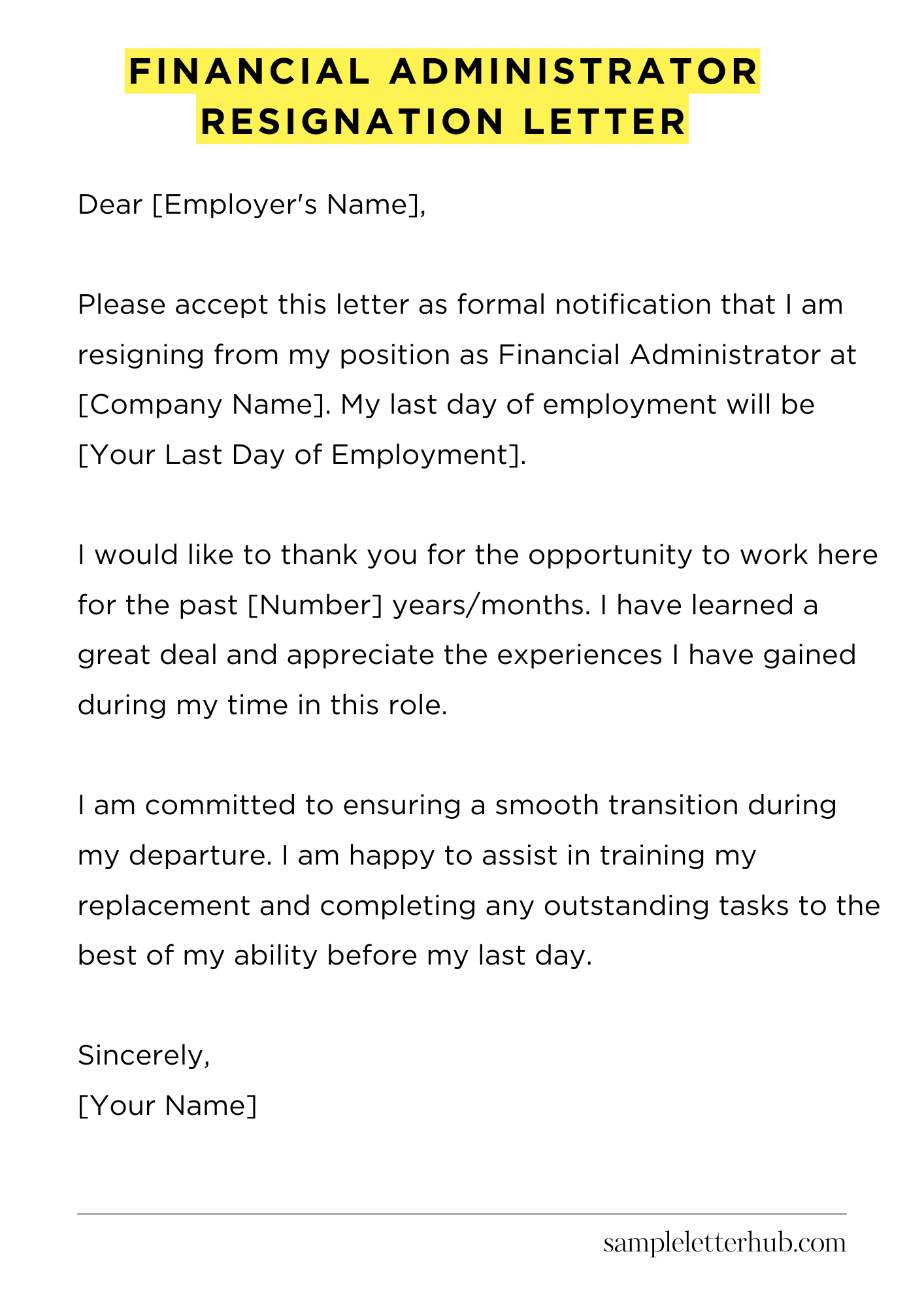
Dear [Employer’s Name],
Please accept this letter as formal notification that I am resigning from my position as Financial Administrator at [Company Name]. My last day of employment will be [Your Last Day of Employment].
I would like to thank you for the opportunity to work here for the past [Number] years/months. I have learned a great deal and appreciate the experiences I have gained during my time in this role.
I am committed to ensuring a smooth transition during my departure. I am happy to assist in training my replacement and completing any outstanding tasks to the best of my ability before my last day.
I wish you and the company continued success in the future.
Sincerely,
[Your Name]
How to Write a Financial Administrator Resignation Letter
1. Getting Started: The Basics You Need
Resigning from any job can feel daunting. But, crafting a professional resignation letter is a crucial first step. Especially when your role involves handling finances, it demands a certain level of precision and formality.
You want to leave on good terms, preserving your professional reputation. First things first: ensure you have all the necessary information at hand. This includes your name, the date, your supervisor’s name, and the company’s address.
Always use a formal business letter format. This is the standard in almost every industry, and financial administration is no exception. This typically means a clear layout with your contact details, the date, and the recipient’s information at the top.
2. The Core of Your Letter: Key Elements to Include
The heart of your letter consists of a few essential elements. Begin with a clear and direct statement of your intent to resign. Be explicit! For example: “Please accept this letter as formal notification that I am resigning from my position as Financial Administrator…” Avoid any ambiguity.
Next, state your last day of employment. This is critical for the transition process. Make sure to adhere to the notice period specified in your employment contract. Offer your assistance with the handover process.
This demonstrates professionalism and a commitment to ensuring a smooth transition. Include a sentence or two expressing your willingness to help train a replacement or complete ongoing tasks.
3. Expressing Gratitude and Maintaining Professionalism
This is where your letter transcends the purely functional and becomes a demonstration of your professionalism. Even if you’re leaving due to dissatisfaction, it’s wise to express gratitude. Consider acknowledging the opportunities you’ve been given or the skills you’ve developed during your time there. Keep this section brief, positive, and genuine.
A simple “I am grateful for the opportunities I’ve been given…” often works well. Refrain from negativity. Don’t use the letter as an opportunity to air grievances or make complaints. Doing so could potentially damage your reputation.
4. Addressing Specifics: Handover and Outstanding Tasks
Because you’re a Financial Administrator, the handover process is especially important. This is where you reassure your employer that everything will be handled correctly. This section is all about the transition.
Mention your availability to assist with the handover process. Offer to prepare necessary documentation or train your replacement. Specifically mention anything that needs immediate attention, such as closing accounts or completing essential reports.
Consider offering a timeframe for the handover and specify how you’ll ensure a smooth transition. If there are any outstanding tasks you’re responsible for, address them and make it clear how they will be completed before your departure.
5. Concluding Your Letter and Polishing It Up
End your letter with a professional and polite closing. Something like “Sincerely,” or “Respectfully,” followed by your typed name and, optionally, your signature above the typed name, is the perfect way to finish.
Before sending it, proofread your letter carefully. Check for any grammatical errors, typos, and ensure the formatting is correct. Have someone else read it over if possible.
A polished letter reflects well on you and leaves a lasting positive impression. Remember: this letter is part of your professional record. Make sure you give a great first impression. Make sure your final letter is perfect.
FAQs about Financial Administrator Resignation Letter
What is the primary purpose of a Financial Administrator resignation letter?
The primary purpose of a Financial Administrator resignation letter is to formally notify an employer of an employee’s intent to leave their position. It serves as an official record of the resignation, the effective date of departure, and may include a brief statement of gratitude or explanation for leaving. It helps to ensure a smooth transition and fulfills any contractual obligations.
What key components should be included in a Financial Administrator resignation letter?
A well-crafted Financial Administrator resignation letter should include: the date, the recipient’s name and title, a clear statement of resignation, the effective date of resignation, a brief statement of appreciation (optional), details regarding the return of company property, and your signature. It’s also often advisable to offer assistance with the handover process if possible.
How much notice should a Financial Administrator provide in their resignation letter?
The notice period depends on your employment contract, local laws, and company policy. Standard practice often dictates providing at least two weeks’ notice. However, specific agreements or the level of your position may necessitate a longer notice period. Always review your employment contract to confirm the required notice period to avoid any potential repercussions.
Should I provide a reason for resigning in my Financial Administrator resignation letter?
While not mandatory, it’s generally acceptable to briefly state a reason for resigning. This is often done to maintain a professional relationship.
Reasons can range from seeking new opportunities, personal relocation, or a different career path. Keep the reason concise and positive. It’s often advisable to avoid overly negative statements about the company or colleagues.
How should I handle the handover process when resigning as a Financial Administrator?
In your resignation letter, it’s beneficial to offer assistance with the handover process. This demonstrates professionalism and commitment.
This might include training a replacement, documenting key processes, or providing support to colleagues during your remaining time. Coordinate with your manager to establish a plan to ensure a smooth transition of your responsibilities, and this is typically done once your resignation is accepted.
Related:
Resignation letter due to rude boss
Resignation letter moving to another state
Resignation letter due to illness of family member
Resignation letter due to study