

A Research Consultant resignation letter is a formal document. Its purpose is to officially inform an employer about a consultant’s decision to leave their position. It also communicates the last day of employment. This letter is a crucial step in the professional separation process.
You’re in the right place! We’re here to help make this process easier. We’ll provide different templates. You can use these examples as a guide. They’ll help you craft your own resignation letter.
Whether you’re moving on or simply need a change, we have options. These samples are designed to be adaptable. They cover various scenarios you might encounter. Find the perfect fit for your needs and make the process smooth.
Research Consultant Resignation Letter
Below is a sample of a Research Consultant Resignation Letter:
[Your Name]
[Your Address]
[Your Phone Number]
[Your Email Address]
[Date]
[Hiring Manager Name] (If known, otherwise use title)
[Hiring Manager Title]
[Company Name]
[Company Address]
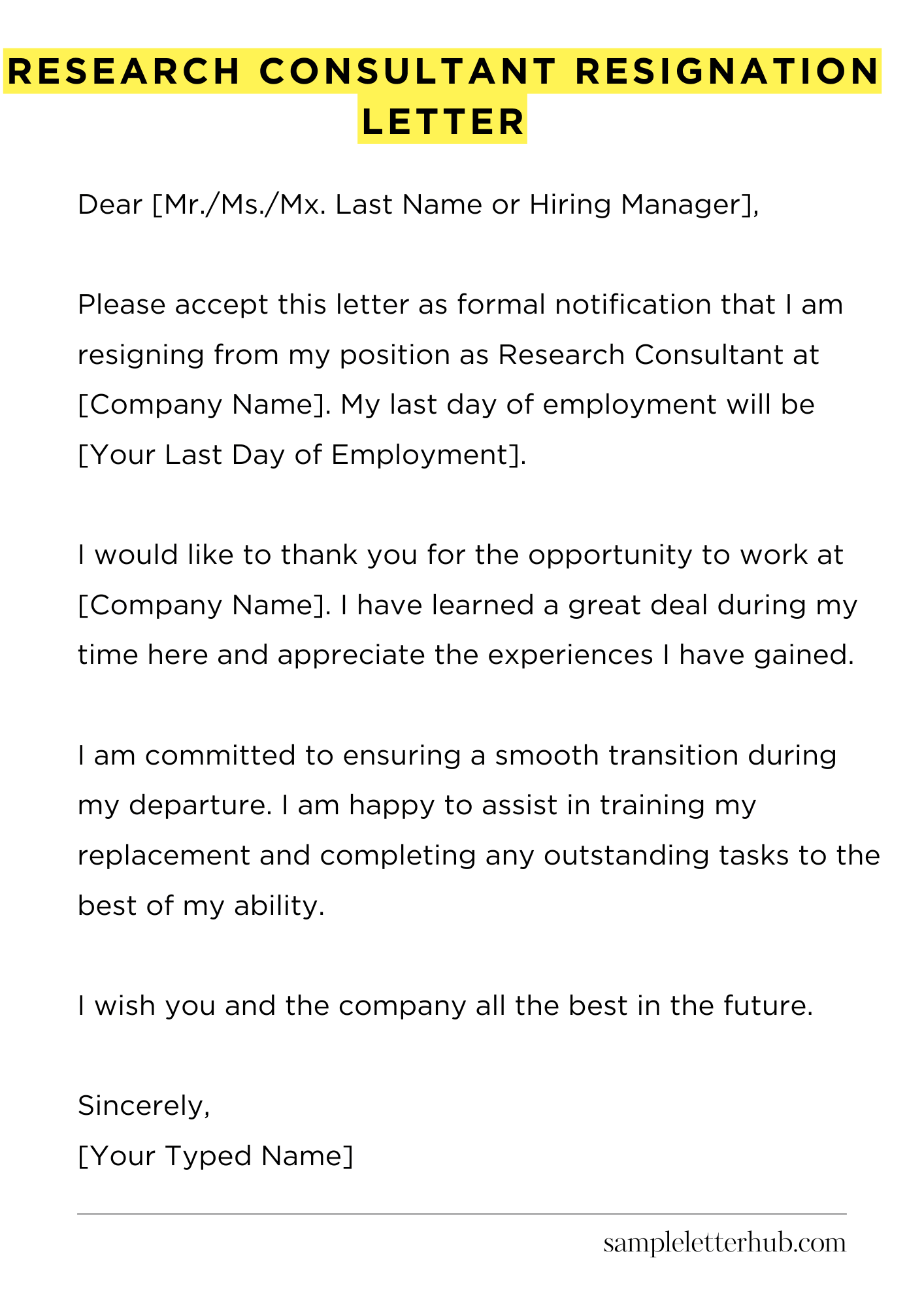
Dear [Mr./Ms./Mx. Last Name or Hiring Manager],
Please accept this letter as formal notification that I am resigning from my position as Research Consultant at [Company Name]. My last day of employment will be [Your Last Day of Employment].
I would like to thank you for the opportunity to work at [Company Name]. I have learned a great deal during my time here and appreciate the experiences I have gained.
I am committed to ensuring a smooth transition during my departure. I am happy to assist in training my replacement and completing any outstanding tasks to the best of my ability.
I wish you and the company all the best in the future.
Sincerely,
[Your Typed Name]
How to Write a Research Consultant Resignation Letter
1. Why Bother with a Resignation Letter?
Leaving a job can be a complex process. You’ve got a lot on your mind, right? You might be thinking about your next opportunity. You could be preoccupied with wrapping up current projects. However, a well-crafted resignation letter is extremely important. It’s more than just a formality; it’s a professional courtesy.
Consider it your last chance to make a good impression. A proper letter documents your departure officially. Plus, it safeguards your reputation for future reference checks. It also helps to keep the separation smooth, which is always desirable.
2. Essential Elements: What to Include
Now, let’s talk specifics. Your letter must include crucial information. Start with a clear and concise statement of your intent to resign. State your last day of employment explicitly.
Next, express your gratitude for the opportunity to have worked there. Then, briefly mention any assistance you’re offering during the transition. For example, if you will help your team after you leave. Always keep it professional and polite. Proofread very, very carefully before you send it!
3. Crafting the Perfect Tone: Keep it Professional
Professionalism is key to make sure your letter gets a good response. Avoid negativity, even if your experience was challenging. You might have had a bad time, but don’t air those grievances.
Maintain a positive and respectful tone. Even a simple “Thank you for the opportunity” can make a world of difference. Your goal is to leave a lasting impression of yourself as a competent professional. Think about the image you want to project.
4. Formatting for Clarity and Impact
Formatting is not to be overlooked, believe it or not. You want your letter to be readable and easy to understand. Keep it concise; aim for one page, if possible. Use a standard business letter format. Include your contact information at the top. Your recipient’s information should also be clearly stated.
The body should be divided into short, easy-to-read paragraphs. Use a professional font like Times New Roman or Arial. Keep the font size 12 for comfort.
5. After the Letter: What to Expect
Once you’ve submitted your letter, the process doesn’t end. Your employer will likely acknowledge your resignation. They might schedule an exit interview with you. Be prepared to discuss your departure in more detail. Be ready to answer questions about your experience and your reasons for leaving.
Remember to keep the same positive and professional attitude. Finally, make sure you complete all of your required tasks before your last day. Leaving on a good note will benefit you in the long run.
FAQs about Research Consultant Resignation Letter
What are the essential elements of a Research Consultant resignation letter?
A well-crafted resignation letter for a Research Consultant should include the following: a clear statement of resignation, your official resignation date, a concise reason for leaving (optional but often included), an expression of gratitude to your employer and colleagues, a professional offer to assist with the transition, and your contact information.
It’s also important to adhere to company policy regarding the submission of your letter.
How much notice should a Research Consultant give when resigning?
The standard notice period for a Research Consultant typically aligns with the employment contract or company policy. Commonly, this is two weeks, but it could be longer depending on your role, seniority, and employment agreement. Always review your contract and consult with HR to confirm the required notice period to avoid any complications.
Should I provide a reason for resigning in my letter?
While not always mandatory, including a brief and professional reason for leaving can be beneficial. This allows your employer to understand your decision and potentially improve in the future. You can keep it general (e.g., “pursuing other opportunities”) or, if you feel comfortable, briefly mention a specific reason. However, avoid negativity or overly detailed explanations.
How should I express gratitude in my resignation letter?
Expressing gratitude is crucial. Acknowledge the opportunities you have been given, the skills you have developed, and the relationships you’ve built. Thank your supervisors, colleagues, and the company for their support. A simple and sincere statement of appreciation can leave a positive lasting impression.
What should I do after submitting my resignation letter?
After submitting your letter, follow up with your supervisor and HR to confirm receipt and discuss the transition plan. Offer your assistance in training your replacement and completing any outstanding projects.
Be professional and cooperative throughout the remaining period of your employment. Finally, ensure all company property, such as laptops, keys, and documents, are returned before your departure.
Related:
Resignation letter due to rude boss
Resignation letter moving to another state
Resignation letter due to illness of family member
Resignation letter due to study