

A manufacturing resignation letter is a formal notice. It tells your employer you are leaving your job. The purpose is to officially announce your departure. It also helps with a smooth transition.
Crafting the perfect resignation can be tricky. Don’t worry, we’re here to help. We’ll share several templates. These templates offer different styles and formats.
You’ll find examples tailored for various situations. You can adapt them. Make them your own. Writing your letter will be easy.
Manufacturing Resignation Letter
Below is a sample of a Manufacturing Resignation Letter:
[Your Name]
[Your Address]
[Your Phone Number]
[Your Email Address]
[Date]
[Employer’s Name]
[Company Name]
[Company Address]
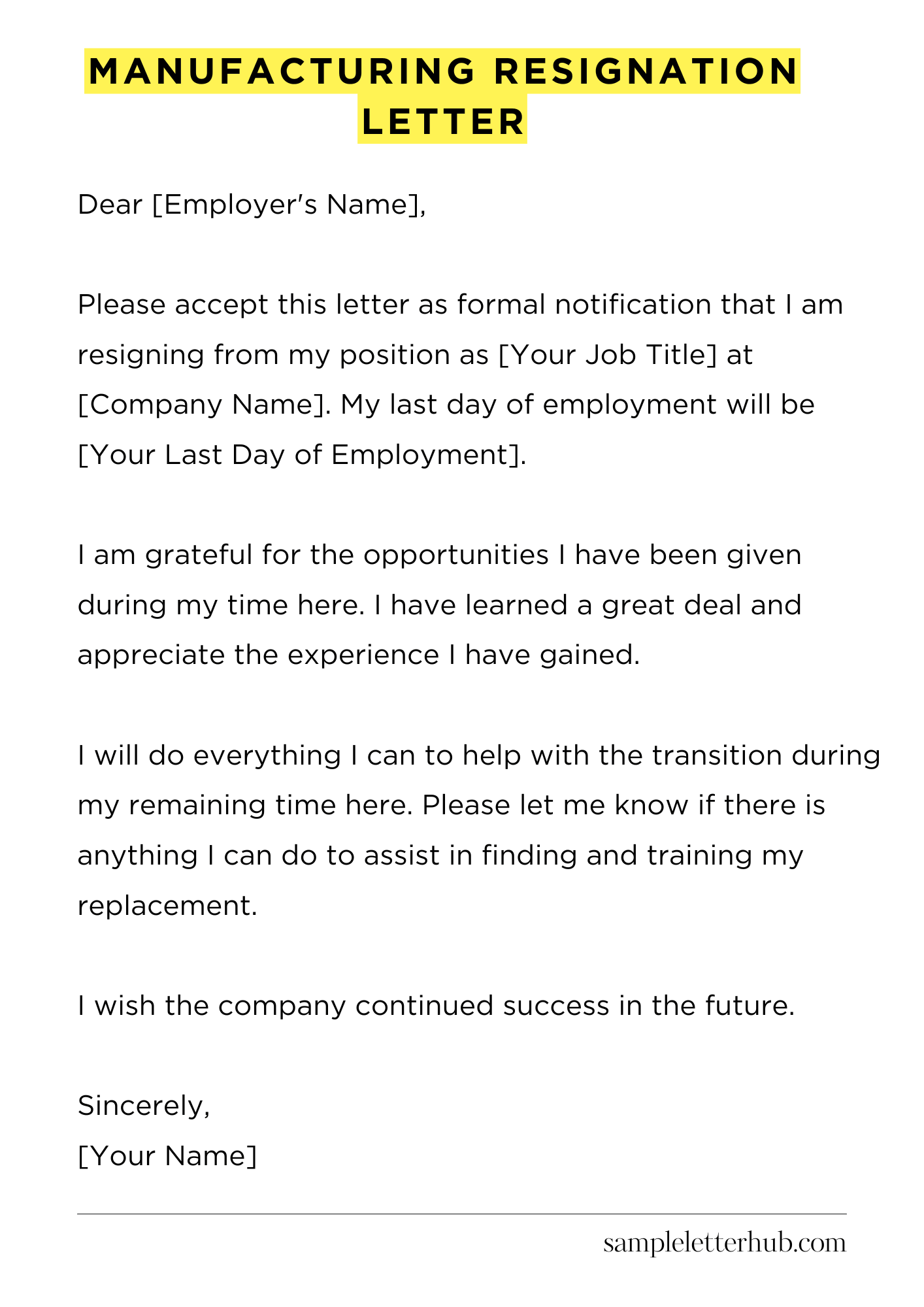
Dear [Employer’s Name],
Please accept this letter as formal notification that I am resigning from my position as [Your Job Title] at [Company Name]. My last day of employment will be [Your Last Day of Employment].
I am grateful for the opportunities I have been given during my time here. I have learned a great deal and appreciate the experience I have gained.
I will do everything I can to help with the transition during my remaining time here. Please let me know if there is anything I can do to assist in finding and training my replacement.
I wish the company continued success in the future.
Sincerely,
[Your Name]
How to Write a Manufacturing Resignation Letter
1. Start with a Clear and Concise Introduction
Leaving a job requires professionalism. It’s a standard practice. Your resignation letter needs to be direct and to the point. Begin by clearly stating your intention: you are resigning. Mention the specific position you’re leaving and the effective date of your departure. Keep it simple; avoid any unnecessary fluff. This will set the tone for the rest of your letter.
For example: “Please accept this letter as formal notification that I am resigning from my position as Production Supervisor, effective November 10, 2024.”
2. Express Gratitude and Positive Remarks
A touch of appreciation goes a long way. Even if your experience wasn’t perfect, find something positive to acknowledge. Did you learn valuable skills? Were there supportive colleagues?
This reflects well on you. Thank the employer for the opportunity to work there. It makes the transition smoother and maintains a good professional relationship. Briefly mention something you valued about your time there.
Consider this: “I am grateful for the opportunities I have been given during my time here at [Company Name]. I have learned a great deal about [mention a specific skill or area].”
3. Detail Your Last Day and Transition Plan (If Applicable)
Clarity is crucial. Restate the effective date of your resignation. Also, specify your willingness to assist in the transition. This shows you’re committed to a smooth handover.
Offer to help train your replacement or complete any ongoing tasks. This is not always required, but it’s generally a nice gesture. Confirm your last day of employment again. The smoother the transition, the better you’ll look.
A good example: “My last day of employment will be November 10, 2024. I am happy to assist in the transition process and will do my best to complete my current projects before my departure.”
4. Keep It Brief and Professional
Keep your letter focused on the essential information. Lengthy explanations and negative comments are best avoided. Stick to the facts. Refrain from discussing personal grievances or workplace conflicts. Maintaining a professional tone is paramount. You want to leave a positive lasting impression.
Remember, this letter is a reflection of you. Keep it simple and show your professionalism in your work and your resignation. Always proofread before you send it.
5. Formal Closing and Contact Information
End your letter with a formal closing and your contact information. Use a professional closing such as “Sincerely” or “Best regards.” Include your full name, and your contact details (phone number and email address) for follow-up questions. Make sure all your details are correct. Double-check to be sure.
An example of how to end: “Sincerely,
[Your Full Name]
[Your Phone Number]
[Your Email Address]”
FAQs about Manufacturing Resignation Letters
What are the essential elements of a manufacturing resignation letter?
A well-crafted resignation letter should include your formal resignation (stating your intent to leave the company), the date of your last day of employment, a concise expression of gratitude for the opportunity, and any necessary information regarding the handover of your responsibilities.
It is generally recommended to keep the tone professional and positive, even if you are leaving due to negative circumstances.
How much notice should I give in my manufacturing resignation letter?
The standard notice period is typically outlined in your employment contract or company policy. Common notice periods are two weeks or a month. Always adhere to the timeframe specified in your agreement. If your contract doesn’t specify a notice period, it’s generally best practice to provide at least two weeks’ notice to allow for a smooth transition.
Should I explain the reason for my resignation in the letter?
While not mandatory, it is often considered a professional courtesy to briefly state the reason for your departure. This can be as simple as stating you are pursuing another opportunity, seeking career advancement, or relocating. Avoid negative comments about the company or colleagues. Keep it concise and positive, focusing on your future endeavors.
How should I handle the handover of my responsibilities in the resignation letter?
In your letter, you can briefly mention your willingness to assist in the transition. While not a detailed plan, it’s good to state that you will cooperate with management to ensure a smooth handover of your duties. You might suggest a meeting to discuss the transfer of responsibilities or offer to train your replacement. This shows professionalism and respect for your colleagues and the company.
What should I do after submitting my manufacturing resignation letter?
Once you’ve submitted your letter, prepare for the handover process. This includes compiling documentation, training your replacement (if applicable), and completing any outstanding tasks.
Be prepared to answer questions and be available for any necessary meetings. Maintain a professional demeanor throughout your remaining time with the company. Be sure to collect all necessary personal items and return any company property.
Related:
Resignation letter due to rude boss
Resignation letter moving to another state
Resignation letter due to illness of family member
Resignation letter due to study