

A paralegal resignation letter is a formal document. It informs your employer of your intention to leave. This letter is your official notice. It helps ensure a smooth departure.
Crafting a resignation letter can feel tricky. We have you covered. This article features various examples. These templates will simplify the process. Use them to create your perfect letter.
Ready to move on? Explore our collection. Find the right format. Adapt it to your situation. Make your resignation clear and professional.
Paralegal Resignation Letter
Below is a sample of a Paralegal Resignation Letter:
[Your Name]
[Your Address]
[Your Phone Number]
[Your Email Address]
[Date]
[Hiring Manager Name] (If known, otherwise use title)
[Hiring Manager Title]
[Law Firm Name]
[Law Firm Address]
Dear [Mr./Ms./Mx. Last Name],
Please accept this letter as formal notification that I am resigning from my position as Paralegal at [Law Firm Name]. My last day of employment will be [Your Last Day of Employment].
I would like to thank you for the opportunity to work here. I have learned a great deal during my time at the firm, and I appreciate the experience I have gained.
I am committed to making this a smooth transition. I am happy to assist in training my replacement and completing any outstanding tasks to the best of my ability before my departure.
I wish you and the firm all the best in the future.
Sincerely,
[Your Signature]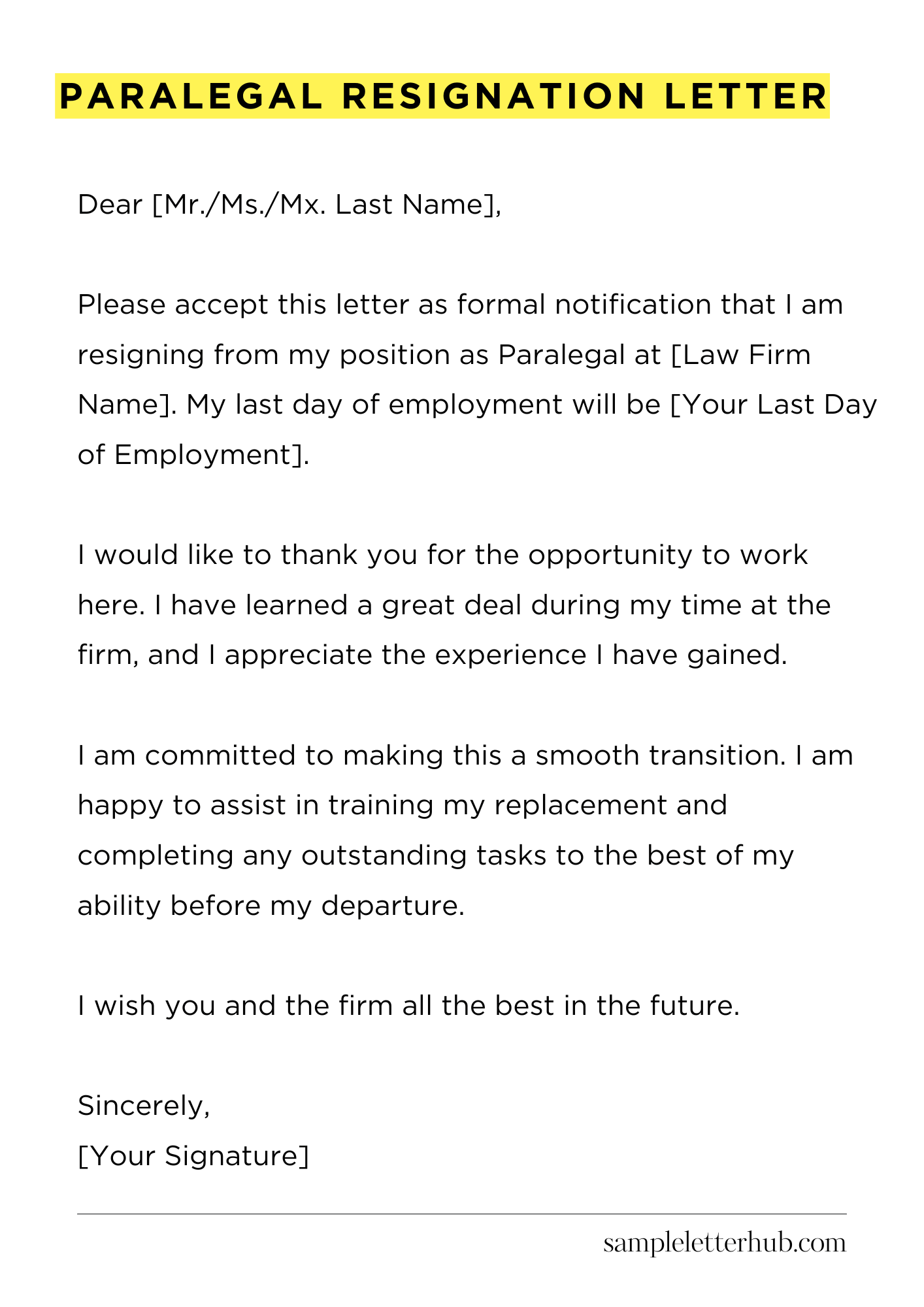
How to Write a Paralegal Resignation Letter
Leaving a job, even one you might not love, can feel tricky. Resigning as a paralegal requires a professional and respectful approach. This is your exit strategy, after all, and you want to leave a good impression. Getting it right is important for your future career prospects.
1. Keep it Short and Sweet
Your resignation letter is not the place to write a novel. It doesn’t need to be long-winded. Focus on the core information: your intention to resign. Simply state that you are resigning from your position as a paralegal.
Specify your last day of employment. This is crucial for payroll and administrative purposes. Clarity here avoids any potential misunderstandings. Make it simple, and to the point.
2. Be Professional and Polite
Even if you’re not thrilled with your current role, maintaining a professional tone is paramount. Avoid negativity, complaints, or harsh language. Thank your employer for the opportunity to work there.
Acknowledge any positive experiences you had during your time at the firm. Consider your words carefully. This is your final professional communication with them. A gracious tone can go a long way, even when you’re moving on.
3. Provide a Reason (If You Want To)
You are not obligated to explain *why* you’re leaving. However, you *can* offer a brief and neutral reason, if you wish. This could be for a “better opportunity” or “to pursue other interests.” Keep it vague, if necessary. You don’t need to overshare the details. If you’re leaving for a specific job, it is not always advised to reveal the name of your new employer.
4. Offer Assistance with the Transition
Show your commitment to a smooth handover. Offer to assist in the transition process. This could include training your replacement, completing outstanding tasks, or providing documentation.
Mention that you are willing to help in any way that you can to make the change easier. Offering assistance shows that you care about your colleagues. It reflects positively on your character and work ethic. Your goal is to show you are a good team player, even as you leave the team.
5. Proofread and Proofread Again!
This seems obvious, but it is super important. Before you send your letter, thoroughly proofread it for any errors in grammar, spelling, or punctuation. Ask a friend or colleague to review it as well. A polished letter demonstrates attention to detail, a quality highly valued in the legal profession.
Make sure it reads well and conveys the message you intend. It is easy to make mistakes. A quick review can prevent any embarrassing errors.
FAQs about Paralegal resignation letter
How do I write a paralegal resignation letter?
A paralegal resignation letter should be concise, professional, and respectful. It should include your formal resignation, the date of your last day of employment, a brief expression of gratitude for the opportunity, and a statement of your willingness to assist with the transition. Keep it short and avoid negativity. You may optionally offer a reason, but it’s not required.
What should I include in my paralegal resignation letter?
Your resignation letter should contain: Your name and contact information (though this is often included in the letterhead), the date of the letter, the recipient’s name and title, a clear statement of your resignation, your last day of employment, a brief thank you for the opportunity, and your offer to help with the transition.
When should I submit my paralegal resignation letter?
Ideally, you should submit your resignation letter at least two weeks before your intended last day of employment, though this can vary depending on your employer’s policy and your employment contract. This allows sufficient time for your employer to find a replacement and for you to assist with the handover of your responsibilities.
Can I provide a reason for resigning in my paralegal resignation letter?
While it’s not mandatory, you can briefly state the reason for your resignation. Keep the explanation professional and avoid negativity. Reasons can be anything from pursuing a new career opportunity, personal reasons, or seeking better work-life balance.
What if I want to leave my paralegal job immediately?
If you must leave immediately, such as due to an emergency, you should still submit a resignation letter. This letter should clearly state that you are resigning, the effective date of your resignation, and the reason for your immediate departure.
You might want to contact HR or your direct supervisor directly, depending on the severity of the reason to alert them immediately. However, be aware that doing so may result in not receiving final pay or benefits, depending on your employment contract and local labor laws.
Related:
Resignation letter due to rude boss
Resignation letter moving to another state
Resignation letter due to illness of family member
Resignation letter due to study