

A Security Consultant resignation letter is a formal document. It informs your employer that you are leaving your job. The letter officially ends your employment. It allows a smooth transition.
Writing a resignation letter can be tricky. We’ve got you covered. We’ll share various templates. These include examples and samples. Use these to craft your perfect letter.
Need a quick exit? Or, maybe a graceful one? Our samples offer options. Choose the best fit for your situation. Make your resignation process simple.
Security Consultant Resignation Letter
Below is a sample of a Security Consultant Resignation Letter:
[Your Name]
[Your Address]
[Your Phone Number]
[Your Email Address]
[Date]
[Recipient Name] (If known, otherwise use title)
[Recipient Title]
[Company Name]
[Company Address]
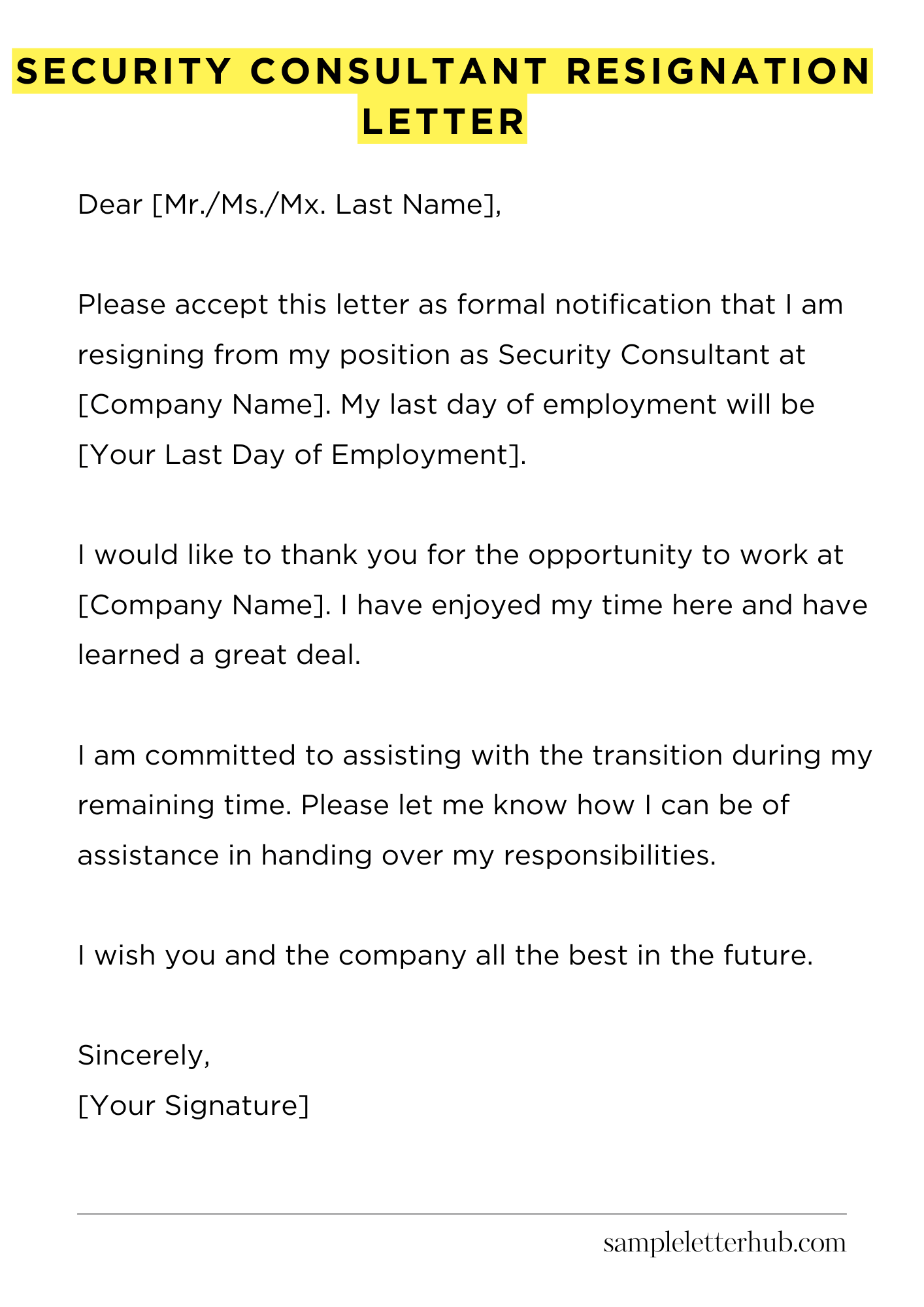
Dear [Mr./Ms./Mx. Last Name],
Please accept this letter as formal notification that I am resigning from my position as Security Consultant at [Company Name]. My last day of employment will be [Your Last Day of Employment].
I would like to thank you for the opportunity to work at [Company Name]. I have enjoyed my time here and have learned a great deal.
I am committed to assisting with the transition during my remaining time. Please let me know how I can be of assistance in handing over my responsibilities.
I wish you and the company all the best in the future.
Sincerely,
[Your Signature]
How to Write a Security Consultant Resignation Letter
Resigning from any job can be tricky, but it’s essential to do it professionally, especially when you’re a security consultant. Your expertise is valuable, and you want to leave a positive impression. Here’s a guide to help you craft a resignation letter that’s both clear and respectful.
1. Start with the Basics: Formatting and Tone
First impressions matter, so let’s get the format right. Keep it concise. Your letter shouldn’t be a novel. Use a standard business letter format. Include your name, address, and contact information.
Your employer’s information should also be there: their name, title, and the company address. This shows respect. Use a professional tone throughout. Avoid sounding overly emotional or negative. Think of this as the final professional communication with your current employer.
2. State Your Intentions Clearly
The core of your letter is stating you’re resigning. Be direct. Immediately state your intention to resign from your position as a Security Consultant. Don’t beat around the bush. Use clear and unambiguous language. Specify the effective date of your resignation.
This date is critical. Make sure it aligns with your employment contract or any company policies. This avoids misunderstandings and potential legal issues. For example: “I am writing to inform you of my resignation from my position as Security Consultant, effective October 27, 2024.”
3. Express Gratitude (and Briefly, if Necessary)
It’s always a good idea to express gratitude for the opportunities you’ve been given. Acknowledge the experience and skills you’ve gained. This shows professionalism and respect. You can briefly mention positive aspects of your time at the company. Keep it short and sincere. Avoid going overboard.
For example: “I am grateful for the opportunities I’ve been given during my time here and for the experience I’ve gained in [mention specific areas].”
4. Offer Assistance with Transition
This is where you demonstrate your commitment to a smooth handover. Offer your help in the transition process. This shows you care about the company’s well-being. Offer to assist in training your replacement or completing any pending projects. This can go a long way in preserving a positive relationship.
Be specific. Mention how you can help. For instance: “I am happy to assist in the transition of my responsibilities and am available to train my replacement, as needed.”
5. Final Touches: Sign-off and Review
End your letter with a professional closing. Use “Sincerely” or “Best regards.” Then, sign your name above your typed name. Before sending it, review your letter carefully.
Check for any grammatical errors or typos. Proofread it thoroughly. Make sure the dates are correct. Consider having a trusted friend or colleague review it as well. It’s always good to have a second pair of eyes. Keep a copy for your records. This is for your own future reference. Good luck!
FAQs about Security Consultant resignation letter
Navigating the process of resigning from any role, particularly within the sensitive field of security consulting, requires careful consideration. A well-crafted resignation letter is essential for ensuring a smooth transition and maintaining a professional relationship. Here are the most frequently asked questions.
What is the primary purpose of a security consultant resignation letter?
The primary purpose is to formally notify your employer of your intention to leave the company. It serves as an official record of your departure, enabling a clean break and setting the stage for a positive final interaction.
The letter should clearly state your last day of employment and can be used to express gratitude, provide brief context for your departure, and offer assistance with the handover of your duties.
What key elements should be included in a security consultant resignation letter?
Your letter should include: your official name and the date, the name and title of the recipient (usually your direct manager or HR representative), a clear and concise statement of your resignation and the effective date, any relevant details regarding the handover of projects or responsibilities, an expression of gratitude for the opportunity.
How much notice should a security consultant give when resigning?
The standard practice is to adhere to the notice period specified in your employment contract or company policy. This is typically two to four weeks. However, depending on your role and the specific project timelines, providing more notice can be beneficial, especially to allow for a comprehensive handover of your ongoing tasks and projects.
Should I provide a reason for leaving in my resignation letter?
While not always required, briefly mentioning the reason for your departure can be helpful. You do not need to provide extensive details. A simple statement such as “I have accepted a new opportunity that aligns more closely with my career goals” or “I am pursuing other interests” can suffice.
Keep the statement neutral and positive, focusing on the future rather than any current dissatisfaction.
Can I offer to assist with the transition of my duties in the resignation letter?
Yes, offering to assist with the transition is highly recommended. It demonstrates professionalism and a commitment to ensuring a smooth handover of your responsibilities.
You can offer to train your replacement, document ongoing projects, or provide any other necessary support to ensure a seamless workflow after your departure. This can also help maintain a positive relationship with your employer.
Related:
Resignation letter due to rude boss
Resignation letter moving to another state
Resignation letter due to illness of family member
Resignation letter due to study