

A “Senior Analyst resignation letter” is a formal document. It is how you officially announce your departure. It informs your employer of your decision. It also outlines your last day of employment.
Thinking of moving on? It can be tricky to write your letter. That’s why we’re here to help! We’ll show you examples. Use these templates. Customize them to fit your situation.
Get ready to craft your perfect goodbye. We offer various samples. They’re designed to make writing easier. Say farewell professionally and with confidence.
Senior Analyst Resignation Letter
Below is a sample of a Senior Analyst Resignation Letter:
[Your Name]
[Your Address]
[Your Phone Number]
[Your Email Address]
[Date]
[Hiring Manager Name] (If known, otherwise use title)
[Hiring Manager Title]
[Company Name]
[Company Address]
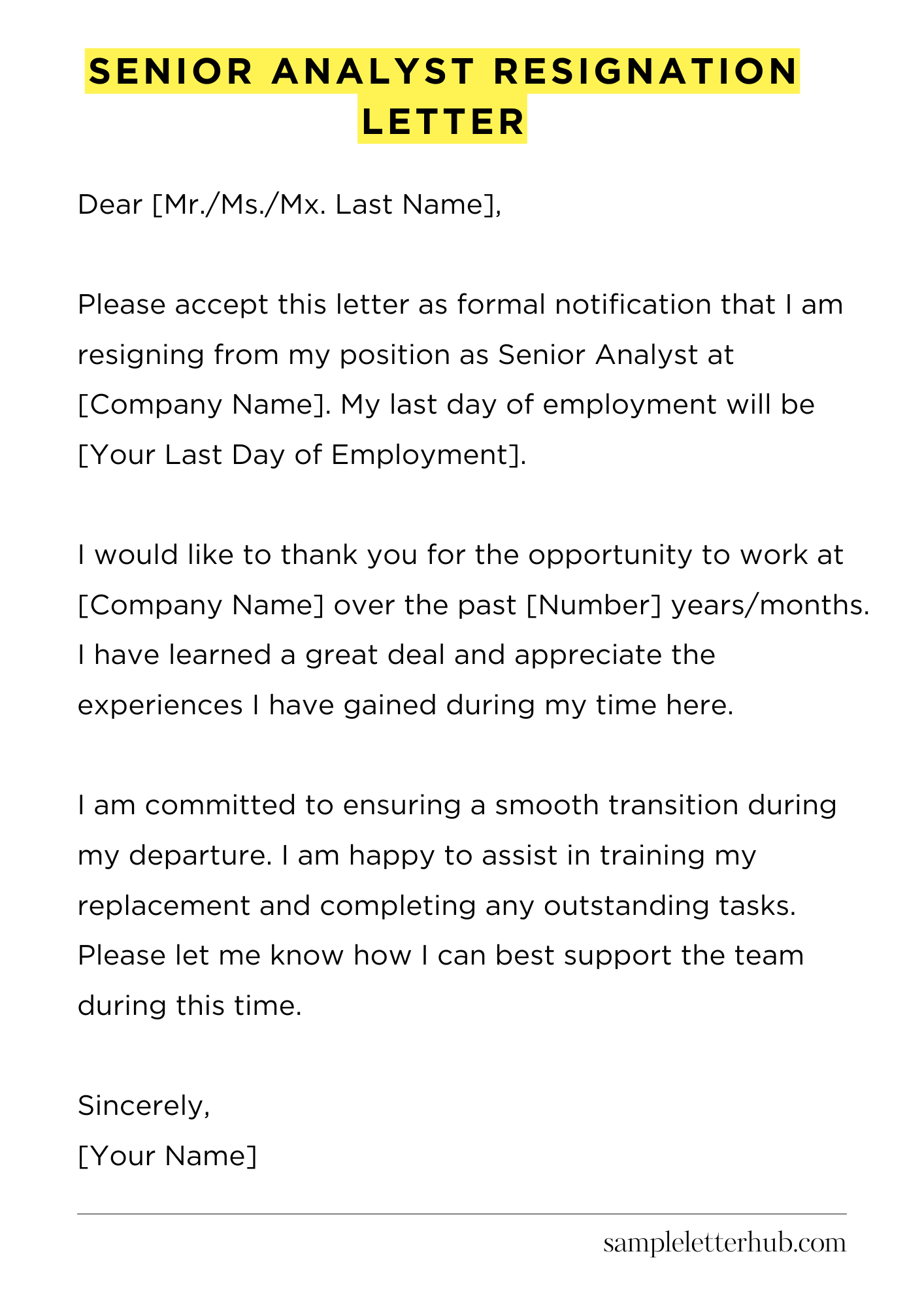
Dear [Mr./Ms./Mx. Last Name],
Please accept this letter as formal notification that I am resigning from my position as Senior Analyst at [Company Name]. My last day of employment will be [Your Last Day of Employment].
I would like to thank you for the opportunity to work at [Company Name] over the past [Number] years/months. I have learned a great deal and appreciate the experiences I have gained during my time here.
I am committed to ensuring a smooth transition during my departure. I am happy to assist in training my replacement and completing any outstanding tasks. Please let me know how I can best support the team during this time.
I wish you and [Company Name] all the best in the future.
Sincerely,
[Your Name]
How to Write a Senior Analyst Resignation Letter
So, you’re ready to move on. Congratulations on the new opportunity or the well-deserved change! A crucial step in this process is crafting a professional resignation letter. It’s more than just a formality. Your Senior Analyst resignation letter can impact your future career and how your departure is perceived. Let’s get into the specifics of how to write a good one.
1. Keep it Concise and Clear
First and foremost: brevity is key. You don’t need to write a novel. The entire letter should be one page, ideally. State your intention clearly and directly in the first paragraph. Specify your last day of employment. This avoids any confusion. Your manager needs to know when you’re leaving!
For example, you might start with: “Please accept this letter as formal notification that I am resigning from my position as Senior Analyst, effective [Your Last Day of Employment].” Make sure this crucial information is easy to find.
2. Express Gratitude (and Be Sincere)
This is where you show some class. It’s always a good idea to express gratitude for the opportunities you’ve been given at the company. Reflect on what you’ve learned. Mention any positive experiences, mentorship, or skills acquired. Even if your experience wasn’t perfect, find something genuinely positive to acknowledge.
It shows you’re a professional. Consider a sentence like: “I am grateful for the opportunities I’ve had to develop my analytical skills and contribute to [mention a specific project or achievement].” This demonstrates appreciation without sounding forced.
3. Offer Assistance with the Transition
Leaving gracefully means offering to help with the transition. This is crucial. Offer your assistance in training your replacement. Indicate your willingness to help transfer your responsibilities.
This reflects positively on you and makes the process easier for your team. You could write: “I am committed to ensuring a smooth transition and am happy to assist in training my replacement or completing any outstanding tasks before my departure.” This simple act goes a long way. Make sure to actually follow through on this offer, too.
4. Maintain a Professional Tone (Always!)
No matter your reasons for leaving, keep the tone professional. Avoid any negative comments about your colleagues, manager, or the company. Now is not the time to air grievances. Maintain a positive and respectful tone throughout the letter. Focus on the future and the new opportunities ahead.
Remember that this letter is a permanent record. You want it to reflect well on you. Proofread it carefully before sending it. Check for any grammatical errors or typos that could undermine your professionalism. That is important.
5. Finalize with a Simple Closing and Contact Information
End the letter with a polite closing. Something like: “I wish you and the company all the best in the future.” Include your contact information. This is for any follow-up questions or for providing any documents you might have. You may include your personal email address or a phone number.
This way, the company can reach you easily if they need to. Sign the letter. Don’t forget your signature! That adds a personal touch. By following these steps, you’ll be able to create a Senior Analyst resignation letter that leaves a positive and lasting impression.
FAQs about Senior Analyst Resignation Letter
What are the essential elements to include in a Senior Analyst resignation letter?
A Senior Analyst resignation letter should include: your formal announcement of resignation, your official last day of employment, a statement of gratitude for the opportunity (optional but recommended), a brief and professional reason for leaving (optional), and your contact information. Be sure to address it to the correct person and sign it with your name.
How much notice should a Senior Analyst give when resigning?
The standard notice period for a Senior Analyst, or any salaried position, is typically two weeks. However, it’s crucial to review your employment contract or company policy, as this period might be longer depending on your agreement. Always adhere to the terms of your contract.
Should I include a reason for leaving in my Senior Analyst resignation letter?
While not mandatory, briefly stating your reason for leaving can be beneficial. It’s best to keep it professional and concise. Common reasons include accepting a new position, pursuing further education, or seeking a better work-life balance. Avoid negative comments about your current employer or colleagues.
What tone should I use in my Senior Analyst resignation letter?
Maintain a professional and respectful tone throughout your letter. Express gratitude for the opportunity, even if you are leaving due to negative reasons. Avoid overly emotional language, complaints, or negativity. Focus on the facts and your plans.
How should I handle outstanding projects and responsibilities in my resignation letter?
In your resignation letter, you can briefly mention your willingness to assist in the transition of your duties. You can state that you’re available to train your replacement and ensure a smooth handover of your projects. Be specific, for example, “I am committed to completing [Project Name] and assisting with the transition of my responsibilities before my departure.”
Related:
Resignation letter due to rude boss
Resignation letter moving to another state
Resignation letter due to illness of family member
Resignation letter due to study