

An Education Director resignation letter is a formal document. It is used to inform an employer about leaving a position. The letter states the employee’s intent to resign. It also includes the effective date of departure.
Writing a resignation letter can be tricky. We’ve got you covered. We’ll share helpful letter templates. You’ll find different examples. These samples make writing your own letter easier.
Need to say goodbye to your Education Director role? This is the place to be. Find the perfect words to move on. Let’s make your transition smooth.
Education Director Resignation Letter
Below is a sample of a Education Director Resignation Letter:
[Your Name]
[Your Address]
[Your Phone Number]
[Your Email Address]
[Date]
[Education Director’s Name]
[School/Organization Name]
[School/Organization Address]
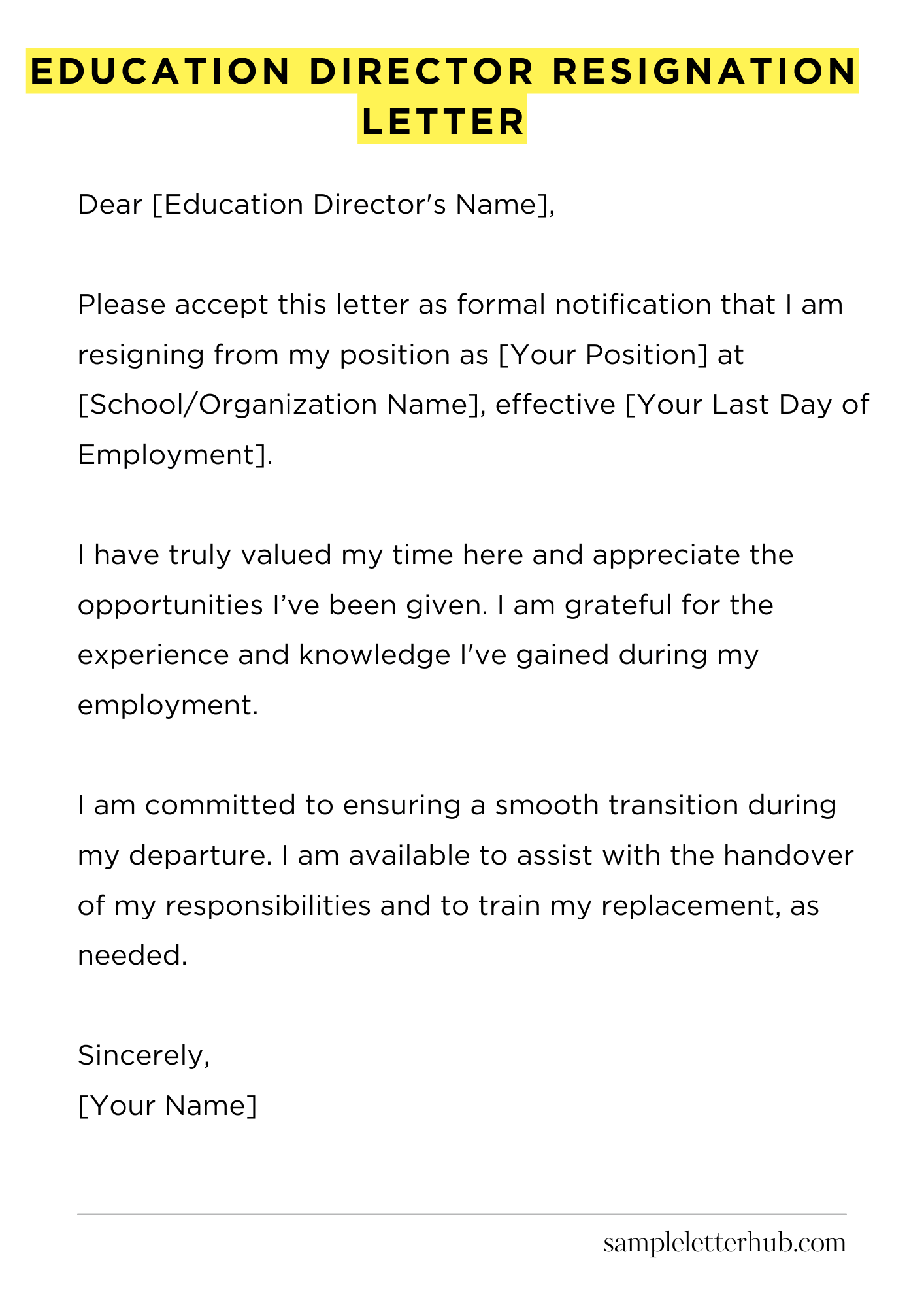
Dear [Education Director’s Name],
Please accept this letter as formal notification that I am resigning from my position as [Your Position] at [School/Organization Name], effective [Your Last Day of Employment].
I have truly valued my time here and appreciate the opportunities I’ve been given. I am grateful for the experience and knowledge I’ve gained during my employment.
I am committed to ensuring a smooth transition during my departure. I am available to assist with the handover of my responsibilities and to train my replacement, as needed. Please let me know how I can be of assistance in this process.
I wish you and the [School/Organization Name] continued success in the future.
Sincerely,
[Your Name]
How to Write an Education Director Resignation Letter
Getting Started: Your Foundation
Leaving a job, especially a position of leadership like an Education Director, requires careful planning and execution. The first step involves understanding your reasons for leaving.
Consider the things that led you to this decision. Think through your reasons; are they personal, professional, or both? This crucial introspection is the bedrock for crafting a strong and professional resignation letter. Now, let’s get into the structure!
The Anatomy of a Great Resignation Letter
A well-written resignation letter is more than just a formality; it’s a reflection of your professionalism and a lasting impression. Begin with a clear and concise statement of your intent to resign. State your position and the effective date of your departure. Keep it short and sweet. Next, express your gratitude.
Acknowledge your experience and the opportunities afforded to you during your tenure. Thank the organization and, where appropriate, specific individuals who supported your journey. Remember, professionalism is key here. It’s important to keep things formal and respectful.
Key Information to Include
After your initial statement and expressions of gratitude, shift your focus to the practicalities. Offer to assist with the transition. Be sure to address your replacement, or help train them, if need be.
You should provide assistance in whatever capacity they need. This could involve training your replacement, documenting ongoing projects, or providing essential information. Your goal is to make the process as seamless as possible.
Do not forget to include your contact information. This ensures that you can be reached for clarification or future reference. Make sure the date and signature are included.
Things to Avoid: Staying Professional
Certain things are best left unsaid in a resignation letter. Avoid negativity. Do not criticize your colleagues, the organization, or its policies. Keep the tone positive and forward-looking.
Avoid getting into excessive detail about your reasons for leaving. Unless absolutely necessary, keep the focus on your plans for the future. Don’t burn bridges. Even if your experience has not been ideal, maintain a professional and respectful tone. Remember, the letter is a record.
Final Touches: Polishing Your Letter
Before submitting your letter, proofread it carefully. Check for any grammatical errors, spelling mistakes, and ensure the language is clear and professional. Ask a trusted colleague or friend to review the letter. A fresh pair of eyes can often catch errors that you might miss.
Once you are satisfied with the final version, make a copy for your records. Then, submit the letter according to the organization’s protocol, usually to your supervisor or the human resources department. And then, good luck with your future endeavors!
FAQs about Education Director resignation letter
What is the primary purpose of an Education Director’s resignation letter?
The primary purpose of an Education Director’s resignation letter is to formally notify the employer of the intent to leave the position. It serves as a written record of the decision, initiating the official process of departure and allowing for a smooth transition of responsibilities.
What key elements should be included in an Education Director’s resignation letter?
Essential elements include a clear and concise statement of resignation, the effective date of departure, a brief expression of gratitude for the opportunity, and any necessary information regarding the handover of duties. Some letters may include a reason for leaving, though this is not always required.
How much notice should an Education Director provide when resigning?
The amount of notice typically depends on the employment contract or company policy. However, as a general guideline, a minimum of two to four weeks’ notice is standard practice. Providing ample notice allows the organization to find a replacement and ensures a more orderly transition.
Can an Education Director’s resignation letter be adjusted for different circumstances?
Yes, the letter can be tailored to suit specific situations. For example, if leaving due to a new job offer, you might state that. If resigning for personal reasons, you might keep the explanation brief. The tone and specific content should align with the individual’s situation and relationship with the employer.
Is it necessary to include a reason for resigning in the letter?
While not always required, including a brief, professional reason can be helpful. It provides context for the departure and can aid in any exit interviews or discussions. However, if you prefer not to disclose the reason, or it is a sensitive matter, it’s perfectly acceptable to keep it general, such as stating you are pursuing other opportunities.
Related:
Resignation letter due to rude boss
Resignation letter moving to another state
Resignation letter due to illness of family member
Resignation letter due to study