

An “Assurance Associate resignation letter” is a formal document. It is used to inform your employer of your intent to leave. This letter initiates the process of your departure from the company.
Planning your exit can feel overwhelming. We understand. This article is designed to help you. We have prepared several templates and examples. These are for crafting your resignation letter.
We’ll share diverse samples. You can easily adapt them. Each sample is a starting point. Choose the one that suits your needs. Writing this letter doesn’t have to be hard.
Assurance Associate Resignation Letter
Below is a sample of a Assurance Associate Resignation Letter:
[Your Name]
[Your Address]
[Your Phone Number]
[Your Email Address]
[Date]
[Hiring Manager Name] (If known, otherwise use title)
[Hiring Manager Title]
[Company Name]
[Company Address]
Dear [Mr./Ms./Mx. Last Name],
Please accept this letter as formal notification that I am resigning from my position as Assurance Associate at [Company Name]. My last day of employment will be [Your Last Day of Employment].
I would like to express my gratitude for the opportunities I have been given during my time here. I have learned a great deal and appreciate the experiences I have gained.
I am committed to assisting with the transition process in any way I can. Please let me know how I can be of help to ensure a smooth handover of my responsibilities.
I wish you and the company all the best in the future.
Sincerely,
[Your Signature]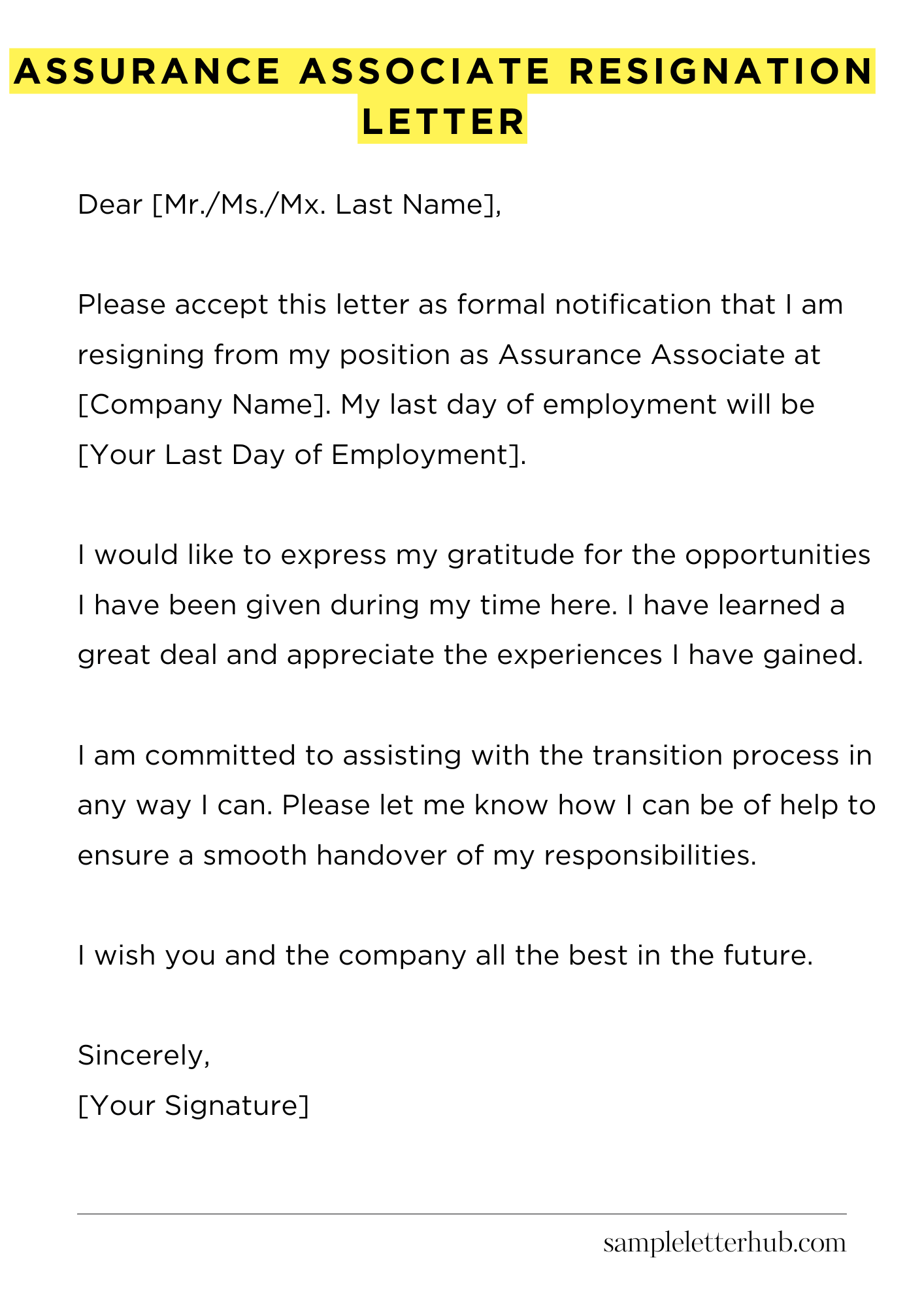
How to Write Assurance Associate Resignation Letter
1. Grasping the Basics: Why Your Letter Matters
Leaving a job, especially as an Assurance Associate, requires a professional touch. Think of your resignation letter as the final impression you’ll leave with your current employer. It’s more than just a formality; it’s a critical document. You want to maintain a positive relationship, even as you move on.
A well-crafted letter can pave the way for a smooth transition. Consider it your last act, and make it count!
Good communication is key, always.
2. Essential Elements: What Your Letter MUST Include
Certain components are absolutely vital. First and foremost, clearly state your intent to resign. Include the specific date of your last day of employment. Don’t leave any room for misinterpretation. Secondly, express your gratitude for the opportunity. Mention any positive experiences or skills gained during your time.
This adds a layer of professionalism and respect. Keep it simple and to the point. Finally, offer assistance with the transition. This simple gesture demonstrates your dedication to helping your team. Be professional, always.
3. Structuring Your Letter: A Step-by-Step Guide
Organization is everything when writing. Start with a formal salutation. This usually involves addressing your supervisor or HR representative by name. Then, clearly state your resignation. Follow this with a brief statement of gratitude. Next, outline your last day of employment. It’s crucial to be explicit.
Include a sentence or two offering help with the transition. Finally, end with a professional closing, such as “Sincerely” or “Best regards”, followed by your typed name. Proofread carefully before sending it. Attention to detail is important.
4. Tailoring Your Message: Keeping it Specific and Relevant
Generic letters aren’t very effective. While adhering to the basic format, customize the content. Reflect on your specific experiences as an Assurance Associate. Did you learn a new skill?
Did you enjoy working on a particular project? Acknowledge these things if you wish to. Mentioning something specific makes the letter more personal and shows that you truly valued your time there. Avoid vague statements. Tailor it to the job you did, and the people you worked with.
Specific examples are always better.
5. The Finishing Touches: Polishing and Proofreading
Once you’ve written your letter, take a moment to review it thoroughly. Check for any grammatical errors or typos. Ensure the tone is appropriate – professional and respectful.
Ask a friend or colleague to read it over as a second pair of eyes. They might catch something you missed. Finally, print a clean copy, or send it as a PDF for a polished appearance. This letter is your legacy, make it good.
Never rush it. Time is of the essence.
FAQs about Assurance Associate resignation letter
How much notice should I give in my Assurance Associate resignation letter?
The standard notice period for an Assurance Associate is typically two weeks. However, this can vary based on your employment contract and company policy. Review your employment agreement to confirm the required notice period. Providing adequate notice is crucial for maintaining a professional relationship with your employer and ensuring a smooth transition.
What should I include in my Assurance Associate resignation letter?
Your resignation letter should include a clear statement of your intent to resign, your official last day of employment, a brief expression of gratitude for the opportunity to work at the company, and any relevant information regarding the handover of your responsibilities. It is usually best to avoid negative comments and keep the tone professional.
Can I provide a reason for my resignation in the letter?
While it’s not mandatory, you may choose to briefly state the reason for your resignation. Keep it concise and professional, such as “to pursue other opportunities” or “for personal reasons.” Avoid going into excessive detail.
How should I deliver my Assurance Associate resignation letter?
It’s best practice to submit your resignation letter in writing to your direct supervisor or HR department. Consider delivering it in person or via email, ensuring you obtain confirmation of receipt. This confirms the date of resignation and helps avoid any misunderstandings.
What happens after I submit my resignation letter?
After submitting your resignation letter, you should anticipate a discussion with your supervisor or HR representative. They may discuss your handover process, conduct an exit interview, and clarify your final pay and benefits. You should prepare to answer any questions about your ongoing projects, the transition of your responsibilities, and your final day of work.
Related:
Resignation letter due to rude boss
Resignation letter moving to another state
Resignation letter due to illness of family member
Resignation letter due to study