

A bookkeeper resignation letter is a formal document. It informs an employer of your intention to leave your bookkeeping position. This letter is crucial. It officially ends your employment.
Writing this letter can be daunting. We are here to help. This article provides helpful templates. You can use these as a guide. They offer different formats and examples.
Get ready to craft your perfect letter. We’ll show you various samples. They cover different situations. Make your job easier.
Bookkeeper Resignation Letter
Below is a sample of a Bookkeeper Resignation Letter:
[Your Name]
[Your Address]
[Your Phone Number]
[Your Email Address]
[Date]
[Employer’s Name]
[Company Name]
[Company Address]
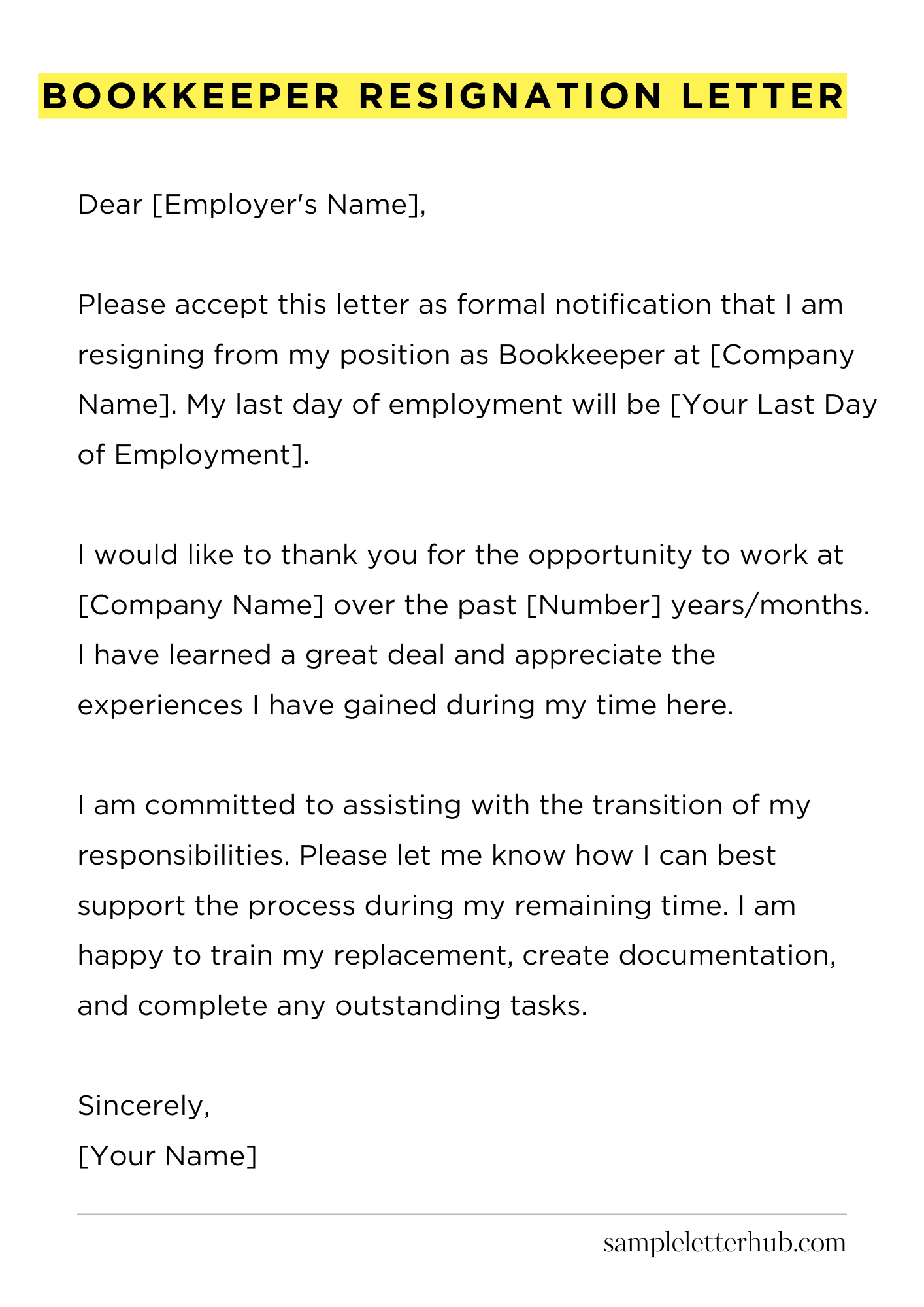
Dear [Employer’s Name],
Please accept this letter as formal notification that I am resigning from my position as Bookkeeper at [Company Name]. My last day of employment will be [Your Last Day of Employment].
I would like to thank you for the opportunity to work at [Company Name] over the past [Number] years/months. I have learned a great deal and appreciate the experiences I have gained during my time here.
I am committed to assisting with the transition of my responsibilities. Please let me know how I can best support the process during my remaining time. I am happy to train my replacement, create documentation, and complete any outstanding tasks.
I wish you and [Company Name] all the best in the future.
Sincerely,
[Your Name]
How to Write a Bookkeeper Resignation Letter
1. Why is a Resignation Letter Necessary?
Leaving a job as a bookkeeper requires more than just a quick chat with your boss. A well-crafted resignation letter is absolutely essential. Think of it like this: it’s your official record. It clearly states your intention to leave, the date your employment will end, and offers a professional way to depart.
Consider it a crucial piece of documentation for both you and your employer. A proper letter keeps things clean and professional. It also protects you legally.
2. Key Components: What to Include
Okay, so what exactly goes in the letter? You’ll want to include a few critical elements. First, state your intention to resign clearly. For example, “I am writing to formally resign from my position as Bookkeeper.” Next, specify your last day of employment. This is super important; make it crystal clear.
Be sure to express your gratitude for the opportunity. You were given a chance and that is something to be thankful for. Briefly mention your reason for leaving, if you choose to. Finally, offer assistance with the transition. A short phrase like, “I am happy to assist in training my replacement” is a great addition.
3. Formatting: Keeping it Professional
Presentation matters! Even in the digital age, a well-formatted letter speaks volumes. Use a professional business letter format. Start with your contact information, followed by the date, and then your employer’s information. Keep your tone formal and respectful throughout. Use a clear, easy-to-read font like Times New Roman or Arial.
Keep the font size at 12 point. Break up your letter into paragraphs. Proofread carefully. Check for grammar and spelling errors. Errors make you look bad! Consider signing the letter by hand if you are submitting a physical copy.
4. Specific Examples & Phrases
Let’s look at some phrases you can use. To start, try, “Please accept this letter as formal notification that I am resigning from my position as Bookkeeper.” For the date, you could say, “My last day of employment will be [Date].”
To show appreciation, consider: “I am grateful for the opportunities I have been given during my time here.” To offer help: “I am happy to assist in the transition process to ensure a smooth handover of my responsibilities.” Tailor these examples to your situation, and you’ll do great!
5. What to Avoid: Common Mistakes
Certain things should be left out of your resignation letter. Avoid negativity, even if you’re unhappy. Don’t rant about your boss, your colleagues, or the company. Keep the letter concise and to the point. Also, don’t make demands. You’re leaving, remember? Avoid providing excessive detail about your new job or other personal matters.
Keep the focus on your departure and the smooth handover of your duties. Finally, don’t burn bridges. You never know when your paths might cross again!
FAQs about Bookkeeper resignation letter
How do I write a bookkeeper resignation letter?
A bookkeeper resignation letter should be professional, concise, and respectful. Begin by stating your intent to resign, including your last day of employment. Briefly express gratitude for the opportunity.
Keep the tone positive and avoid negative comments about your experience. You may briefly state the reason for leaving, but this is optional. Offer to assist with the transition. Conclude with a thank you and your contact information.
What information should be included in a bookkeeper resignation letter?
Essential information includes: your formal resignation, your last day of employment, a brief expression of gratitude, and your contact information. You may include the reason for leaving (though it is not mandatory). Providing any assistance to transition your tasks may also be included, such as training your replacement.
What is the appropriate notice period for a bookkeeper resignation?
The appropriate notice period typically aligns with the employment contract or company policy. Typically, a two-week notice is standard. Review your employment agreement or consult with your HR department. Give as much notice as possible.
How should I handle sensitive information in my bookkeeper resignation letter?
Avoid including confidential information in your resignation letter. Maintain professional discretion. If you’re concerned about handling sensitive financial data, seek legal advice before resigning, and only share information as it is needed to transition your responsibilities.
Can I provide a reason for resigning in my bookkeeper resignation letter?
Yes, you may provide a brief reason for resigning. Keep it concise, positive, and professional. You do not need to provide extensive details. Consider stating you have accepted a new position, or are seeking new opportunities. However, providing a reason is optional.
Related:
Resignation letter due to rude boss
Resignation letter moving to another state
Resignation letter due to illness of family member
Resignation letter due to study