

An Artistic Director resignation letter formally announces your departure. It’s a crucial document. It officially communicates your decision to leave your role. This letter serves several purposes. It provides a record of your resignation. It helps to ensure a smooth transition.
Preparing to step down can be daunting. You want to make sure you do it right. We’re here to help. This article offers helpful templates. We’ve compiled a collection of examples. These samples will guide you.
Use these as a starting point. Tailor them to your specific situation. Writing your own letter becomes much easier. Explore our selection and craft your own resignation letter.
Artistic Director Resignation Letter
Below is a sample of a Artistic Director Resignation Letter:
[Your Name]
[Your Address]
[Your Phone Number]
[Your Email Address]
[Date]
[Artistic Director’s Name (if known), or “The Board of Directors”]
[Theatre/Company Name]
[Theatre/Company Address]
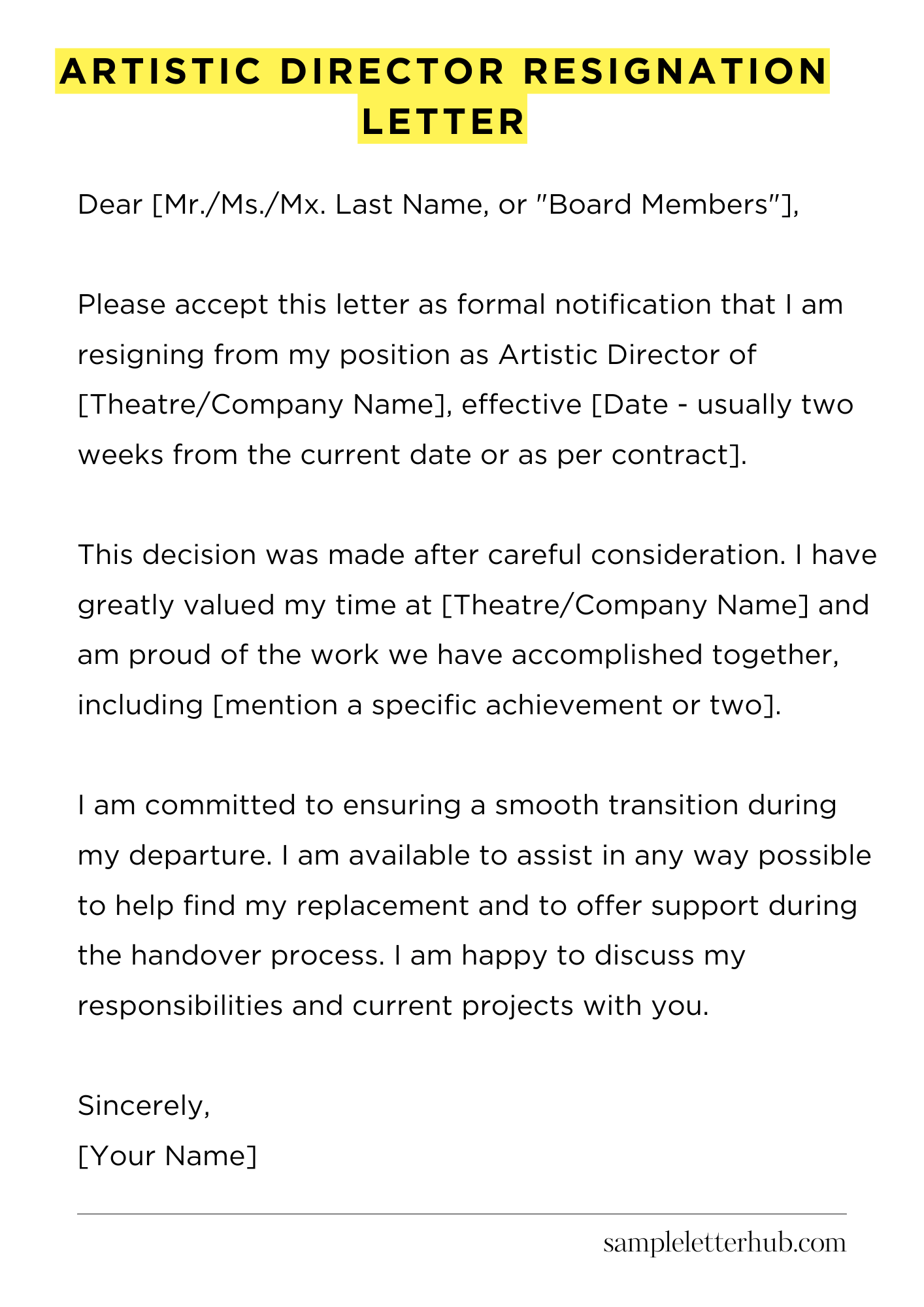
Dear [Mr./Ms./Mx. Last Name, or “Board Members”],
Please accept this letter as formal notification that I am resigning from my position as Artistic Director of [Theatre/Company Name], effective [Date – usually two weeks from the current date or as per contract].
This decision was made after careful consideration. I have greatly valued my time at [Theatre/Company Name] and am proud of the work we have accomplished together, including [mention a specific achievement or two].
I am committed to ensuring a smooth transition during my departure. I am available to assist in any way possible to help find my replacement and to offer support during the handover process. I am happy to discuss my responsibilities and current projects with you.
I wish [Theatre/Company Name] continued success in the future.
Sincerely,
[Your Name]
How to Write an Artistic Director Resignation Letter
So, you’re stepping down. You’ve poured your heart and soul into guiding a theater, dance company, or arts organization as its Artistic Director. Now it’s time to move on to a new chapter, which is understandable. But before you can embark on that journey, there’s a vital task to accomplish: writing your resignation letter.
It might feel like a formality, but it’s more than that; this letter can solidify your legacy, and pave the way for a smooth transition. Let’s look at how to construct a thoughtful and professional letter.
1. Clarity and Directness: The Foundation
First and foremost, keep it clear. State your intention to resign directly and unambiguously. State the effective date of your departure. Avoid ambiguity! You want everyone to be clear on what’s happening.
Don’t use vague language or beat around the bush. For example, instead of saying, “I’m considering a change,” say something like, “I am writing to inform you of my resignation from my position as Artistic Director.” The effective date should also be explicit, like “My last day of employment will be [Date].” That’s it.
2. Expressing Gratitude and Acknowledgment: The Heart of the Matter
Remember this is about saying goodbye as a professional. This is also your opportunity to convey your appreciation. Acknowledge the experience and opportunities you’ve been given. Briefly express gratitude for the experience, the people you’ve worked with, and the organization’s mission.
Mention specific positive experiences, such as successful productions, audience growth, or collaborative partnerships. If you enjoyed your time, let them know. Show genuine thanks for the chance to have served in this role. Avoid being overly effusive or lengthy. A sincere note goes a long way. After all, you want to leave on a good note.
3. Offering Assistance with the Transition: The Professional Touch
Demonstrate your professionalism by offering assistance with the transition. This is crucial. It shows that you care about the organization’s future. Offer your help in identifying a successor or helping the organization during the handover. Suggest you are available to train the new Artistic Director.
Be reasonable with your offer. Specify how you can help, such as offering to assist with upcoming productions, introducing your replacement to key stakeholders, or creating a transition document. A proactive approach helps to ease the change for your colleagues.
4. Brevity and Professionalism: Keeping It Concise
Keep your letter concise and to the point. While expressing gratitude is essential, avoid getting carried away. Refrain from listing every single achievement or dwelling on past grievances.
Maintain a positive and professional tone throughout the letter. This isn’t the time to air out complaints or engage in criticisms. Ensure your letter is well-formatted and free of errors. Proofread it carefully before sending it. Double-check everything, including dates, and names. A typo can be a final impression you don’t want to make.
5. Final Thoughts and Future Endeavors: The Closing Statement
In your closing paragraph, briefly express your future plans, but avoid dwelling too much on personal matters. You can hint that you are looking forward to new challenges, or simply express your best wishes for the organization’s continued success.
End with a statement like “I wish [Organization Name] the very best in the future” or “I am grateful for my time here and am confident that the organization will continue to thrive.”
Be sincere in your closing remarks. Finally, sign your name and include your contact information for future correspondence. You’re done! Your resignation letter is ready.
FAQs about Artistic Director resignation letter
How much notice should an Artistic Director give when resigning?
The standard notice period for an Artistic Director varies depending on their employment contract, organizational policies, and industry norms. However, a minimum of one month’s notice is generally expected.
Senior positions like this often require two or three months, or even longer, to allow sufficient time for transition planning and the recruitment of a successor. Always refer to the employment agreement for the specific contractual obligations.
What key elements should be included in an Artistic Director’s resignation letter?
A well-crafted resignation letter should include: a clear and concise statement of resignation, the effective date of departure, a brief expression of gratitude for the opportunity (optional but recommended), a professional and courteous tone, and an offer to assist with the transition of responsibilities.
It’s also beneficial to briefly mention any unfinished projects and how they can be managed post-departure (if applicable). Providing contact information for any follow-up is also good practice.
Should an Artistic Director provide a reason for resigning in their letter?
While not strictly required, providing a reason for resignation is generally advisable, although the level of detail is at the discretion of the individual. Reasons can range from personal growth opportunities, career changes, or a desire for a different work-life balance.
Keep it professional and focus on the positive aspects of the experience or future endeavors, avoiding negativity or critical comments about the organization or its leadership.
The reason for leaving can also be discussed separately with the relevant senior management during the exit interview.
What is the proper format for an Artistic Director’s resignation letter?
The resignation letter should follow a formal business letter format. This includes: the sender’s contact information (address, phone, and email), the date, the recipient’s contact information, a formal salutation (e.g., “Dear [Recipient Name]”), a clear and concise body, a professional closing (e.g., “Sincerely,” or “Regards,”), and the sender’s typed name.
It’s also important to proofread the letter carefully for any grammatical errors or typos. Consider sending it via both physical mail and email for official documentation.
What should an Artistic Director do after submitting their resignation letter?
After submitting the letter, an Artistic Director should be prepared for follow-up conversations with the employer regarding their departure. Be prepared to answer questions about the transition period and assist with any necessary handover tasks, such as training a successor, documenting ongoing projects, and ensuring a smooth transition of responsibilities.
It is crucial to maintain a professional demeanor throughout the notice period.
Additionally, maintain open communication with the team and stakeholders, and adhere to any confidentiality agreements that are in place.
Related:
Resignation letter due to rude boss
Resignation letter moving to another state
Resignation letter due to illness of family member
Resignation letter due to study