

So, you’re ready to move on from your Staff Scientist role? A Staff Scientist resignation letter is your official notice. It tells your employer you’re leaving. Its purpose is to formally communicate your departure.
Writing this letter doesn’t have to be hard. We’ve got you covered. We’ll share several templates. You’ll find examples and samples here. These will help you craft your own letter.
Need a simple start? Want to be more creative? We have formats for every situation. You can adapt them to fit your needs. Let’s get started.
Staff Scientist Resignation Letter
Below is a sample of a Staff Scientist Resignation Letter:
[Your Name]
[Your Address]
[Your Phone Number]
[Your Email Address]
[Date]
[Hiring Manager Name] (If known, otherwise use title)
[Hiring Manager Title]
[Company Name]
[Company Address]
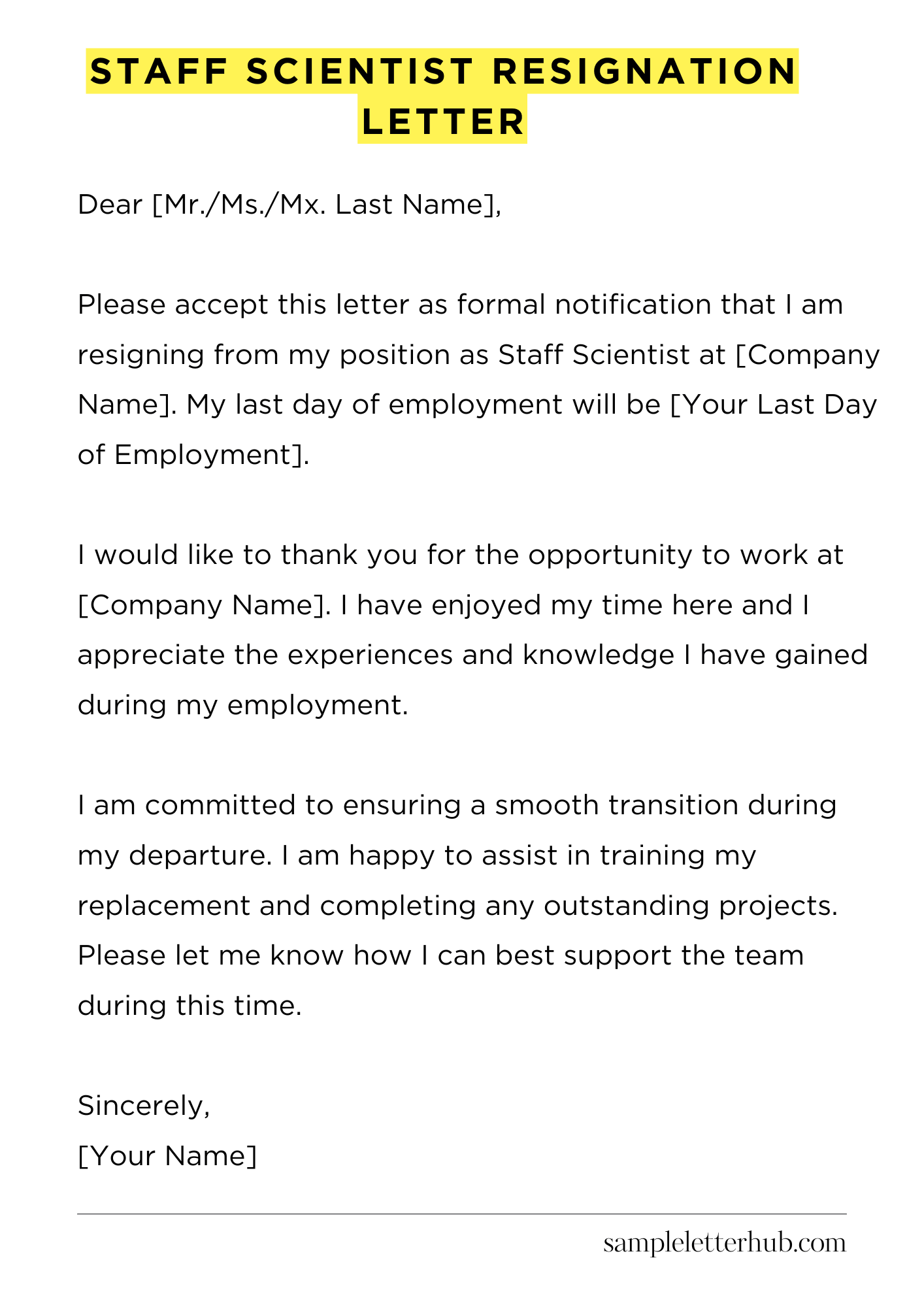
Dear [Mr./Ms./Mx. Last Name],
Please accept this letter as formal notification that I am resigning from my position as Staff Scientist at [Company Name]. My last day of employment will be [Your Last Day of Employment].
I would like to thank you for the opportunity to work at [Company Name]. I have enjoyed my time here and I appreciate the experiences and knowledge I have gained during my employment.
I am committed to ensuring a smooth transition during my departure. I am happy to assist in training my replacement and completing any outstanding projects. Please let me know how I can best support the team during this time.
I wish [Company Name] continued success in the future.
Sincerely,
[Your Name]
How to Write Staff Scientist Resignation Letter
Getting Started: The Basics
So, you’ve made a decision. You’re leaving your role as a Staff Scientist. That’s a big step! Now, you need to craft your resignation letter. It might feel awkward, but it’s a critical part of the process. It’s your professional farewell. The goal is to leave on good terms. You want to maintain a positive relationship with your employer and colleagues. Start by simply stating your intentions.
Keep things concise and to the point. No need for lengthy explanations about why you’re moving on in the initial part of the letter. This is about formality and respect. Date the letter clearly and address it to your direct supervisor or the appropriate HR representative.
Structuring Your Letter: The Core Components
Your resignation letter needs a few key elements. First, state your intention to resign. Be direct and clear. “I am writing to formally resign from my position as Staff Scientist” works perfectly. Next, include your last day of employment. This is usually determined by your employment contract or company policy.
Adhere to any required notice period; two weeks is generally standard. This is the timeline everyone will work from.
Then, express your gratitude for the opportunity. You were there, you gained experience. Acknowledge your time spent at the organization. Thank them for the experience, opportunities, and support you received. Briefly mention anything specific you appreciated.
This makes the letter warmer. It also shows you are professional. After that, keep it short. Avoid oversharing details of your future plans. This isn’t necessary.
The Tone: Keeping it Professional and Positive
Maintain a professional tone throughout the letter. Avoid any negativity or complaints. This isn’t the time for airing grievances. Remember, you want to leave on a positive note. Do not burn bridges. Keep your language respectful and formal. Refrain from using slang or overly casual language.
Focus on expressing your gratitude and best wishes. If appropriate, offer to assist with the transition. This includes things like training your replacement or completing any unfinished projects. It shows you care about a smooth handover. It reflects well on your character. It’s a way to demonstrate your professionalism.
What to Include (and What to Avoid)
The essentials have been covered. But, here’s some further guidance. Always include your name, job title, and the date. You do not need to explain the reasons for your departure. Keep your personal reasons private. It’s up to you if you are inclined to elaborate in a separate conversation, but it’s not a requirement for the letter.
Avoid any unnecessary details. This includes salary information or specific internal issues. Do not mention any negative experiences or criticisms of your current workplace. Just focus on the positive aspects of your tenure. Steer clear of any promises you can’t keep. Keep it short and sweet.
Final Steps: Proofreading and Submission
Proofread your letter carefully. This is essential! Check for any grammatical errors, spelling mistakes, and typos. These errors can undermine the professionalism you’ve worked so hard to convey. Read it again! Ask a colleague or friend to review it as well. They might catch something you missed.
Once you are satisfied, print the letter. If your company policy dictates this, you can also send a digital copy. Maintain a copy for your records. Deliver the letter to the appropriate person as outlined by your company policy. Follow up on any required steps. Keep your composure and be respectful. Your future success matters.
FAQs about Staff Scientist Resignation Letter
What information should I include in my Staff Scientist resignation letter?
Your resignation letter should include: your formal announcement of resignation, your intended last day of employment, a brief expression of gratitude for the opportunity, and any necessary information regarding the handover of responsibilities. You may also include a brief statement about your future plans if you wish, but it’s not required.
What is the proper format for a Staff Scientist resignation letter?
The format should be professional. Typically, you should include a formal business letter format: your contact information, the date, your supervisor’s name and title, the company’s address, a formal salutation (e.g., “Dear [Supervisor’s Name]”), the body of your letter outlining your resignation, a closing (e.g., “Sincerely,” or “Best regards,”), and your typed name.
How much notice should I give when resigning as a Staff Scientist?
The standard notice period is typically two weeks, though this can vary based on your employment contract, company policy, or the specific demands of your role. Review your employment agreement to confirm the required notice period. Providing more notice is often appreciated, particularly in a specialized role like Staff Scientist.
Should I provide a reason for resigning in my Staff Scientist resignation letter?
While not always required, you can briefly state a general reason for resigning, such as “to pursue other opportunities” or “for personal reasons.” You are not obligated to provide detailed explanations. The focus should be on your official resignation and any transition plans.
Can I ask for a letter of recommendation in my resignation letter?
It is best practice to request a letter of recommendation. You can include a simple statement indicating your desire for a reference. For example: “I would be grateful if you would consider writing a letter of recommendation on my behalf.” It’s important to provide your supervisor with sufficient time to write the recommendation.
Related:
Resignation letter due to rude boss
Resignation letter moving to another state
Resignation letter due to illness of family member
Resignation letter due to study