

A Chief Marketing Officer (CMO) resignation letter is a formal document. It signals a CMO’s intention to leave a company. This letter serves several key purposes. It officially notifies the employer. It states the effective date of departure. It can also express gratitude or explain the reason for leaving.
Navigating the resignation process can be tricky. We’ve got you covered. This article offers helpful templates. You’ll find various examples of CMO resignation letters. Each sample caters to different scenarios.
Use these samples as a starting point. Tailor them to fit your specific needs. Writing a professional resignation letter becomes simple. We aim to ease the process. Let us help you compose your perfect letter.
Chief Marketing Officer Resignation Letter
Below is a sample of a Chief Marketing Officer Resignation Letter:
[Your Name]
[Your Address]
[Your Phone Number]
[Your Email Address]
[Date]
[Chief Executive Officer’s Name]
[Chief Executive Officer’s Title]
[Company Name]
[Company Address]
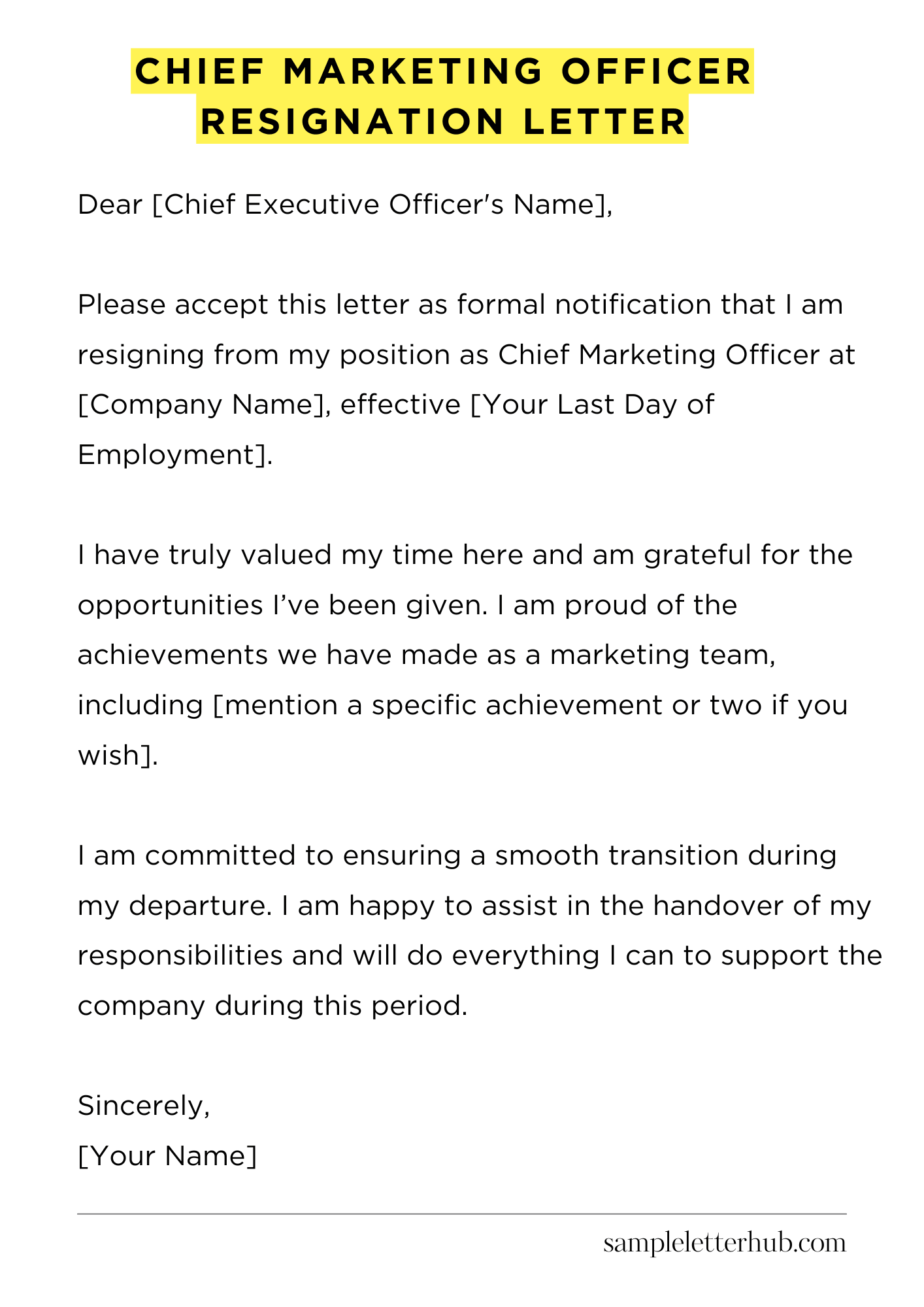
Dear [Chief Executive Officer’s Name],
Please accept this letter as formal notification that I am resigning from my position as Chief Marketing Officer at [Company Name], effective [Your Last Day of Employment].
I have truly valued my time here and am grateful for the opportunities I’ve been given. I am proud of the achievements we have made as a marketing team, including [mention a specific achievement or two if you wish].
I am committed to ensuring a smooth transition during my departure. I am happy to assist in the handover of my responsibilities and will do everything I can to support the company during this period. Please let me know how I can be of assistance.
I wish you and the company continued success in the future.
Sincerely,
[Your Name]
How to Write a Chief Marketing Officer Resignation Letter
1. The Core Components: What Absolutely MUST Be Included
Resigning from a high-level position like Chief Marketing Officer (CMO) demands a carefully crafted resignation letter. This isn’t just about saying “I quit.” It’s about maintaining professionalism and leaving a positive (or at least neutral) impression. First, state your intention clearly and directly. This is your primary goal.
Begin with the date and recipient’s name (typically the CEO or your direct superior). Next, formally state your resignation. For instance: “Please accept this letter as formal notification that I am resigning from my position as Chief Marketing Officer, effective [Your Last Day of Employment].” This needs to be stated in plain language, no hidden meanings.
Crucially, include your final day of employment. Make this very specific. Finally, keep the tone professional. Avoid any personal grievances or negativity, save for a brief mention of any reason if you are comfortable.
2. Expressing Gratitude (and Possibly a Brief Explanation)
Now, let’s talk about the more cordial parts. It is good practice to express your gratitude for the opportunity to have worked in the organization. This shows grace and maturity. A simple sentence goes a long way. Something like: “I am grateful for the opportunities I have been given during my time here.”
You may also briefly, and I mean *briefly*, explain your reason for leaving. This is optional, but it can be helpful. However, keep it short and neutral. For example: “I am pursuing a new opportunity that aligns with my long-term career goals.” Do not go into extensive detail; that can be done separately. Your resignation letter is not the place for lengthy explanations.
3. Addressing Handover and Transition Plans
Your responsibility extends beyond just informing your resignation. Think about the people you are working with. A smooth transition is a sign of professionalism. Offer to assist with the handover process. This demonstrates your commitment to the company’s continued success, even after you leave.
Suggest helping with the transition process. Consider adding: “I am committed to ensuring a smooth transition during my departure. I am happy to assist in any way possible to train my replacement, and to ensure a full transition of all ongoing projects.” Think about what needs to be done. What projects need to be transitioned?
Are there any key contacts who should be passed on to the new person? Do your best to identify them.
4. Formalities and Closing: The Finishing Touches
Now, to the close. You should end your letter with a polite and professional closing. Common examples include: “Sincerely,” “Respectfully,” or “Best regards.” Choose one that feels right for the company culture and your relationship with the recipient.
Below your closing, leave space for your handwritten signature. Then type your full name. It is simple, yet very important. Make sure that all the details are accurate. A well-written resignation letter reflects positively on you and can pave the way for a positive reference in the future.
5. Proofreading and Final Considerations
Before you send your letter, proofread it *carefully*. Check for any spelling or grammatical errors. Also, ensure the dates are correct. Ideally, have someone else read it over for a second pair of eyes.
Think about the overall impact of your letter. It should convey respect, professionalism, and a commitment to a smooth handover. Remember, a well-written resignation letter is not just a formality; it’s a reflection of your character and your brand.
FAQs about Chief Marketing Officer resignation letter
What is the primary purpose of a Chief Marketing Officer (CMO) resignation letter?
The primary purpose of a CMO resignation letter is to formally notify the employer of the intent to resign from the position. It serves as a legal document, officially marking the end of the employment.
The letter provides a clear date of departure and can also include expressions of gratitude, a brief explanation for leaving (though this is optional), and offers of assistance during the transition period.
What essential information should be included in a CMO resignation letter?
A well-crafted CMO resignation letter should include: a clear statement of resignation, the effective date of resignation, and a formal salutation. It should explicitly state the intention to leave the position and the exact last day of employment.
It’s advisable to also thank the company for the opportunity and, if desired, to offer assistance during the transition. Avoid negative language or inflammatory statements.
How much notice should a CMO give when resigning?
The standard notice period for a CMO varies based on the employment contract, company policy, and local labor laws. However, a general rule of thumb is to provide at least four weeks’ notice.
More senior roles, like CMO positions, often benefit from a longer notice period (e.g., 2-3 months) to allow for a smoother transition of responsibilities and recruitment of a replacement. Always consult your employment agreement for specific requirements.
Should a CMO resignation letter include the reason for leaving?
While not mandatory, it can be beneficial to briefly mention the reason for leaving the CMO role. The extent of detail provided is at the discretion of the departing employee.
Common reasons include accepting a new position, pursuing personal interests, or seeking a better work-life balance. Keep the explanation concise, professional, and positive, focusing on the future rather than dwelling on any issues with the current employment.
What is the recommended tone and format for a CMO resignation letter?
The tone of a CMO resignation letter should be professional, respectful, and appreciative. It is crucial to maintain a positive and constructive attitude. The format should be a formal business letter, including a salutation (e.g., “Dear [Manager’s Name]”), the body of the letter, and a closing (e.g., “Sincerely” or “Best regards”).
The letter should be well-organized, concise, and easy to read. Proofreading for any grammatical errors and typos is essential.
Related:
Resignation letter due to rude boss
Resignation letter moving to another state
Resignation letter due to illness of family member
Resignation letter due to study