

So, you’re a Benefits Analyst ready to move on? A “Benefits Analyst resignation letter” is your official goodbye. It informs your employer of your departure. It outlines your last day of employment. This crucial document helps ensure a smooth transition.
Crafting a resignation letter can feel daunting. We’re here to help ease the process. We’ve compiled various templates and examples. These samples are tailored for Benefits Analysts. You’ll find options for different situations.
Whether you’re after a simple or detailed letter, we’ve got you covered. Consider this your toolbox for crafting the perfect resignation. Use these to confidently express your next steps.
Benefits Analyst Resignation Letter
Below is a sample of a Benefits Analyst Resignation Letter:
[Your Name]
[Your Address]
[Your Phone Number]
[Your Email Address]
[Date]
[Employer’s Name]
[Employer’s Title]
[Company Name]
[Company Address]
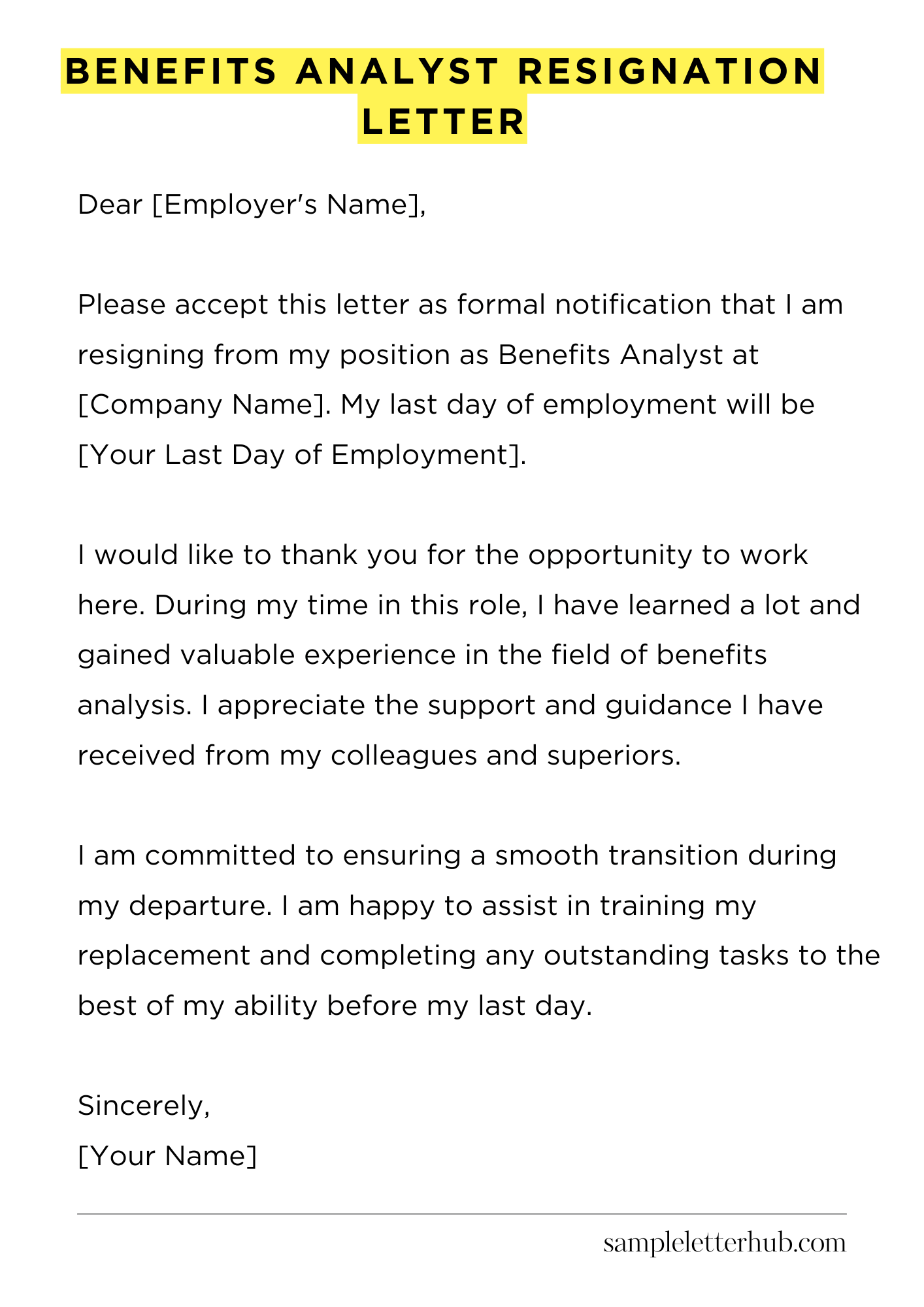
Dear [Employer’s Name],
Please accept this letter as formal notification that I am resigning from my position as Benefits Analyst at [Company Name]. My last day of employment will be [Your Last Day of Employment].
I would like to thank you for the opportunity to work here. During my time in this role, I have learned a lot and gained valuable experience in the field of benefits analysis. I appreciate the support and guidance I have received from my colleagues and superiors.
I am committed to ensuring a smooth transition during my departure. I am happy to assist in training my replacement and completing any outstanding tasks to the best of my ability before my last day.
I wish you and [Company Name] all the best in the future.
Sincerely,
[Your Name]
How to Write a Benefits Analyst Resignation Letter
1. Getting Started: The Basics You Can’t Skip
Resigning from a job can be a big step. A resignation letter is your official notice. It’s important to do it right. You need to create a professional letter. Start with the basics. Include your name, the date, and the recipient’s name and title. Address the letter to your direct supervisor or HR. This ensures it goes to the correct person. This establishes a clear record of your intentions.
Think about the tone. Keep it professional. Maintain a respectful tone. Avoid any negativity or complaints. This helps to leave a good impression. You might need a reference later on.
2. The Core: Stating Your Intent and Departure Date
The core of your letter should clearly state your intention to resign. This part is crucial. Make sure your statement is direct and unambiguous. “I am writing to formally resign from my position as Benefits Analyst.” That’s simple and effective. Then, specify your last day of employment.
This is another key piece of information. Give your employer the standard two weeks’ notice. This is a common courtesy. It’s also often required. Your departure date is critical. Make sure it’s correct. Double-check it! This needs to align with your employment agreement or company policy.
It helps in smooth transition. It also shows respect for the company.
3. Expressing Gratitude: Showing Appreciation
Show your appreciation. This is a crucial element. Consider including a brief expression of gratitude. Thank the company for the opportunity. Mention any specific experiences you are thankful for. This could be learning new skills. Maybe you have enjoyed working with your team.
Even a simple “Thank you for the opportunity to work here” is enough. Showing appreciation goes a long way. This is especially true, even if you weren’t thrilled about your employment. Keep your statements genuine. It’s a nice touch. It helps maintain a positive relationship.
Positive interactions are important.
4. Offering Assistance: Making the Transition Easier
Show that you are professional. Offer your help with the transition process. This enhances your professionalism. Indicate your willingness to assist with training.
Offer to help with any handover tasks. Be available to answer questions from your replacement. This is a significant gesture. It demonstrates your commitment. It helps to ensure a smooth transition. This helps you to leave on good terms. You don’t have to be excessively involved. Just let them know you’ll help.
This shows respect for your colleagues and employer.
5. Final Touches: Polishing and Proofreading
Before you send your letter, polish it. Carefully proofread the entire document. Check for any grammatical errors or typos. Ensure your letter is easy to read and understand. Maintain a professional tone throughout. This is your last chance to make a good impression. Review the letter again.
Get a second pair of eyes to read it. Make sure everything is perfect. A well-written letter reflects positively on you. Now, submit the letter. Follow your company’s policy for submitting resignations.
It’s time to move on to your next opportunity.
FAQs about Benefits Analyst Resignation Letter
What is the primary purpose of a Benefits Analyst resignation letter?
The primary purpose of a Benefits Analyst resignation letter is to formally notify the employer of the employee’s intent to leave their position. It serves as an official record of the resignation, providing crucial details such as the employee’s name, the effective date of departure, and, optionally, a brief explanation for leaving.
It is also an opportunity to express gratitude and maintain a professional relationship with the employer.
What key information should be included in a Benefits Analyst resignation letter?
A Benefits Analyst resignation letter should include: the employee’s full name, the official title of the position, a clear statement of resignation, the effective date of resignation, a brief and polite statement of thanks or any other professional sentiment, and the employee’s signature.
Optional elements may include a reason for leaving (though this is often omitted), contact information for future correspondence, and an offer to assist with the transition of responsibilities.
How much notice should a Benefits Analyst give when resigning?
The amount of notice a Benefits Analyst should give when resigning typically aligns with the company’s policy and/or any existing employment contract.
A standard timeframe is generally two weeks, though this can vary. It’s crucial to consult the employment contract or employee handbook to ascertain the required notice period. Providing adequate notice ensures a smooth transition and upholds professional courtesy.
Should a Benefits Analyst include a reason for leaving in their resignation letter?
Including a reason for leaving in a Benefits Analyst resignation letter is optional. While it’s acceptable to briefly state a reason, it’s not a requirement. Some employees choose to keep the reason private.
If a reason is provided, it should be concise, professional, and avoid negativity. It’s often sufficient to state a simple reason such as “pursuing other opportunities” or “seeking career growth.”
What is the appropriate tone for a Benefits Analyst resignation letter?
The appropriate tone for a Benefits Analyst resignation letter is professional, courteous, and respectful. It should maintain a positive and polite demeanor, regardless of the employee’s reasons for leaving.
The language should be formal and clear, avoiding jargon or overly casual expressions. Expressing gratitude for the opportunity to work at the company and offering assistance during the transition period is also recommended to maintain a positive relationship.
Related:
Resignation letter due to rude boss
Resignation letter moving to another state
Resignation letter due to illness of family member
Resignation letter due to study