

Navigating a career change? You’ll likely need to write a Talent Acquisition Consultant resignation letter. This is a formal document. It informs your employer of your departure. It officially ends your employment.
Crafting the perfect resignation can be tricky. Don’t worry, we’ve got you covered. We’ll provide helpful templates and examples. These are designed for Talent Acquisition Consultants.
Need a jumpstart? Consider these samples. They will help streamline your writing process. These adaptable options simplify letter creation. You can adapt them to your specific circumstances.
Talent Acquisition Consultant Resignation Letter
Below is a sample of a Talent Acquisition Consultant Resignation Letter:
[Your Name]
[Your Address]
[Your Phone Number]
[Your Email Address]
[Date]
[Hiring Manager Name] (If known, otherwise use title)
[Hiring Manager Title]
[Company Name]
[Company Address]
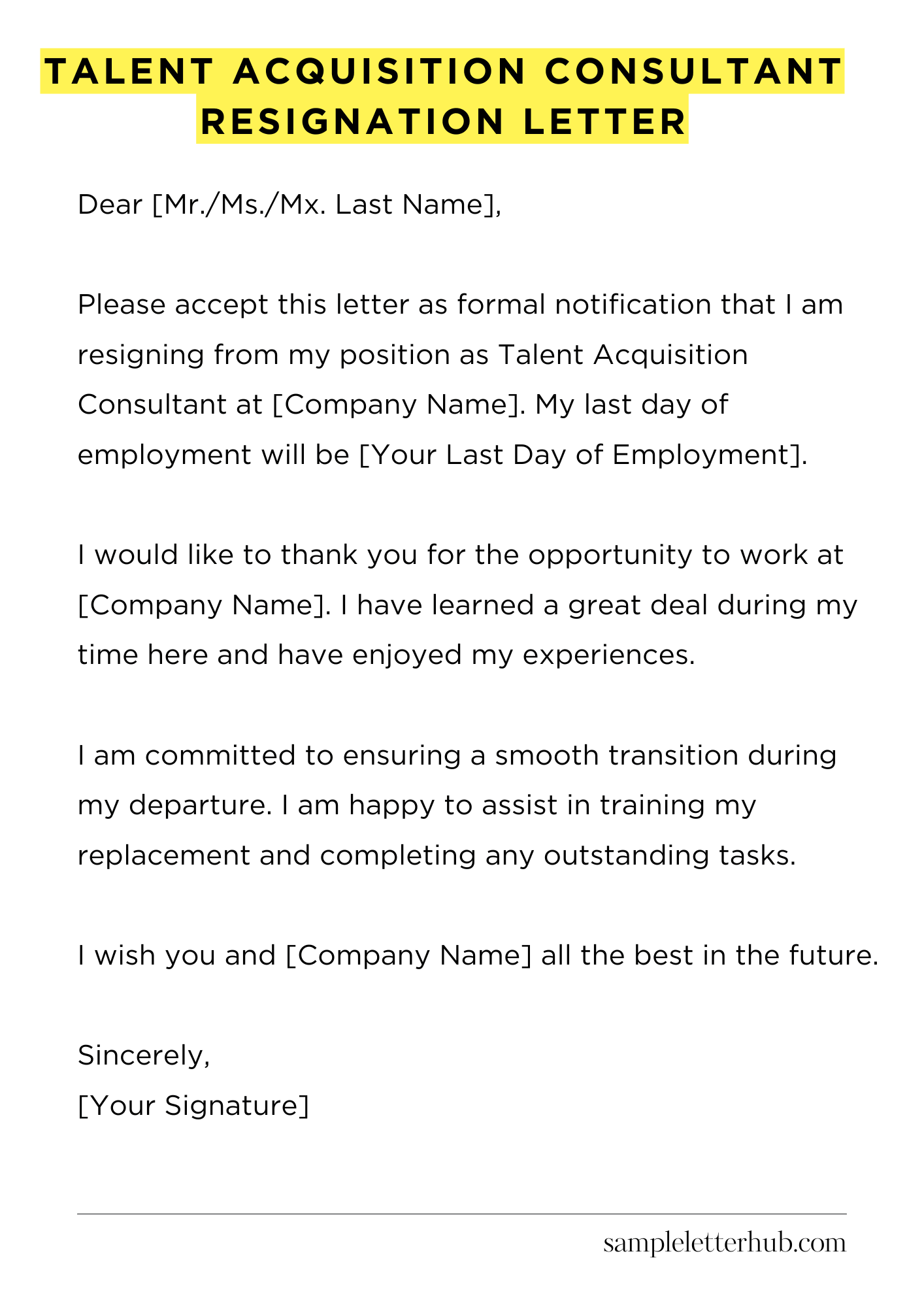
Dear [Mr./Ms./Mx. Last Name],
Please accept this letter as formal notification that I am resigning from my position as Talent Acquisition Consultant at [Company Name]. My last day of employment will be [Your Last Day of Employment].
I would like to thank you for the opportunity to work at [Company Name]. I have learned a great deal during my time here and have enjoyed my experiences.
I am committed to ensuring a smooth transition during my departure. I am happy to assist in training my replacement and completing any outstanding tasks. Please let me know how I can be of assistance in the coming weeks.
I wish you and [Company Name] all the best in the future.
Sincerely,
[Your Signature]
How to Write a Talent Acquisition Consultant Resignation Letter
Leaving a job is a big deal. You’ve made a decision, and now you need to communicate it professionally. As a Talent Acquisition Consultant, your resignation letter needs to reflect your skills and professionalism. This letter is your final impression, so make it count.
1. Keep it Concise and Clear
First and foremost: brevity is key. Get straight to the point. No need for elaborate introductions or lengthy explanations. State your intention to resign and the effective date of your departure immediately.
A simple sentence like, “Please accept this letter as formal notification that I am resigning from my position as Talent Acquisition Consultant, effective [Date]” is perfect. Clarity avoids any confusion. Remember, your goal is to clearly and respectfully inform your employer.
2. Express Gratitude (and Be Sincere!)
Even if the job wasn’t a dream, and you are not looking back, a touch of gratitude goes a long way. Briefly acknowledge the opportunity you were given. You could say something like, “I am grateful for the opportunities I have been given during my time here.” Or, “I appreciate the experience and training I’ve received.”
Avoid generic platitudes; aim for something genuine. This demonstrates professionalism and leaves a positive final impression.
3. Highlight Your Contributions (If You Wish)
While not strictly necessary, you can briefly mention your key contributions or achievements during your tenure. This is a chance to remind your employer of your value.
For example, you could write, “During my time, I successfully sourced and hired over [Number] candidates for key roles, contributing to a significant reduction in time-to-hire.” Keeping it brief and focused on measurable accomplishments demonstrates your value without being boastful.
4. Offer Assistance with Transition
Showing a willingness to help with the transition is crucial. This is a sign of respect and can smooth the process for both you and your employer. Offer to assist in any way you can, such as training your replacement, documenting processes, or completing ongoing projects.
A simple line like, “I am happy to assist with the transition process and ensure a smooth handover of my responsibilities” goes a long way. Consider mentioning any specific tasks you’re willing to handle to ease the process.
5. Maintain a Professional Tone and Format
Always maintain a professional tone throughout your letter. Avoid negativity, complaints, or personal opinions about your former employer. Use a standard business letter format. Your letter should be well-formatted, with proper spacing and grammar. Include your contact information at the top.
Use a professional closing such as “Sincerely” or “Best Regards.” Proofread carefully before sending to avoid any errors. This letter reflects your professionalism, and you want to leave on a good note.
FAQs about Talent Acquisition Consultant resignation letter
Why is a well-crafted resignation letter important for a Talent Acquisition Consultant?
A well-crafted resignation letter is crucial for a Talent Acquisition Consultant for several reasons. It serves as a formal declaration of your departure, ensuring clarity and professionalism in your communication with your employer. It allows you to express your gratitude for the opportunities you’ve received, leaving a positive lasting impression.
Furthermore, it details your last day of employment, helping with the smooth transition of your responsibilities and preventing any misunderstandings. Finally, it documents your departure for the company’s records and protects your professional reputation.
What key elements should be included in a Talent Acquisition Consultant resignation letter?
A comprehensive resignation letter for a Talent Acquisition Consultant should include several key elements. Begin with a clear and direct statement of your intent to resign, followed by your official last day of employment.
Express your gratitude for the opportunity to work at the company and highlight any valuable experiences or skills you’ve gained. If you choose to, you can briefly explain your reason for leaving, but this is not always necessary.
It’s often beneficial to offer assistance with the transition process, such as training a replacement or documenting ongoing projects. Finally, maintain a professional tone throughout the letter and reiterate your thanks.
How should a Talent Acquisition Consultant handle the delivery of the resignation letter?
A Talent Acquisition Consultant should deliver their resignation letter with professionalism and consideration. Typically, the resignation letter should be submitted to your direct manager or Human Resources department. It’s often best to deliver the letter in person, if possible, allowing for a face-to-face conversation.
If an in-person meeting is not feasible, an email is acceptable. Ensure you keep a copy of the letter for your records. Remember to maintain a respectful and courteous demeanor during this process, even if you are leaving due to negative circumstances.
What should a Talent Acquisition Consultant avoid when writing a resignation letter?
When crafting a resignation letter, a Talent Acquisition Consultant should avoid certain pitfalls. Refrain from including negative or critical comments about your current employer, colleagues, or the company culture.
Avoid providing excessive details about your reasons for leaving, unless you choose to do so in a concise and professional manner. Don’t make any demands or requests that might be considered unreasonable.
Avoid burning bridges by remaining positive and professional in your communication. Finally, proofread the letter carefully to avoid any grammatical errors or typos that could undermine your credibility.
What are the legal considerations a Talent Acquisition Consultant should be aware of when resigning?
A Talent Acquisition Consultant should be aware of several legal considerations when resigning. Review your employment contract or any agreements you’ve signed to understand any specific notice periods or non-compete clauses.
Understand if you have access to any confidential information or trade secrets, and ensure you comply with any requirements related to their protection. Be mindful of any potential repercussions if you plan to join a competitor.
Consulting with an attorney is advisable if you have any questions or concerns about the legal aspects of your resignation, especially if you have a complex employment agreement.
Related:
Resignation letter due to rude boss
Resignation letter moving to another state
Resignation letter due to illness of family member
Resignation letter due to study