

A Staffing Coordinator resignation letter is a formal document. It informs your employer of your decision to leave your job. The letter officially marks the end of your employment. It is a crucial step in the resignation process.
Finding the right words can be tough. We understand it’s not always easy to write these letters. That’s why we’re here to help. This article provides you with templates. They are examples and samples to guide you.
Use these to craft your own resignation letter. We’ve got different scenarios covered. Whether you need a simple notice or something more specific, we have you covered. Let’s make writing this letter easier for you.
Staffing Coordinator Resignation Letter
Below is a sample of a Staffing Coordinator Resignation Letter:
[Your Name]
[Your Address]
[Your Phone Number]
[Your Email Address]
[Date]
[Hiring Manager Name] (If known, otherwise use title)
[Hiring Manager Title]
[Company Name]
[Company Address]
Dear [Mr./Ms./Mx. Last Name],
Please accept this letter as formal notification that I am resigning from my position as Staffing Coordinator at [Company Name]. My last day of employment will be [Your Last Day of Employment].
I would like to thank you for the opportunity to work at [Company Name]. I have enjoyed my time here and have learned a great deal. I appreciate the experience I have gained during my employment.
I am committed to ensuring a smooth transition during my departure. I am happy to assist in training my replacement and completing any outstanding tasks to the best of my ability. Please let me know how I can be of assistance during this period.
I wish you and the company all the best in the future.
Sincerely,
[Your Typed Name]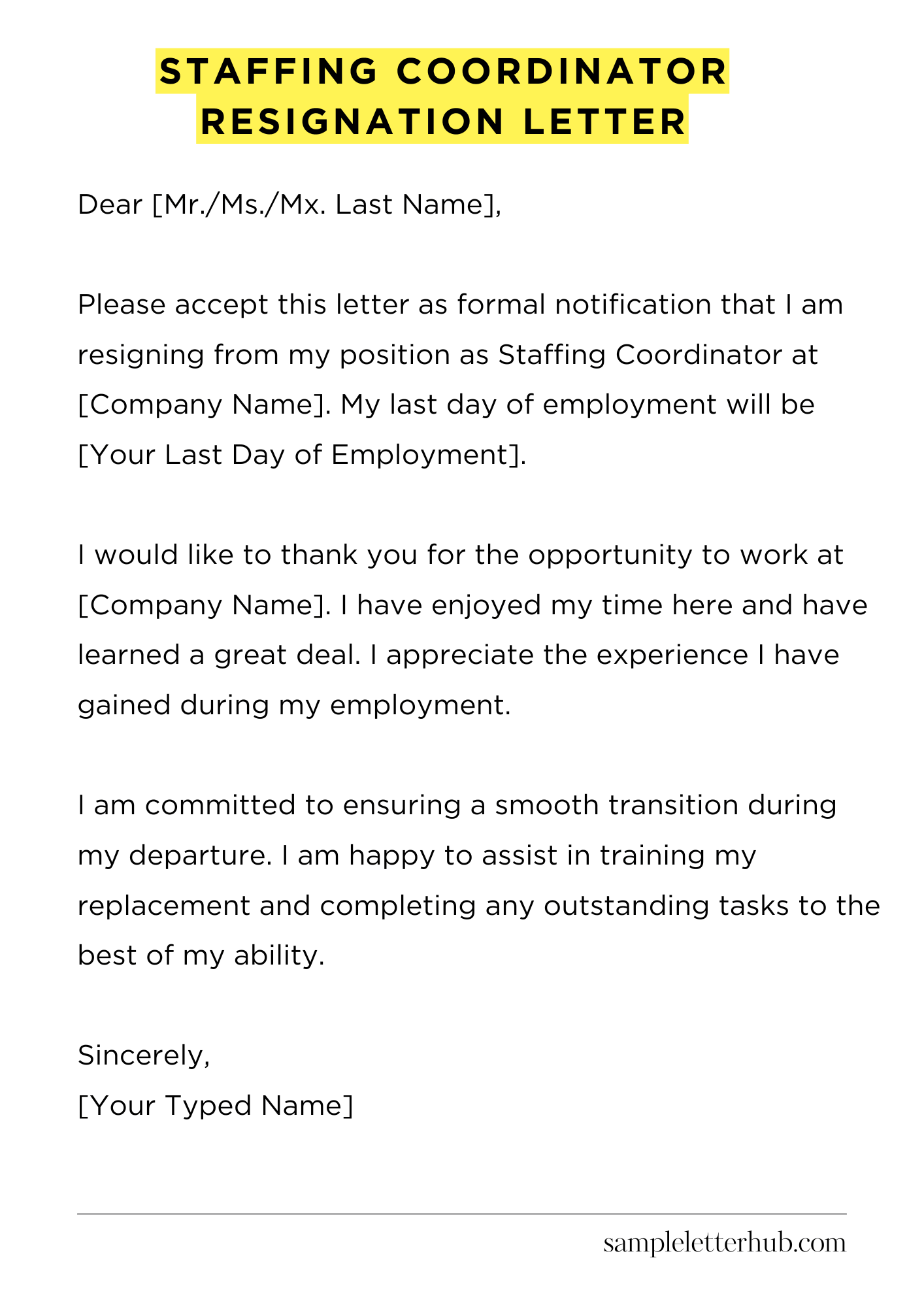
How to Write a Staffing Coordinator Resignation Letter
Know the Basics Before You Start
Leaving a job is a big deal, and a resignation letter is your formal way of doing it. It’s more than just a formality, though. It’s a professional statement that sets the tone for your departure.
First and foremost, keep it professional. Avoid gossip, negativity, or airing grievances. Your goal is to leave on good terms, preserving future opportunities. Keep in mind that a well-written letter reflects positively on you, even as you move on.
Make sure you know your company’s policy for resignations. Sometimes, they have specific procedures or forms. Always respect the guidelines, which can include things like how much notice they require.
Formatting is Key: The Structure of Your Letter
A well-formatted letter is easy to read and understand. Always start with your contact information, followed by the date. Next, address the letter to the appropriate person—usually your direct supervisor or HR department.
Use a clear subject line, such as “Resignation – [Your Name]”. This helps the recipient quickly understand the purpose of the letter. The body should have three distinct parts.
First, state your intention to resign and your last day of employment. Second, express gratitude for the opportunity and the experiences you’ve gained. Finally, offer your assistance during the transition period.
What to Include: Content That Matters
Be direct. The primary purpose of your letter is to formally announce your departure. Clearly state your intention to resign and the specific date you will be leaving the company. Be sure this date aligns with your company’s notice policy.
Next, offer your thanks. Express your gratitude for the opportunity to work at the company. Mention any specific positive experiences or skills you’ve developed. Acknowledge your manager’s support and any professional growth the company gave you.
Offer assistance with the transition. This simple gesture demonstrates your professionalism and commitment. Offer to help train your replacement, complete any outstanding tasks, or transfer knowledge. It leaves a positive lasting impression.
Things to Avoid: Common Mistakes to Sidestep
Avoid negativity, no matter how tempting it is. Do not complain about your colleagues, manager, or company policies. Instead, focus on the positive aspects of your employment and future goals.
Refrain from excessive detail. Keep the letter concise and focused on the key information. Avoid going into long explanations or justifications for your resignation. You are not required to give the reason you are leaving your job.
Never burn bridges. Even if your time with the company was less than ideal, maintain a professional tone. Avoid personal attacks, insults, or any language that could damage your reputation or career prospects. Focus on the positive aspects and the future.
Proofread and Finalize: The Last Important Steps
Before sending your letter, proofread it carefully. Check for any grammatical errors, typos, or spelling mistakes. It’s a critical step that demonstrates attention to detail.
Read your letter aloud. This helps identify any awkward phrasing or unclear statements. Make sure the tone is professional, positive, and respectful.
Finally, keep a copy of your resignation letter for your records. Consider sending a digital copy and a printed copy to your supervisor, following your company’s protocol. This serves as proof of your resignation and ensures your last day is clear.
FAQs about Staffing Coordinator Resignation Letter
What information should I include in my Staffing Coordinator resignation letter?
Your resignation letter should clearly state your intention to resign, the effective date of your resignation, and your name and job title. It’s also customary to express gratitude for the opportunity to work at the company and briefly state your reason for leaving, if desired. Keep the tone professional and concise.
How far in advance should I submit my Staffing Coordinator resignation letter?
The standard practice is to provide at least two weeks’ notice. However, this may vary depending on your employment contract or company policy. Review your contract to determine the required notice period. Providing more notice can be beneficial, especially for a smooth transition.
Should I provide a reason for resigning in my Staffing Coordinator resignation letter?
While not mandatory, it is often helpful to include a brief, neutral reason for your resignation. You can simply state that you are pursuing other opportunities or personal reasons. Avoid providing excessive details or negative comments about the company or your colleagues in your Staffing Coordinator resignation letter.
Can I use a template for my Staffing Coordinator resignation letter?
Yes, using a template is perfectly acceptable. There are numerous templates available online that you can adapt to your situation. Ensure the template is suitable for your specific job role and personal circumstances. Customize the template to reflect your own experiences and to maintain a professional tone.
What should I do after submitting my Staffing Coordinator resignation letter?
Once you’ve submitted your resignation letter, you should prepare for your departure by completing any outstanding tasks, assisting in the transition of your responsibilities, and gathering any personal belongings. Be prepared to participate in an exit interview, if offered, and maintain a professional attitude throughout your remaining time with the company.
Related:
Resignation letter due to rude boss
Resignation letter moving to another state
Resignation letter due to illness of family member
Resignation letter due to study