

A Chief Information Officer (CIO) resignation letter is a formal document. It is written by a CIO when they decide to leave their job. The letter informs their employer of their departure. It also usually includes the last day of employment.
Thinking of moving on to new opportunities? Crafting the perfect goodbye can be tough. We’ve got you covered. We’ll share examples of CIO resignation letters. These examples will help you.
You’ll find various templates and samples here. They’ll make writing your own letter simple. Adapt these letters to your specific situation. Say farewell gracefully and professionally.
Chief Information Officer Resignation Letter
Below is a sample of a Chief Information Officer Resignation Letter:
[Your Name/Address]
[Your Phone Number]
[Your Email Address]
[Date]
[Recipient Name] (Chief Executive Officer or relevant person)
[Recipient Title]
[Company Name]
[Company Address]
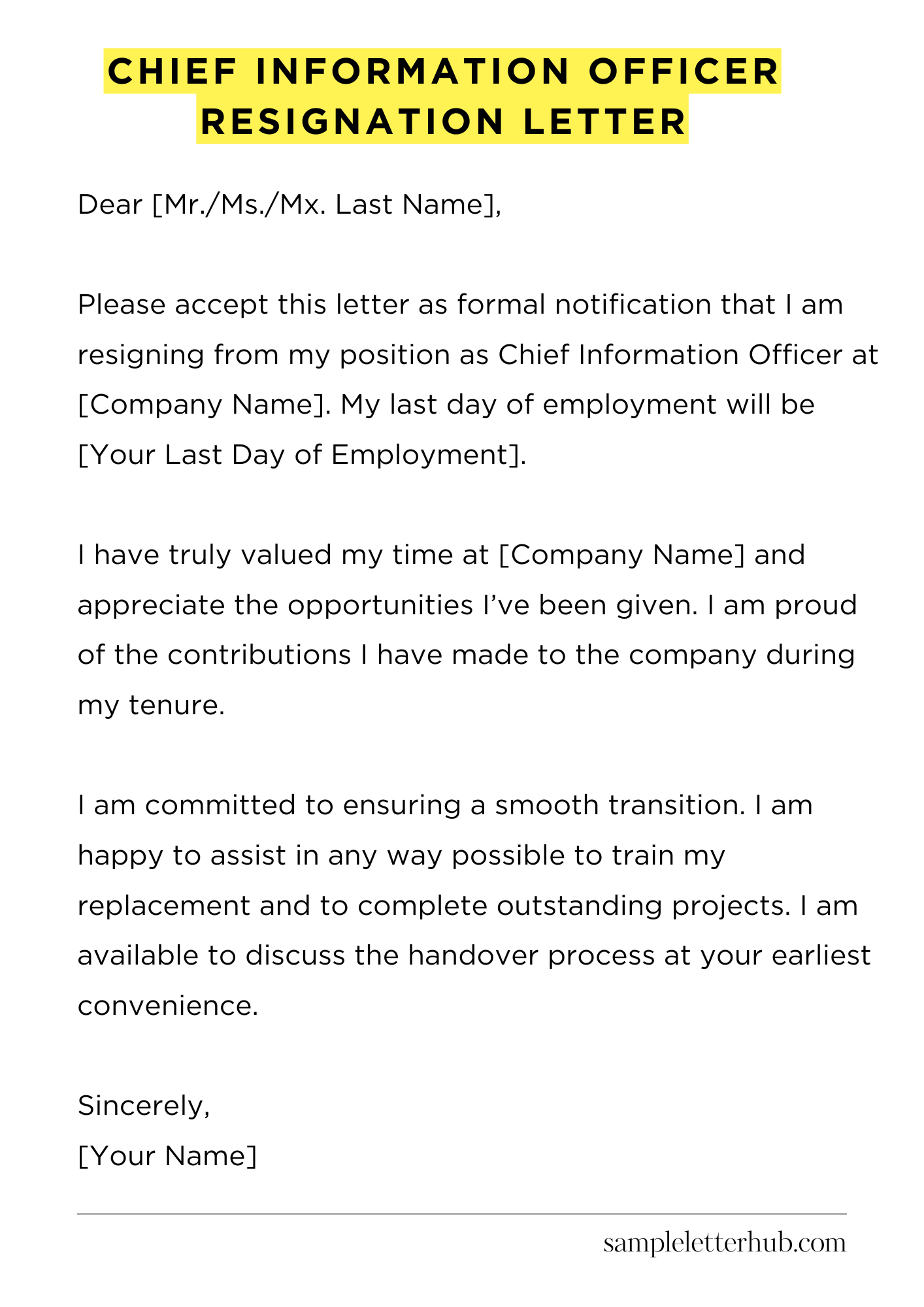
Dear [Mr./Ms./Mx. Last Name],
Please accept this letter as formal notification that I am resigning from my position as Chief Information Officer at [Company Name]. My last day of employment will be [Your Last Day of Employment].
I have truly valued my time at [Company Name] and appreciate the opportunities I’ve been given. I am proud of the contributions I have made to the company during my tenure.
I am committed to ensuring a smooth transition. I am happy to assist in any way possible to train my replacement and to complete outstanding projects. I am available to discuss the handover process at your earliest convenience.
I wish you and [Company Name] continued success in the future.
Sincerely,
[Your Name]
How to Write a Chief Information Officer Resignation Letter
1. Grasping the Basics: Why Your Letter Matters
Resigning from any high-level position, especially a CIO role, is a significant event. A well-crafted resignation letter is more than just a formality; it’s a professional statement.
It officially communicates your departure, sets a tone for future interactions, and potentially impacts your reputation. Think about it: this letter is a snapshot of your professionalism, your communication skills, and your ability to handle transitions. So, get it right!
A poorly written letter can create unnecessary drama. A great one can leave a positive lasting impression.
2. Structure: What to Include and How to Say It
Let’s get down to the nitty-gritty. Your letter should follow a clear and professional structure. You want to be sure you are clear! Begin with a simple, direct statement of your intent to resign, including your last day of employment. Next, express your gratitude for the opportunity. Mentioning specific positive experiences or key accomplishments during your tenure adds a personal touch.
The core elements are straightforward:
- Formal Salutation: Address the appropriate person (e.g., your direct superior or the CEO).
- Clear Resignation Statement: State your intent to resign.
- Effective Date of Resignation: Specify your final day.
- Expression of Gratitude: Thank the company for the opportunity.
- Optional: Brief Explanation (if desired): You are not required to provide a reason, but a concise statement can be helpful.
- Offer of Assistance: Offer to assist with the transition.
- Professional Closing: Use a formal closing (e.g., “Sincerely” or “Respectfully”).
3. Content: What to Avoid and What to Emphasize
Focus on positivity and professionalism. Steer clear of negativity, complaints, or making personal attacks. This is not the time to air grievances; it’s a time to preserve your image. Instead, highlight your contributions and the positive aspects of your time at the company.
Instead of rambling about issues, concentrate on offering support. Offering to help with the transition, such as training your replacement or documenting key processes, demonstrates a commitment to the company’s success even after your departure. Keep the tone friendly and helpful.
Proofread everything. Seriously. Typos and grammatical errors undermine your credibility and look unprofessional. Use a grammar checker and have a colleague review it. This is super important!
4. Delivery: Timing and Methods
The timing and method of delivering your resignation are critical. Ideally, you should first discuss your resignation in person with your direct superior. After that conversation, follow up with the written letter.
Deliver the letter via a method specified by your company, or consider delivering it via email and a hard copy. Ensure you have a copy for your records. Consider the company culture, as certain companies will prefer one delivery method over another.
5. Examples and Templates: Putting It All Together
Here’s a basic template to get you started:
        [Your Name]
        [Your Address]
        [Your Phone Number]
        [Your Email]

        [Date]

        [Recipient Name]
        [Recipient Title]
        [Company Name]
        [Company Address]

        Dear [Recipient Name],

        Please accept this letter as formal notification that I am resigning from my position as Chief Information Officer at [Company Name], effective [Your Last Day of Employment].

        I am grateful for the opportunities I have been given during my time at [Company Name]. I have truly enjoyed [mention a positive experience or accomplishment].

        I am committed to ensuring a smooth transition. I am happy to assist in any way possible, including [offer specific assistance, e.g., training my replacement, documenting key processes].

        I wish you and [Company Name] continued success in the future.

        Sincerely,
        [Your Signature]
        [Your Typed Name]
Remember to adapt this template to your specific situation, and tailor it to reflect your personal experiences and the company culture. A great template is a starting point, but personalization is key.
FAQs about Chief Information Officer resignation letter
What is the typical format for a Chief Information Officer (CIO) resignation letter?
The typical format for a CIO resignation letter generally follows a professional business letter style. It should start with a clear and concise statement of resignation, followed by the effective date of departure. A brief expression of gratitude for the opportunity to work at the organization is often included.
You may also include a brief reason for leaving, if you choose, and a statement expressing your willingness to assist with the transition. It should conclude with a professional closing and your signature.
What key information must be included in a CIO resignation letter?
The most crucial information includes the explicit statement of resignation, the effective date of resignation, and your signature. While not strictly mandatory, it’s highly recommended to express gratitude for the opportunity. You should also provide your contact information, if desired, for any questions. Any other information depends on the specific circumstances of the departure.
How much notice should a CIO give when resigning?
The appropriate notice period for a CIO resignation is generally determined by the employment contract, company policy, and industry norms.
A standard notice period could range from 30 to 90 days, or even longer, depending on the complexity of the IT infrastructure and projects. However, it’s critical to review your contract to ensure compliance and avoid any legal complications.
What should a CIO do to ensure a smooth transition of responsibilities?
To ensure a smooth transition, a CIO should prepare a comprehensive handover plan. This may include identifying key projects and their status, documenting essential systems and processes, and training a successor or team members.
The outgoing CIO should also be available to answer questions and assist with the transition during the notice period. Documenting all key IT systems, processes, and any ongoing projects helps the transition.
Are there any legal considerations a CIO should be aware of when submitting a resignation letter?
Yes, several legal considerations are relevant. Review your employment contract to understand any non-compete clauses, confidentiality agreements, or intellectual property stipulations.
Ensure that you adhere to any notice periods specified in the contract. Consider consulting with an attorney if there are any doubts or concerns about the terms of the employment agreement or potential legal ramifications. Verify that you’re in compliance with any laws or regulations that may apply.
Related:
Resignation letter due to rude boss
Resignation letter moving to another state
Resignation letter due to illness of family member
Resignation letter due to study