

A painter resignation letter is a formal document. It is written by a painter to their employer. Its purpose is to officially announce their departure. It serves as a record of their resignation.
We understand leaving a job can be tricky. Writing the perfect resignation letter can be stressful. We’ve got you covered! This article provides helpful examples. You will find different templates. We’ll offer sample letters.
Use these to craft your own. Tailor them to your specific situation. Make the process easier and less daunting. Say goodbye with grace and professionalism.
Painter Resignation Letter
Below is a sample of a Painter Resignation Letter:
[Your Name]
[Your Address]
[Your Phone Number]
[Your Email Address]
[Date]
[Employer’s Name]
[Employer’s Title]
[Company Name]
[Company Address]
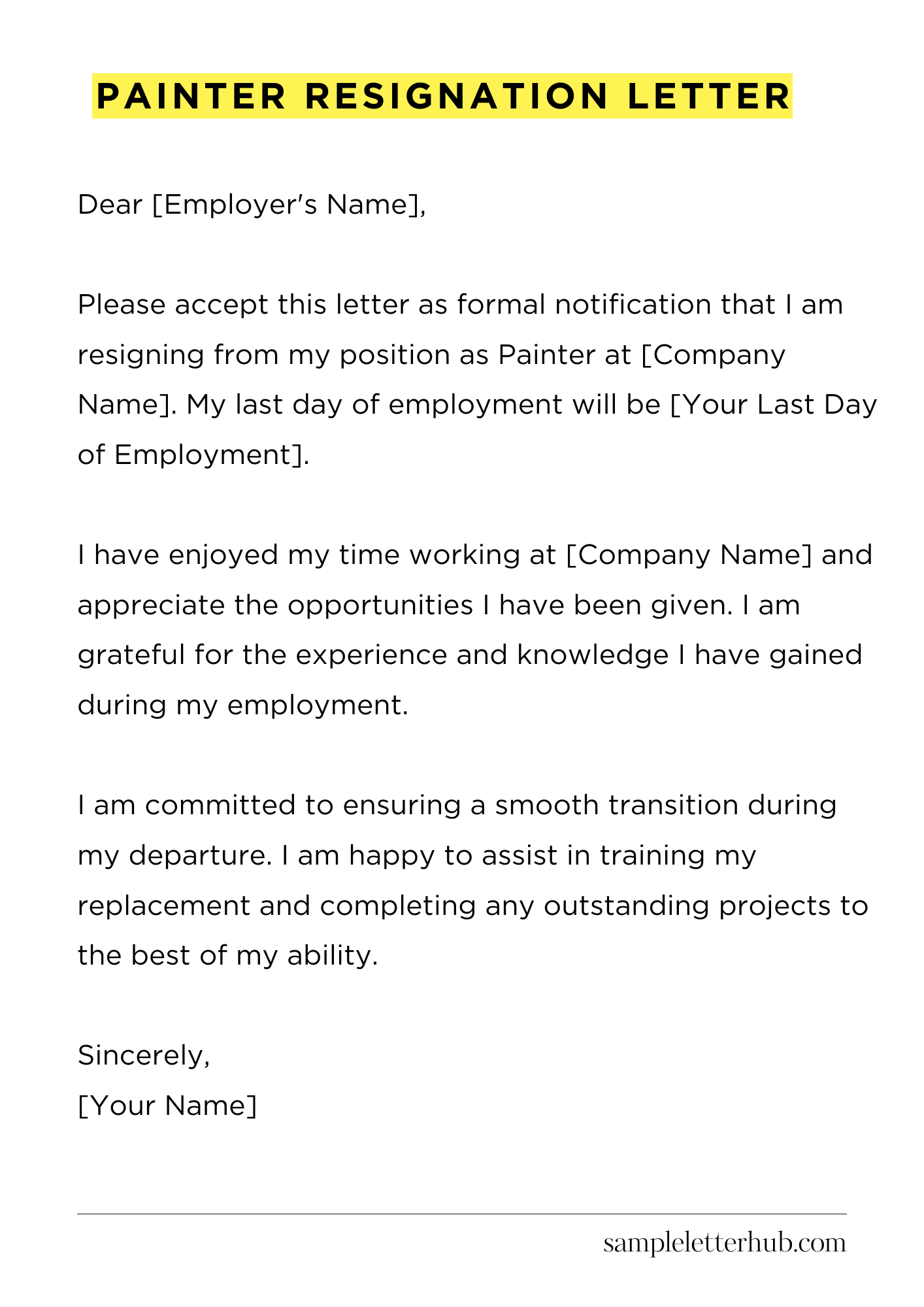
Dear [Employer’s Name],
Please accept this letter as formal notification that I am resigning from my position as Painter at [Company Name]. My last day of employment will be [Your Last Day of Employment].
I have enjoyed my time working at [Company Name] and appreciate the opportunities I have been given. I am grateful for the experience and knowledge I have gained during my employment.
I am committed to ensuring a smooth transition during my departure. I am happy to assist in training my replacement and completing any outstanding projects to the best of my ability.
Thank you for your understanding. I wish you and [Company Name] all the best in the future.
Sincerely,
[Your Name]
How to Write a Painter Resignation Letter
1. Grasping the Basics: Why a Resignation Letter is Essential
Leaving a job, especially a skilled trade like painting, requires professionalism. You need to do it right. A well-crafted resignation letter is more than just a formality; it’s a critical step in ending your employment on positive terms. Think of it as your final professional statement.
It officially communicates your intent to leave and provides vital information to your employer. Moreover, a properly written letter protects you. It creates a clear record of your departure, shielding you from potential misunderstandings.
2. Essential Elements: What Your Letter Must Include
Now, let’s break down the essential components. Your letter must start with a clear and concise statement of your resignation. Begin with a direct sentence, such as “Please accept this letter as formal notification that I am resigning from my position as Painter.” Next, you must state your last day of employment.
This is critical for payroll and scheduling purposes. Include the date. Following this, you might express gratitude. Thank your employer for the opportunity, mention what you enjoyed about the job, or even acknowledge specific mentors. Keep it brief. Finally, finish with your contact information, just in case. Your phone number or personal email may be helpful.
3. Crafting the Content: Tone and Language
The tone of your letter is crucial. Maintain a professional and respectful attitude. Avoid negativity, even if you’re unhappy. Avoid the temptation to vent about difficult clients or working conditions. Keep it positive. The language should be clear and concise. Avoid jargon specific to your field.
Simple, direct sentences are always best. Proofread your letter meticulously! Typos and grammatical errors undermine your professionalism.
4. Tailoring to Your Situation: Examples and Adaptations
Here’s a basic example:
[Your Name]
[Your Address]
[Your Phone Number]
[Your Email Address]
[Date]
[Employer’s Name]
[Employer’s Company Name]
[Employer’s Address]
Dear [Employer’s Name],
Please accept this letter as formal notification that I am resigning from my position as Painter, effective [Your Last Day of Employment]. I appreciate the opportunities I have been given during my time here. Thank you for the experience. I wish you and the company all the best in the future.
Sincerely,
[Your Signature]
[Your Typed Name]
Adapt this template. For instance, If you’re moving to another city for family, you could briefly mention it. If you’re open to helping with the transition, you might offer to assist in training your replacement (if appropriate). Always tailor the letter to your specific circumstances, ensuring it reflects your personality while remaining professional.
5. Delivery and Follow-Up: Final Steps
Once your letter is ready, how do you deliver it? Always deliver the letter in person. If not possible, email is usually acceptable. Make sure you get confirmation that they received it. Keep a copy for your records. After submitting your letter, be prepared to answer questions from your employer.
Be professional and patient during the discussions. If you’re asked to do exit interviews or offer feedback, do so constructively. Your professionalism during this time solidifies your reputation and can be beneficial in the future.
FAQs about Painter Resignation Letter
What is the primary purpose of a painter’s resignation letter?
The primary purpose of a painter’s resignation letter is to formally notify their employer of their intent to leave their position. It serves as an official record of the resignation, the last day of employment, and often includes a brief statement of gratitude or farewell.
What essential information should be included in a painter’s resignation letter?
A painter’s resignation letter should include the following essential information: a clear and concise statement of resignation, the effective date of resignation (last day of employment), the painter’s name, the employer’s name or company name, and a professional closing.
Optional additions might include a brief reason for leaving (optional), an offer to assist with the transition, and a thank you to the employer.
How should a painter format their resignation letter?
The resignation letter should be formatted professionally. It should begin with the date, followed by the employer’s name and address. The body of the letter should be written in a clear, concise manner, using a formal tone. The letter should be single-spaced with a space between paragraphs.
A professional closing, such as “Sincerely” or “Respectfully,” should be followed by the painter’s signature and printed name.
Is it necessary for a painter to provide a reason for resigning in their letter?
While not mandatory, providing a reason for resignation is often helpful, although it is optional. Keeping the reason brief and neutral is usually the best approach.
Common reasons include accepting a new job, pursuing further education, or personal reasons. If the painter is comfortable, a brief explanation can help the employer understand the situation. However, the painter is not obligated to provide details.
How can a painter ensure their resignation letter is received and acknowledged appropriately?
To ensure proper receipt and acknowledgment of the resignation letter, a painter should follow a few steps. First, the letter should be addressed to the appropriate person, usually the painter’s supervisor or human resources department. It’s often best to deliver the letter in person or via email.
If delivering in person, a copy should be kept for personal records. Requesting a written acknowledgement of receipt, especially when delivered in person, can provide additional confirmation. If sending via email, it is wise to request a read receipt.
Related:
Resignation letter due to rude boss
Resignation letter moving to another state
Resignation letter due to illness of family member
Resignation letter due to study