

Thinking of moving on? A “Closer Resignation Letter” is your official goodbye. It’s a formal document. You use it to inform your employer of your departure. This letter signals the end of your employment. It’s your last act in your current role.
Need help crafting the perfect letter? We’ve got you covered. We’ll show you the way. We’ve gathered useful samples. You can use these templates. They’ll help you write your own letter.
This article offers several examples. You can adapt them to your specific needs. From short and sweet to more detailed, choose what fits. Writing a resignation letter has never been so simple.
Closer Resignation Letter
Below is a sample of a Closer Resignation Letter:
[Your Name]
[Your Address]
[Your Phone Number]
[Your Email Address]
[Date]
[Recipient’s Name]
[Recipient’s Title]
[Company Name]
[Company Address]
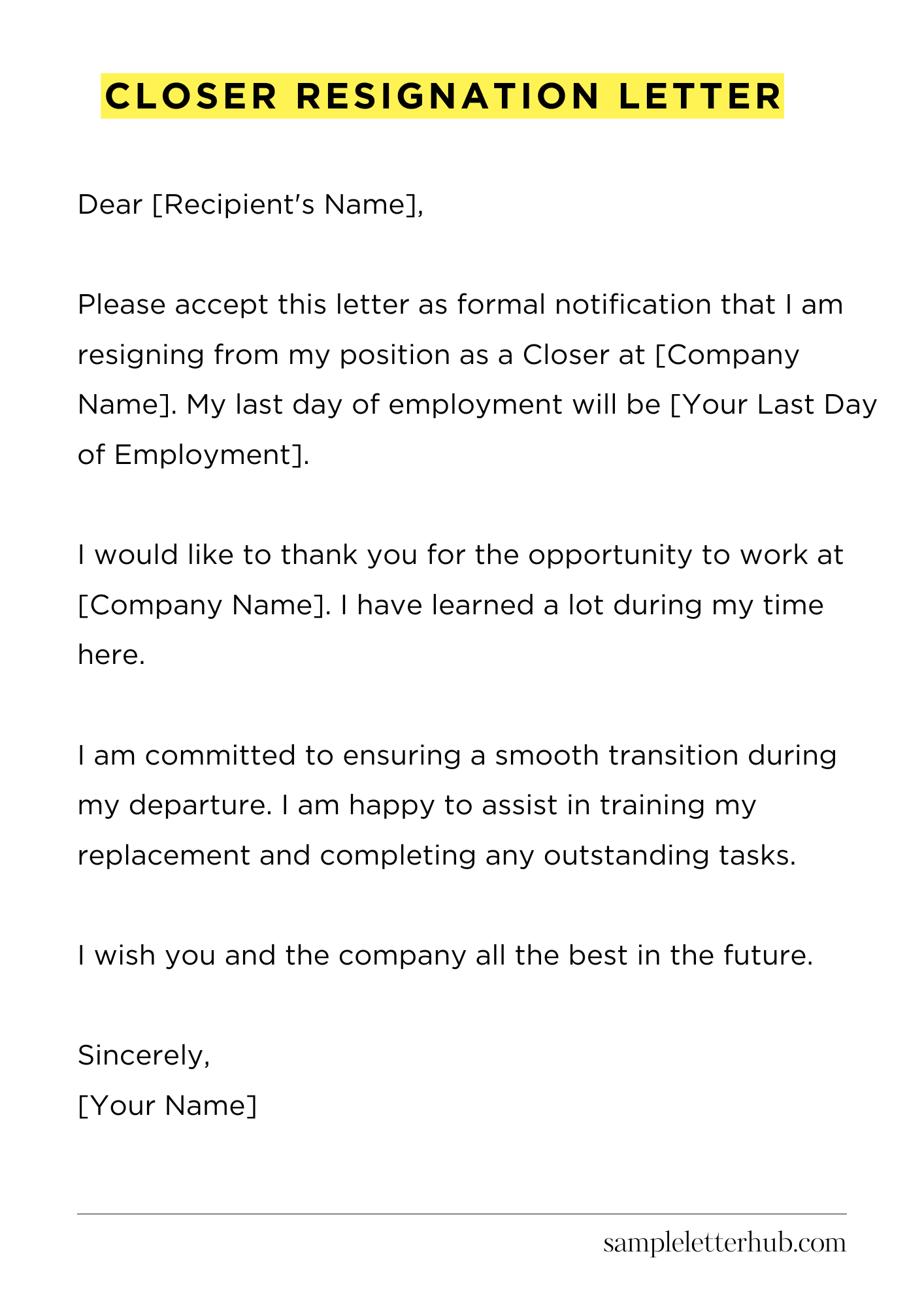
Dear [Recipient’s Name],
Please accept this letter as formal notification that I am resigning from my position as a Closer at [Company Name]. My last day of employment will be [Your Last Day of Employment].
I would like to thank you for the opportunity to work at [Company Name]. I have learned a lot during my time here.
I am committed to ensuring a smooth transition during my departure. I am happy to assist in training my replacement and completing any outstanding tasks.
I wish you and the company all the best in the future.
Sincerely,
[Your Name]
How to Write a Closer Resignation Letter
1. Getting Started: The Basics You Can’t Skip
So, you’re ready to move on. Congratulations! But before you grab your new job’s contract and celebrate, there’s a vital piece of paperwork to handle: the resignation letter. This isn’t just about saying “bye,” it’s about doing it right. First, keep it professional. No need to burn bridges.
Your letter should be brief, respectful, and clear. Start with your name, the date, and the recipient’s name and title. Get this foundational stuff correct.
Keep your tone formal. Always use a proper business letter format. Your current employer deserves that.
2. Declaring Your Intent: The Core of Your Message
This is where you state the obvious: you are resigning. Be direct. Clearly state your intention to resign from your position. Don’t beat around the bush. Include your job title. Then, mention your last day of employment. This is crucial for HR and your manager to process your departure.
Make sure it aligns with your employment contract or any company policies regarding notice periods. For example: “I am writing to inform you of my resignation from the position of [Your Job Title], effective [Your Last Day of Employment].” Remember, clarity is key here.
That is the most important part of the letter.
3. Gratitude & Positivity: Saying “Thank You”
Show some appreciation. Acknowledge the opportunity you had. Even if you’re leaving a less-than-ideal situation, expressing gratitude can leave a positive impression.
You can thank your employer for the opportunities, experiences, and training you’ve received. Briefly mention the positive aspects of your employment, like valuable lessons learned or relationships you’ve built.
For example: “I am grateful for the opportunities I’ve had at [Company Name] and for the experience I’ve gained during my time here.” This bit matters quite a lot. A little bit of kindness goes a long way.
Keep it sincere, and keep it brief.
4. Handling the Transition: Offering Help
Show willingness to help the company with the transition. Offer assistance in the handover process. This demonstrates professionalism and a commitment to ensuring a smooth workflow. Offer to help train your replacement, complete ongoing projects, or document your processes.
For example: “I am happy to assist in the transition process and to train my replacement. Please let me know how I can be of help in the coming weeks.” This is especially useful if you are in a specialized role. A good employee always facilitates the company’s continuous workflow.
This can enhance your professional reputation.
5. Closing Strong: The Final Touches and Sign Off
End the letter with a polite and professional closing. Reiterate your gratitude. Restate your contact information, if desired, in case they need something from you.
Finally, sign your name. Use a closing such as “Sincerely,” “Respectfully,” or “Best regards.” Below your typed name, leave space for your signature, if you’re submitting a hard copy. Your signature should come directly above your printed name. Proofread your letter carefully for any typos or grammatical errors.
A well-written letter reflects positively on you and can help maintain a strong professional relationship, no matter what. After all, you never know when you might cross paths with these people again.
Now, go forth and write that letter. You got this!
FAQs about Closer Resignation Letter
What is a Closer Resignation Letter, and when is it used?
A Closer Resignation Letter is a formal document an employee submits to their employer to officially announce their departure from the company. It’s used when an employee is leaving a sales or closing-focused role, often outlining the last day of employment and sometimes providing a brief reason for leaving.
This letter is crucial for a smooth transition and serves as a record of the employee’s intent to resign.
What key information should be included in a Closer Resignation Letter?
The key information includes a clear statement of resignation, the employee’s name and title, the effective last day of employment, a brief and professional statement of gratitude (optional), and the employee’s signature. Consider providing contact information for future communication, if desired. The goal is clarity and professionalism to ensure a clean break.
How should I handle the delivery of a Closer Resignation Letter?
It’s generally recommended to deliver the letter in person to your direct supervisor or HR representative, followed by email. This allows for immediate acknowledgment and any necessary discussions. Ensure you keep a copy of the letter for your records. The delivery method should reflect the company’s communication protocol.
Can I include a reason for leaving in my Closer Resignation Letter?
While not mandatory, you can include a brief and neutral reason for leaving, such as pursuing new opportunities or personal growth. However, it’s generally advisable to keep the reason concise and positive. Avoid including negative feedback or grievances in the resignation letter. Save those conversations for exit interviews.
What are the legal considerations related to a Closer Resignation Letter?
The legal implications are generally straightforward. The letter serves as written notice, which is important for employment records. Review your employment contract for any specific clauses regarding resignation notice periods. Ensure your letter complies with any company policies concerning the resignation process.
Consulting with an attorney is recommended if the separation involves legal issues like non-compete agreements or potential disputes.
Related:
Resignation letter due to rude boss
Resignation letter moving to another state
Resignation letter due to illness of family member
Resignation letter due to study