

A Visiting Researcher resignation letter is a formal document. It is written by a visiting researcher. Its purpose is to officially inform the institution about their departure. The letter states their intention to resign from their research position.
Sometimes, crafting the perfect resignation letter feels tough. We understand. That’s why we’re here to help. We’ll explore various examples for your use. These templates cover different scenarios.
We have a collection of sample letters. They cater to your needs. Use these as a starting point. Modify them to suit your specific situation. Writing your letter just got easier.
Visiting Researcher Resignation Letter
Below is a sample of a Visiting Researcher Resignation Letter:
[Your Name]
[Your Address]
[Your Phone Number]
[Your Email Address]
[Date]
[Researcher’s Supervisor’s Name]
[Researcher’s Supervisor’s Title]
[Department Name]
[University/Institution Name]
[University/Institution Address]
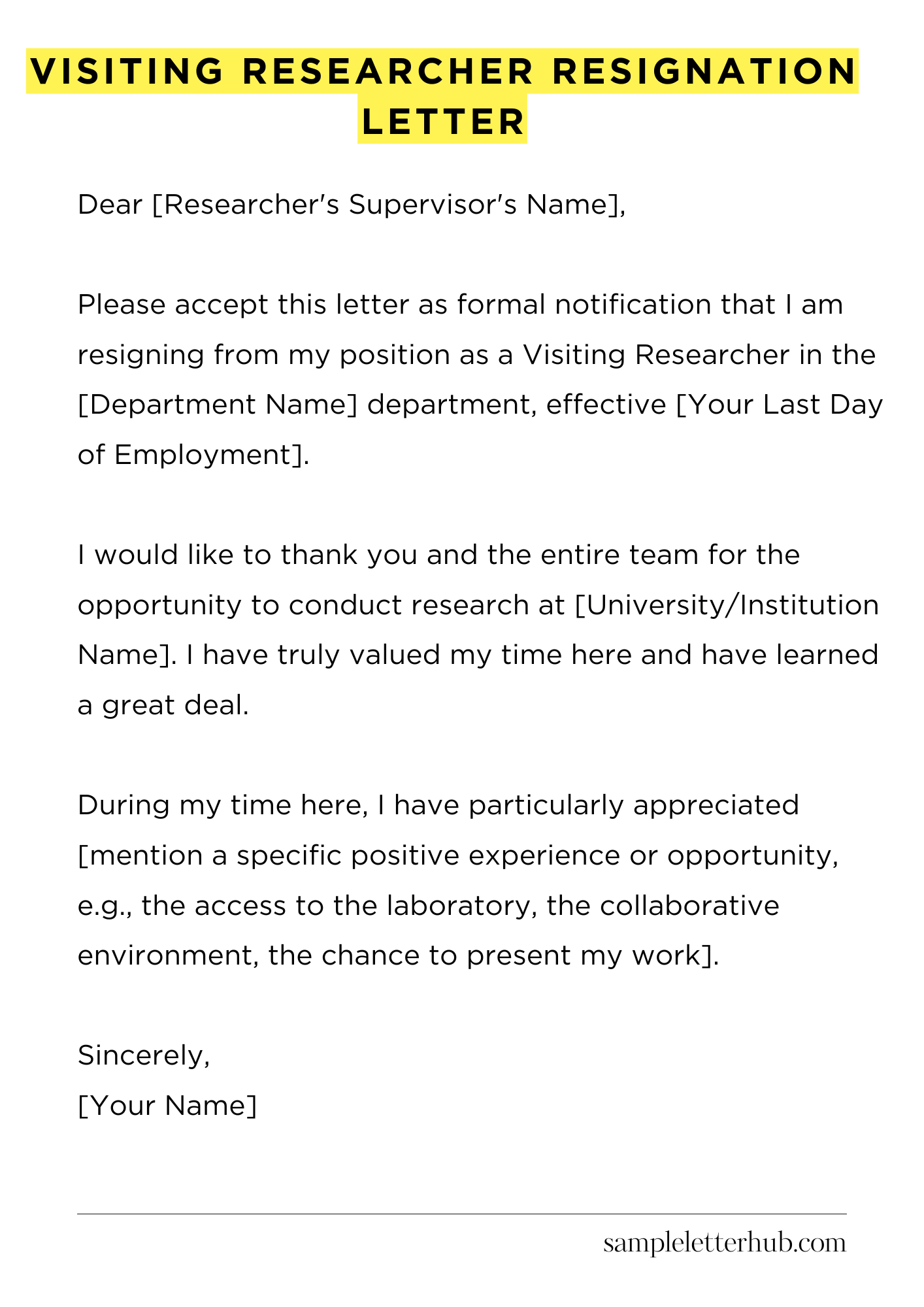
Dear [Researcher’s Supervisor’s Name],
Please accept this letter as formal notification that I am resigning from my position as a Visiting Researcher in the [Department Name] department, effective [Your Last Day of Employment].
I would like to thank you and the entire team for the opportunity to conduct research at [University/Institution Name]. I have truly valued my time here and have learned a great deal.
During my time here, I have particularly appreciated [mention a specific positive experience or opportunity, e.g., the access to the laboratory, the collaborative environment, the chance to present my work].
I will ensure all my current research projects are completed or properly handed over before my departure. I am happy to assist in the transition process in any way possible.
I wish you and the department all the best in the future.
Sincerely,
[Your Name]
How to Write a Visiting Researcher Resignation Letter
1. Why Bother with a Letter Anyway?
So, you’re leaving. Congratulations on your next adventure! You might think, “Can’t I just tell someone and be done with it?” Well, yes, you *could*. However, a well-crafted resignation letter is more than just a formality; it’s a professional necessity.
Firstly, it creates a clear and documented record of your departure. This protects both you and the institution. Secondly, it allows you to express your gratitude for the opportunity. It’s a nice gesture. And lastly, it’s your chance to maintain a positive relationship. You never know when you might need a reference or want to collaborate again down the road.
2. What to Include: The Essential Ingredients
A good resignation letter isn’t rocket science, but it needs to be clear and concise. Think of it as a recipe. Here’s what you need:
- Your Name and Contact Information: Always a good place to start. Include your current role, too.
- The Date: Very important for the official record.
- The Recipient: Address the letter to the appropriate person. Usually, it’s your supervisor or the department head. Double-check who needs to receive it!
- A Clear Statement of Resignation: State plainly that you are resigning from your position. Make it official!
- Your Last Day of Employment: Provide the exact date of your departure. Stick to the agreed-upon timeframe.
- A Brief Statement of Gratitude: Thank the institution for the opportunity. Mention specific experiences if you have room.
- Optional: Brief Explanation (If Necessary): You don’t *have* to explain why you are leaving, but a very brief reason (e.g., “to pursue other opportunities”) is often polite. Don’t go into excessive detail.
- Closing: End with a professional closing, such as “Sincerely,” or “Respectfully,” followed by your signature (if submitting a hard copy) and your typed name.
- Contact Information: Include contact information (Email and Phone number)
3. Crafting the Perfect Tone: Keep it Professional
Your tone is key. Even if you’re not thrilled about leaving, keep it positive and professional. Avoid negativity, complaints, or personal gripes. This is not the place for venting! Remember, this letter is a reflection of you. Keep these points in mind:
- Be Positive: Focus on the good aspects of your experience.
- Be Grateful: Express your appreciation for the opportunity.
- Be Concise: Get to the point without rambling.
- Be Clear: Make your intentions and departure date unmistakable.
- Proofread! Proofread! Proofread! Errors undermine your credibility.
4. Formatting and Delivery: Dotting the ‘i’s and Crossing the ‘t’s
The visual aspects matter. A well-formatted letter demonstrates professionalism. Ensure your letter is formatted correctly.
- Use a standard business letter format.
- Use a clear and easy-to-read font like Times New Roman or Arial.
- Keep the letter concise. Ideally, it should be no more than one page.
- Deliver the letter properly. Check your institution’s protocol. Usually, you’ll submit a digital copy (email is common) and sometimes a hard copy too. Always ask.
5. Examples and Templates: Get Inspired
Not sure where to start? Numerous templates are available online. However, customize any template. Generic templates are okay but tailoring it to your specific experience makes it more genuine.
Important note: Remember to adapt any example to your own circumstances. Personalize the letter.
Do not just copy and paste! Put in the effort!
By following these steps, you can create a resignation letter that is both professional and effective, leaving a positive lasting impression.
FAQs about Visiting Researcher resignation letter
What is the primary purpose of a Visiting Researcher resignation letter?
The primary purpose of a resignation letter from a Visiting Researcher is to formally communicate the intention to end their research affiliation with the host institution.
It serves as a written record of the researcher’s departure, ensuring a clear and documented transition. It should state the effective date of resignation, and often includes a brief reason, and express gratitude for the opportunity.
What key elements should be included in a Visiting Researcher resignation letter?
A well-crafted resignation letter should include: a formal salutation to the appropriate contact person (e.g., supervisor, department head), a clear statement of resignation, the specific effective date of the resignation, a brief and professional reason for leaving (optional but often included).
It may also include details on completing ongoing projects, transferring data, or arranging for a smooth handover of responsibilities.
When should a Visiting Researcher submit their resignation letter?
The timing of the resignation letter is crucial. It should be submitted in accordance with the terms outlined in the Visiting Researcher’s agreement or the institution’s policies, typically allowing for a notice period (e.g., two weeks, one month).
The letter should be submitted as soon as the decision to resign is final, allowing sufficient time for the host institution to prepare for the researcher’s departure.
What are the common reasons for a Visiting Researcher to resign?
Common reasons for resignation include the completion of the research project, the expiration of the visiting period, the acceptance of a new position (e.g., a permanent research role or academic appointment), a change in personal circumstances, or a lack of funding for the research.
Occasionally, resignation may result from disagreements or dissatisfaction with the research environment, although these reasons are often less detailed in the letter itself.
How should a Visiting Researcher handle data and ongoing projects in their resignation letter?
The resignation letter should address the handling of data and ongoing projects. The researcher should indicate their plan for project completion or handover. This may involve providing documentation, transferring data to the host institution, or assisting in training a replacement.
The researcher must adhere to the institution’s policies on data management, intellectual property, and research ethics. The letter is an opportunity to clarify the transition plan and offer assistance.
Related:
Resignation letter due to rude boss
Resignation letter moving to another state
Resignation letter due to illness of family member
Resignation letter due to study