

Need to leave your work-study job? You’ll likely need a work-study resignation letter. This is a formal way to inform your employer of your departure. It officially ends your employment in this role.
Don’t know where to start? We’ve got you covered. We’ll share several templates. These are designed to guide you. You can easily adapt them for your situation.
Need a letter for a specific reason? We have examples. Find the right words. Make the process simple. Let’s get you on your way!
Work Study Resignation Letter
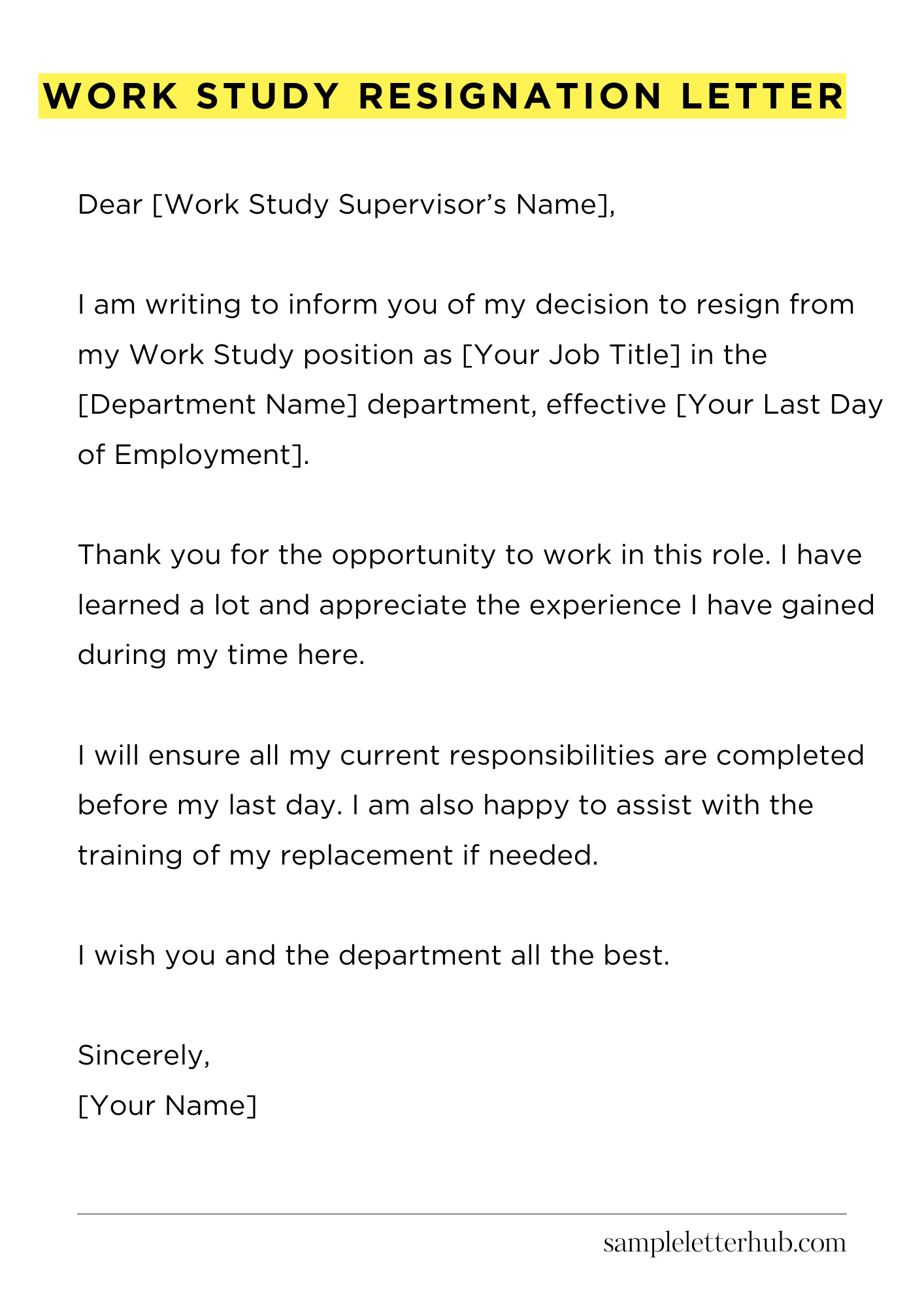
Below is a sample of a Work Study Resignation Letter:
[Your Name]
[Your Address]
[Your Phone Number]
[Your Email Address]
[Date]
[Work Study Supervisor’s Name]
[Work Study Department]
[University/College Name]
[University/College Address]
Dear [Work Study Supervisor’s Name],
I am writing to inform you of my decision to resign from my Work Study position as [Your Job Title] in the [Department Name] department, effective [Your Last Day of Employment].
Thank you for the opportunity to work in this role. I have learned a lot and appreciate the experience I have gained during my time here.
I will ensure all my current responsibilities are completed before my last day. I am also happy to assist with the training of my replacement if needed.
I wish you and the department all the best.
Sincerely,
[Your Name]
How to Write a Work Study Resignation Letter
1. Why Resign? Reasons for Moving On
So, you’re thinking about quitting your work-study job. That’s a big decision, and it’s essential to understand why. Many reasons might push you to resign.
Maybe you got a better job offer. Perhaps your academic schedule is getting too hectic. Or, the work isn’t the right fit. Whatever the cause, it’s crucial to acknowledge it. Reflect on your situation, and try to pinpoint the main reason you’re leaving. This understanding will help shape your letter. It also helps you approach the situation thoughtfully.
Furthermore, this will guide your future choices.
2. Essential Elements: What Your Letter MUST Include
Your resignation letter needs to be clear and professional. Several key elements must be present. First, state your intention to resign. This seems obvious, but it’s important to be direct. Include the date of your last day of employment. This is usually two weeks from the date you submit the letter, but confirm this with your supervisor.
Next, clearly state the name of your position and who you report to. Be polite and professional. Finally, add your signature at the end. Keep it brief. You also may want to include a brief, sincere expression of gratitude for the opportunity.
Remember, this letter is a reflection of you.
3. Formatting and Tone: Keep it Professional
A professional tone is a must. Address your supervisor by name. Use a formal greeting, like “Dear [Supervisor’s Name]”. The content should also maintain a respectful demeanor.
Avoid negativity. Keep sentences straightforward, and the language should be formal. Proofread meticulously. Errors can undermine your credibility. Check spelling and grammar carefully before you submit it.
The formatting matters, too. Use a standard business letter format. This includes your name, address, and the date at the top. The recipient’s information should follow. You can use a simple font like Times New Roman or Arial.
The goal is to leave a positive lasting impression.
4. Writing the Body: Content is King
The body of your letter is where you explain your decision. Keep it concise. Start by stating your intention to resign and the date of your last day. Briefly, mention the reason for leaving if you want. It’s okay to be general. For example, “due to a change in my academic schedule”.
Avoid going into excessive detail. Express gratitude for the opportunity to work. This can be as simple as, “Thank you for the opportunity to work in this position.” Finally, offer to help with the transition. Offer to train your replacement. This is not required, but it shows goodwill. Sign off with a polite closing, like “Sincerely” or “Respectfully”.
Ensure that it sounds respectful and thoughtful.
5. After Submission: What Happens Next
Once you’ve submitted your letter, your work isn’t entirely done. After you submit the letter, expect a response from your supervisor. They might acknowledge your resignation and discuss the exit process. Make sure to complete any necessary paperwork. This might include an exit interview.
This is your chance to clarify things. It is very important to conduct yourself professionally until your last day. Be prepared to fulfill your duties.
Demonstrate professionalism even as you prepare to leave. Finally, leave on good terms. You never know when you might need a reference or cross paths with colleagues in the future. Burning bridges is never a good idea.
Remember, the goal is to depart respectfully and professionally.
FAQs about Work Study Resignation Letter
What is the proper format for a Work Study resignation letter?
A Work Study resignation letter should follow a professional business letter format. Include your name, address, and contact information, followed by the date, and the recipient’s information (supervisor’s name, department, university address).
The body of the letter should state your intention to resign from your Work Study position, the effective date of your resignation, and a brief statement of gratitude for the opportunity. Keep it concise, professional, and positive. End with a formal closing (e.g., “Sincerely” or “Respectfully”) and your typed name.
How much notice should I give when resigning from a Work Study position?
The standard practice is to provide at least two weeks’ notice, but this can vary depending on your university’s or department’s policy. Always review your employment contract or the student employment handbook for specific requirements. Giving ample notice allows your supervisor time to find a replacement and ensures a smooth transition.
What information should I include in my Work Study resignation letter?
Your letter should clearly state your intention to resign, the effective date of your resignation, your name, your Work Study position, and a brief expression of gratitude for the experience. You may also briefly explain the reason for your resignation, if you wish to, but it’s not required. You do not need to provide extensive details. Ensure your tone is professional and positive.
Can I resign from my Work Study position immediately?
While you can technically resign immediately, it’s generally not advisable. Resigning without proper notice can negatively affect your employment record and potentially impact future employment opportunities or future Work Study eligibility.
Review your employment contract or university policies regarding immediate resignation consequences, but aim for the standard two weeks’ notice to maintain a professional demeanor.
Where should I submit my Work Study resignation letter?
Submit your letter to your immediate supervisor or the designated contact person within the department. Ensure you keep a copy of the letter for your records. Some universities may also require a copy to be submitted to the financial aid or student employment office. Confirm the specific submission procedure with your supervisor or the student employment office.
Related:
Resignation letter due to rude boss
Resignation letter moving to another state
Resignation letter due to illness of family member
Resignation letter due to study