

A Kitchen Assistant resignation letter is a formal document. Its purpose is to officially inform an employer about leaving a job. It states the employee’s intent to resign. It also typically includes the last day of employment.
This article has you covered. We’ve gathered helpful templates. You’ll find different examples here. These examples will get you started. They will simplify the process.
You can customize the samples. Adapt them to fit your specific situation. Writing a resignation letter becomes easier. Craft your departure with confidence.
Kitchen Assistant Resignation Letter
Below is a sample of a Kitchen Assistant Resignation Letter:
[Your Name]
[Your Address]
[Your Phone Number]
[Your Email Address]
[Date]
[Employer’s Name]
[Restaurant Name]
[Restaurant Address]
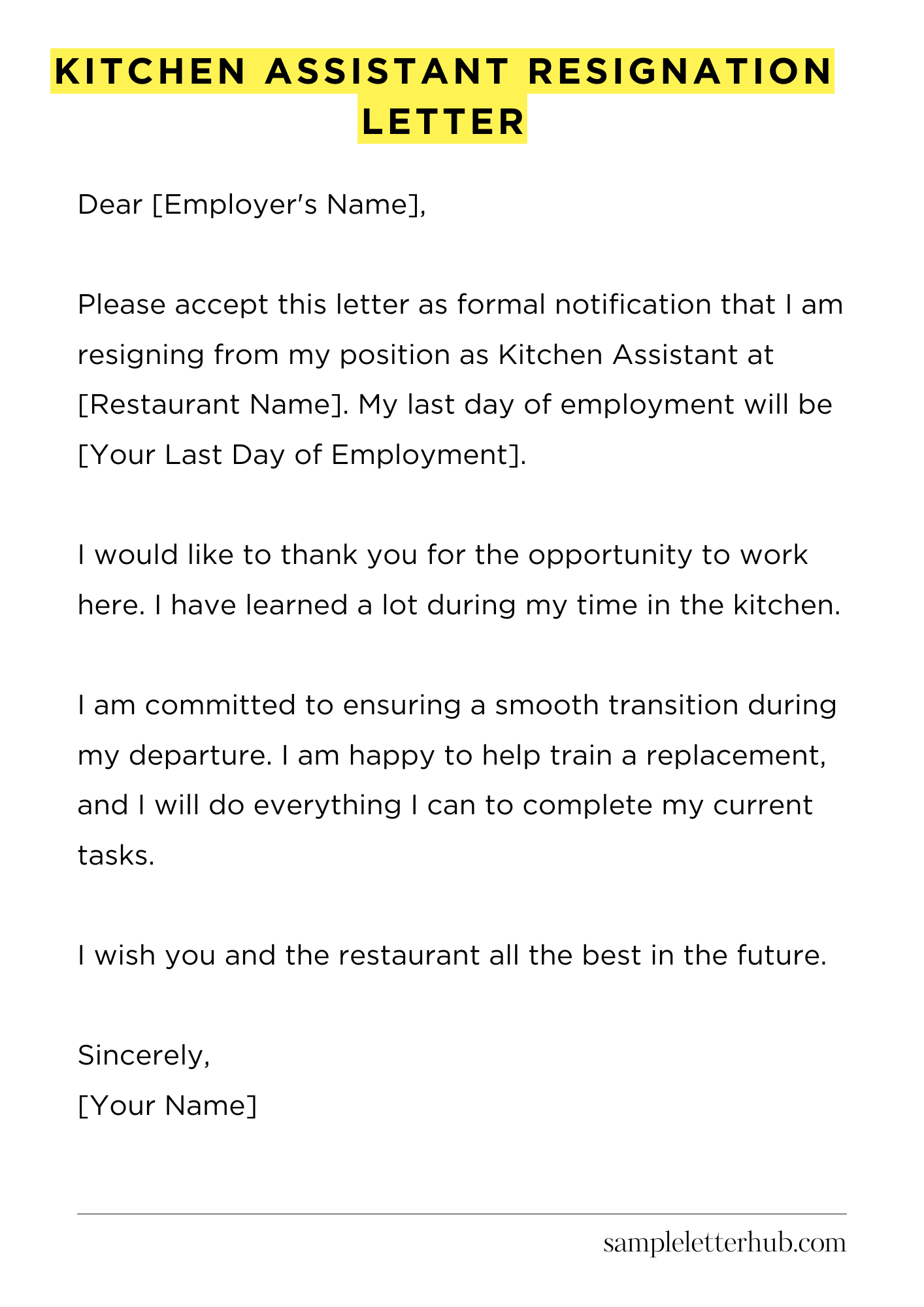
Dear [Employer’s Name],
Please accept this letter as formal notification that I am resigning from my position as Kitchen Assistant at [Restaurant Name]. My last day of employment will be [Your Last Day of Employment].
I would like to thank you for the opportunity to work here. I have learned a lot during my time in the kitchen.
I am committed to ensuring a smooth transition during my departure. I am happy to help train a replacement, and I will do everything I can to complete my current tasks.
I wish you and the restaurant all the best in the future.
Sincerely,
[Your Name]
How to Write Kitchen Assistant Resignation Letter
Leaving a job is never easy. It takes courage to move on, especially from a place you’ve spent a significant amount of time. Writing a resignation letter is a key step in that process.
This letter is your formal notice of departure. It’s also an important document that can influence your future relationships with previous employers. Let’s delve into writing a good kitchen assistant resignation letter.
1. Keep it Short and Sweet
Brevity is the soul of wit, and also, the soul of a good resignation letter. You don’t need to write a novel. Get straight to the point. State your intention clearly and concisely.
Begin by stating you are resigning from your position as a kitchen assistant. Include your last day of employment. This is crucial for your employer to plan accordingly. Keep it professional. Use standard business letter format. Avoid overly emotional language.
2. Express Your Gratitude (and Be Sincere)
Even if you’re not thrilled about leaving, a touch of gratitude goes a long way. Thank your employer for the opportunity to work as a kitchen assistant.
Briefly mention any positive experiences or skills you’ve gained. This demonstrates professionalism and leaves a good impression. Consider this part carefully. It’s a chance to build a good bridge with your employer. This might be useful in the future.
3. Provide Necessary Information (and Be Clear)
Besides your resignation date, you might need to include some other key information. Depending on the company policy, you may be asked to return equipment or uniforms. If so, mention that you’ll comply with the relevant procedures. Include contact information.
Provide your contact details for future communication. Offer assistance during the transition period. This shows consideration and professionalism. Offer to help train your replacement, if possible.
4. Keep it Positive and Professional
Avoid negativity. Don’t use the letter to air grievances or complaints. Save those for a separate exit interview, if there is one. The purpose of this letter is to formally announce your departure. Maintain a professional tone throughout the letter. Proofread it carefully before submitting it.
Check for grammatical errors and typos. Make sure your name is clearly printed, and the date is included. Remember, your resignation letter is a reflection of you.
5. The Closing and Delivery
End the letter with a polite closing. “Sincerely” or “Respectfully” are good choices. Sign the letter. Print your name below your signature. Deliver the letter to your supervisor or the appropriate person. Be sure to obtain a confirmation of receipt, or send it via certified mail.
This will protect you. It provides proof that you submitted your resignation. Follow up, if needed. If you don’t hear back, follow up to confirm that your letter has been received.
FAQs about Kitchen Assistant resignation letter
How do I start a kitchen assistant resignation letter?
Begin your resignation letter professionally. Start with your name, the date, and the recipient’s name and title. Then, clearly state your intention to resign from your position as a Kitchen Assistant. This should be done in the first paragraph.
What key information should be included in a kitchen assistant resignation letter?
Your resignation letter should include: a clear statement of resignation, the date of your last day of employment (typically two weeks from the date you submit the letter, check your employment contract), a brief expression of gratitude for the opportunity to work there, and any necessary information regarding the handover of your duties.
Is it necessary to provide a reason for leaving in a kitchen assistant resignation letter?
While not always required, you might consider briefly stating the reason for your departure if you are comfortable doing so. Common reasons include accepting another job, pursuing further education, or personal reasons. However, you are not obligated to provide a detailed explanation. Keep it concise.
How should I end a kitchen assistant resignation letter?
End your letter professionally. Thank your employer for the opportunity and express your willingness to assist with the transition. You can also offer your contact information for any follow-up questions. Conclude with a formal closing, such as “Sincerely” or “Best regards,” followed by your full name and signature.
What if I need to leave a Kitchen Assistant position sooner than two weeks?
If you need to leave sooner than the standard two-week notice period, you should still state your desired last day in the letter. However, be aware that your employer may not be obligated to accommodate this request, and there may be consequences depending on your employment agreement.
Try to discuss your situation with your employer directly to find a mutually agreeable solution.
Related:
Resignation letter due to rude boss
Resignation letter moving to another state
Resignation letter due to illness of family member
Resignation letter due to study