

Sometimes, board members step down from their positions. This action requires a formal letter. It’s a “Board Member Resignation Letter.” The letter communicates the decision to leave the board. It also provides the effective date.
Writing this letter can feel tricky. Don’t worry, we’re here to help. We’ll share several templates. You’ll find different examples. They cover various situations.
These samples are easy to use. Adapt them to fit your needs. Crafting your resignation letter will be much smoother. Get ready to write a clear and concise letter.
Board Member Resignation Letter
Below is a sample of a Board Member Resignation Letter:
[Your Name/Address]
[Your Email]
[Your Phone Number]
[Date]
[Recipient Name/Title]
[Company Name]
[Company Address]
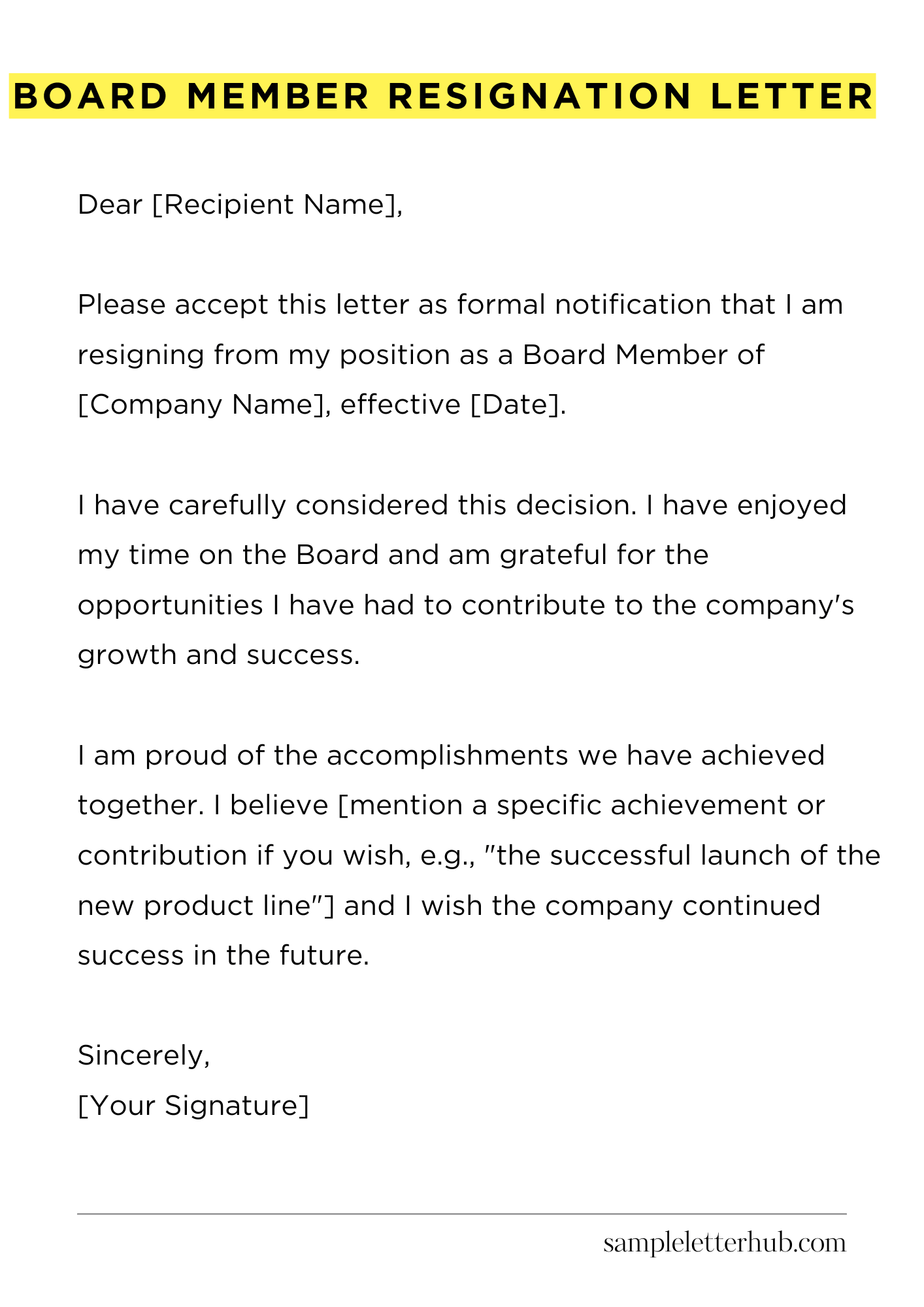
Dear [Recipient Name],
Please accept this letter as formal notification that I am resigning from my position as a Board Member of [Company Name], effective [Date].
I have carefully considered this decision. I have enjoyed my time on the Board and am grateful for the opportunities I have had to contribute to the company’s growth and success.
I am proud of the accomplishments we have achieved together. I believe [mention a specific achievement or contribution if you wish, e.g., “the successful launch of the new product line”] and I wish the company continued success in the future.
I am happy to assist in the transition process in any way I can. Please let me know how I can be of assistance during this period.
Thank you again for the experience.
Sincerely,
[Your Signature]
How to Write a Board Member Resignation Letter
1. Why is a Resignation Letter Important?
Resigning from a board position is a significant decision. You’re ending a formal commitment. A well-crafted resignation letter is more than just a formality; it’s a critical document. First, it makes your departure official. It clearly states the date your resignation takes effect.
Think of it as your official exit ticket. Second, it creates a record. This letter is proof of your resignation for the organization’s files and potentially for your own. Good record-keeping is vital. Lastly, a well-written letter can help maintain positive relationships. Your tone and content can influence how you are perceived long after you leave the board.
2. Essential Elements of Your Letter
What should you absolutely include? Start with the basics: your name, the date, and the board’s name. Be specific. Next, clearly state your intent. The first line should clearly announce your resignation from the board of directors. Then, state the effective date of your resignation.
Be precise, mentioning the day and month is crucial. Also, it’s advisable to include a brief, professional thank you. Acknowledge the organization and any positive aspects of your experience. Finally, optional, but often appreciated, you can offer assistance. For example, offering to help with the transition of your responsibilities.
3. Choosing the Right Tone and Language
Keep it professional and concise. Avoid unnecessary drama or negativity. This is not the time for airing grievances! Use respectful language. Even if your experience wasn’t entirely positive, maintain a neutral tone. Consider your audience. The board members are likely busy individuals.
The letter should be easy to read and understand. Stick to facts. Avoid overly emotional language or personal opinions unless they are constructive and relevant to the transition. Proofread meticulously! Spelling and grammar errors reflect poorly.
4. Structure and Formatting for Clarity
Formatting matters. Use a standard business letter format. Include a formal salutation, like “Dear Board of Directors.” Keep your paragraphs short and focused. This improves readability. Use clear and direct language. Avoid jargon. Be direct with your message. The body of the letter should be concise.
Stick to the essential information. Close with a professional closing. Examples include “Sincerely,” or “Respectfully.” Sign the letter. Include your printed name underneath the signature. Make it easy to process. Ensure the formatting is consistent throughout the document.
5. After Sending Your Letter: What to Expect
Once you’ve sent your letter, what comes next? The board may acknowledge your resignation. Expect to receive a formal acknowledgement, usually through email or a written response. You might be asked to participate in a brief exit interview. Be prepared to answer questions about your experience.
Be gracious and cooperative. You will likely need to transfer responsibilities. Prepare any documents or materials necessary for a smooth handover. Maintain professionalism. Remember, your actions during this period reflect on you. It’s best to leave a positive lasting impression.
FAQs about Board Member resignation letter
How should a Board Member start a resignation letter?
A Board Member resignation letter typically begins with a formal salutation, such as “Dear [Name of Board President/Chair]” or “Dear Members of the Board.” It should then clearly state the intent to resign from the board, specifying the effective date of the resignation. Concise and professional language is crucial from the outset.
What key information must be included in a Board Member resignation letter?
The core elements include the Board Member’s full name, the official title held, a clear statement of resignation, the effective date of resignation, and a brief and professional reason for leaving.
Optional elements include an expression of gratitude for the opportunity to serve, acknowledgment of past accomplishments, and an offer to assist with the transition. It is also common to include contact information.
Is it necessary to provide a reason for resigning in the letter?
While not always mandatory, including a brief, professional reason for resigning is often recommended. This can provide clarity and help the board understand the context of the departure. Common reasons include personal reasons, career changes, conflicting commitments, or differences in opinion regarding the board’s direction. Keep it concise and avoid negativity.
How should a Board Member handle the effective date of resignation?
The effective date should be explicitly stated and agreed upon by the Board. It’s crucial to give the board sufficient time to find a replacement and ensure a smooth handover of responsibilities.
Typically, a notice period of a month or more is considered standard, but this can vary depending on the organization’s bylaws and the nature of the board’s work. The date should be clearly indicated in the letter.
What are the best practices for delivering the resignation letter?
The resignation letter should be submitted in writing, preferably as a formal letter or email addressed to the Board President or Chair, and copied to the Board Secretary. It’s generally best to deliver the letter directly to the individual, or via a secure digital method, ensuring the letter’s confidentiality.
Follow up with a verbal discussion to offer further support and answer any questions. Keeping the process courteous and professional is key.
Related:
Resignation letter due to rude boss
Resignation letter moving to another state
Resignation letter due to illness of family member
Resignation letter due to study