

So, you’re moving on. An “Expert Resignation Letter” is your official goodbye. It’s a professional document. It formally announces your departure from a job. It is a crucial step. It is the end of your employment.
We understand. Writing a resignation letter can be tricky. You want to leave a good impression. You want to make it easy for yourself. You want to keep it simple. That’s why we’ve got you covered.
Here, find ready-made templates. We’ll share examples of resignation letters. These samples will help you. They will guide you. They’ll simplify the process. Use them to craft your own perfect letter.
Expert Resignation Letter
Below is a sample of a Expert Resignation Letter:
[Your Name]
[Your Address]
[Your Phone Number]
[Your Email Address]
[Date]
[Recipient’s Name]
[Recipient’s Title]
[Company Name]
[Company Address]
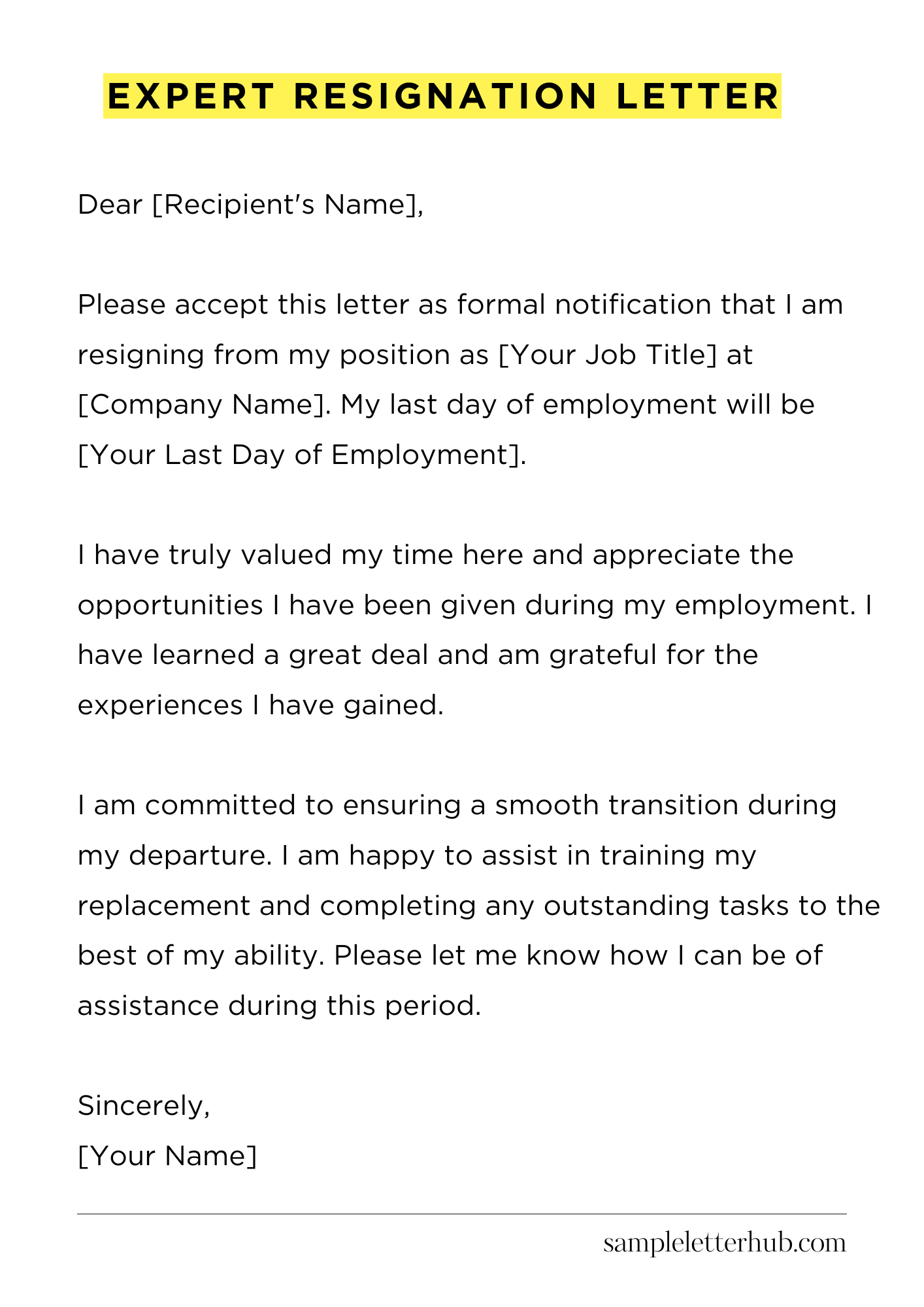
Dear [Recipient’s Name],
Please accept this letter as formal notification that I am resigning from my position as [Your Job Title] at [Company Name]. My last day of employment will be [Your Last Day of Employment].
I have truly valued my time here and appreciate the opportunities I have been given during my employment. I have learned a great deal and am grateful for the experiences I have gained.
I am committed to ensuring a smooth transition during my departure. I am happy to assist in training my replacement and completing any outstanding tasks to the best of my ability. Please let me know how I can be of assistance during this period.
I wish you and the company continued success in the future.
Sincerely,
[Your Name]
How to Write an Expert Resignation Letter
Leaving a job can be a big step. Maybe you’ve found a better opportunity. Perhaps it’s just time for a change. Whatever the reason, you’ll need to write a resignation letter. This is more important than you think! A well-crafted letter can leave a positive impression, even as you depart.
1. Keep it Concise and Clear
Don’t beat around the bush. Get straight to the point. Your letter’s primary purpose is to officially state your departure. State the position you’re leaving. Also include your last day of employment. Use direct and simple language. Avoid rambling or overly flowery prose. The goal is to be understood without confusion.
For example, instead of, “I am writing this communication to formally announce my intention to discontinue my employment…”, write, “This letter is to inform you that I am resigning from my position as [Your Position] at [Company Name]. My last day of employment will be [Date].” See? Much easier, and you’ve gotten your message across.
2. Express Gratitude (Always a Good Idea)
Even if the job wasn’t perfect, find something to be thankful for. This shows professionalism and class. Acknowledge any positive experiences or opportunities you received. Consider thanking your supervisor, colleagues, or the company as a whole. This builds bridges instead of burning them. You never know when you might cross paths again.
You might write: “I am grateful for the opportunities I’ve had at [Company Name], and I have learned a great deal. I particularly appreciate [Mention something specific, e.g., the training I received, the colleagues I worked with, or a specific project].”
3. Be Professional and Positive
It’s crucial to maintain a professional tone throughout the letter. Avoid any negativity or complaints about your job or employer. This is not the place for venting! Even if you have grievances, it’s best to keep those to yourself or address them separately if absolutely necessary. Maintain a positive attitude. This is what helps in the long run.
Instead of saying, “I hated my job,” you might say, “I am looking forward to exploring new opportunities that align with my career goals.” See the difference? One sounds constructive, while the other sounds petty.
4. Offer Assistance with the Transition
Demonstrate your commitment to a smooth transition. Offer to help with the handover of your responsibilities. You can assist in training your replacement. Or, you can document your ongoing projects. This demonstrates that you value the company and care about its continued success, even after you’re gone. It’s also just the right thing to do.
You could say: “I am happy to assist in any way possible to ensure a smooth transition. Please let me know how I can help with the handover of my responsibilities.”
5. Proofread and Proofread Again
Before you send your resignation letter, make sure you check it carefully. Proofread it for any typos, grammatical errors, or formatting issues. These mistakes reflect poorly on your professionalism. Ask a friend or colleague to review it as well. A fresh pair of eyes can often catch errors you might miss. It is always wise to double-check everything.
A well-written and error-free letter will leave a positive and lasting impression. This can make a big difference in the future. Your reputation is important, so ensure your message is perfect.
FAQs about Expert Resignation Letter
What is an expert resignation letter, and why is it important?
An expert resignation letter is a formal document written by an individual with specialized knowledge and skills, such as a specialist, consultant, or senior-level employee, to officially notify their employer of their intention to leave their position.
It’s important because it serves as a professional record of the employee’s departure, clarifies the last day of employment, and can set a positive tone for the transition period.
A well-crafted letter can also help maintain a positive relationship with the former employer and open doors for future opportunities.
What key elements should be included in an expert resignation letter?
An effective expert resignation letter should include the following key elements: a clear statement of resignation, the employee’s official job title, the date of resignation, the last day of employment, a brief expression of gratitude for the opportunity, and any relevant details regarding the transition process, such as offering assistance with the handover of responsibilities.
It’s also wise to maintain a professional tone and avoid any negative comments about the employer or colleagues.
How much notice should an expert give when resigning?
The notice period depends on several factors, including the employment contract, company policy, and local laws. However, a general rule of thumb is to provide at least two weeks’ notice. Experts, particularly those in senior roles or with critical responsibilities, may be expected to provide a longer notice period, often 30, 60, or even 90 days, to facilitate a smooth transition.
Consulting the employment contract and company handbook is crucial to determine the required notice period.
How should an expert address the letter to their employer?
The letter should be addressed formally to the appropriate person, usually the immediate supervisor, the human resources department, or the hiring manager. It is crucial to check the company’s organizational chart or employee handbook to identify the correct recipient.
If unsure, addressing it to the supervisor is generally the safest approach. Using a professional and respectful salutation like “Dear [Name]” or “Dear Mr./Ms. [Last Name]” is crucial.
Should an expert include a reason for resignation in their letter?
While not mandatory, an expert may choose to briefly state the reason for their resignation in the letter. However, this is usually kept concise and professional.
Common reasons include “pursuing another opportunity,” “relocating,” or “seeking a new career path.” Avoid going into excessive detail or including any negative feedback about the company. The focus should be on the transition and expressing gratitude for the experience.
Related:
Resignation letter due to rude boss
Resignation letter moving to another state
Resignation letter due to illness of family member
Resignation letter due to study