

A “Prof resignation letter” is a formal document. It is written by a professor. The purpose is to officially announce their departure from a university or college. It signals the end of their employment.
Leaving a job can be tough. Crafting the right words matters. We understand. This article is all about making the process easier. We’ve put together various templates and examples.
These samples will help. You can adapt them to your specific situation. No matter what letter you are trying to write, we’ve got you covered. Let’s make it simple and stress-free.
Prof Resignation Letter
Below is a sample of a Prof Resignation Letter:
[Your Name]
[Your Address]
[Your Phone Number]
[Your Email Address]
[Date]
[Recipient’s Name]
[Recipient’s Title]
[Department]
[University Name]
[University Address]
Dear [Recipient’s Name],
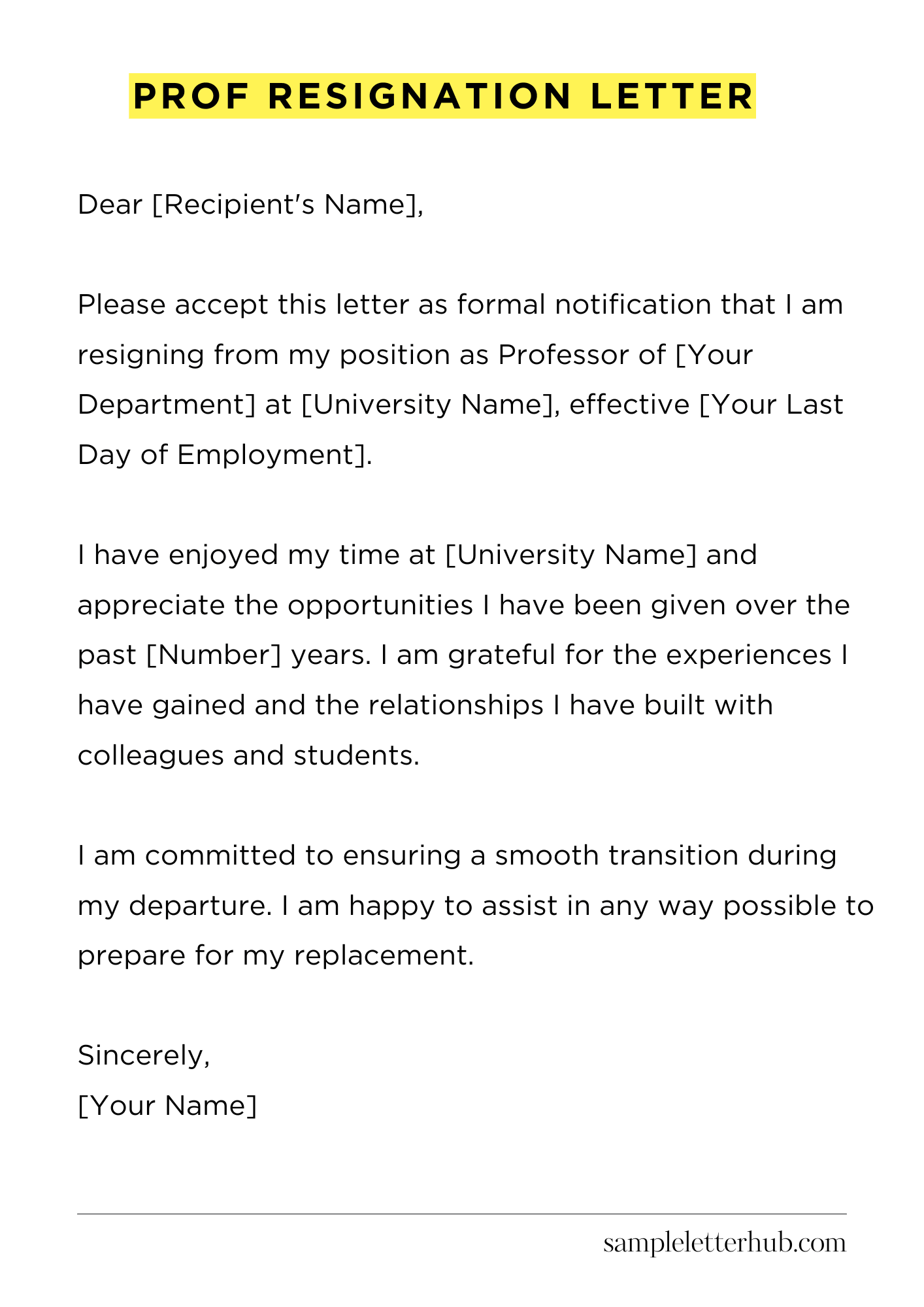
Please accept this letter as formal notification that I am resigning from my position as Professor of [Your Department] at [University Name], effective [Your Last Day of Employment].
I have enjoyed my time at [University Name] and appreciate the opportunities I have been given over the past [Number] years. I am grateful for the experiences I have gained and the relationships I have built with colleagues and students.
I am committed to ensuring a smooth transition during my departure. I am happy to assist in any way possible to prepare for my replacement, including sharing information about my ongoing projects and responsibilities.
Thank you again for the support I have received during my tenure. I wish you and [University Name] all the best in the future.
Sincerely,
[Your Name]
How to Write a Prof Resignation Letter
Understanding the Importance of a Well-Crafted Resignation Letter
Leaving a professorship is a significant life event. This deserves a proper, professional send-off. A well-written resignation letter is not just a formality; it is a crucial document. You want to leave a positive lasting impression.
This letter can affect your future career prospects. It sets the tone for your departure and can even influence potential references. Essentially, this single document encapsulates your professionalism and respect for the institution.
Essential Elements: What to Include
Your resignation letter needs to contain key information. Firstly, state your intention to resign clearly and concisely. Specify your last day of employment. This is the date you are officially ending your employment with the university. Next, formally address the letter to the appropriate individual.
Usually, this is the department head or the Dean of your faculty. You need to express your gratitude for the opportunity. Mention any positive experiences, professional growth, or support you received during your tenure. Keep the tone appreciative and respectful.
Consider whether you want to offer assistance with the transition. Offering to help train your replacement, complete ongoing projects, or provide documentation can demonstrate your commitment and professionalism. However, this is optional, and your level of involvement should depend on your personal circumstances and contractual obligations.
Finally, express your best wishes for the future of the institution. A positive closing reinforces your professionalism and respect.
Structuring Your Letter for Maximum Impact
The structure is important for clarity. Begin with a formal salutation. Something like “Dear Professor [Name]” or “Dear Dean [Name]” is appropriate. Then, state your intention. Make the main body of your letter relatively brief and concise. The body includes gratitude, transition offers, and other key details you want to add.
Conclude with a professional closing, such as “Sincerely” or “Respectfully,” followed by your full name and signature. Proofread it meticulously, and then you can send it.
Common Pitfalls to Avoid
Some things can hinder a good impression. Avoid negativity or complaints about your time at the university. Even if you faced challenges, keep your letter professional.
Do not burn any bridges. Be careful about excessive length. Keep it concise and to the point. Refrain from including too many personal details or emotional statements. Also, do not use jargon or overly complex language that can be difficult for others to understand.
Final Steps and Delivery
Before submitting, double-check your letter for any errors in grammar or spelling. A mistake can be very embarrassing. Make sure you have the correct contact information for the recipient. Consider whether to deliver the letter electronically or in hard copy. Many universities now accept email submissions.
Ensure you keep a copy of your letter for your records. This is vital. Finally, send it at the appropriate time, typically at least a month or two before your intended departure date. This gives the university enough time to plan for your replacement. This is a very common courtesy.
FAQs about Prof resignation letter
What is the purpose of a professor’s resignation letter?
The primary purpose of a professor’s resignation letter is to formally notify the employing institution of their decision to leave their position. It serves as an official record of the resignation, the effective date, and, often, a statement of gratitude or farewell. It provides a clear and documented means of ending the employment relationship.
What key elements should be included in a professor’s resignation letter?
A comprehensive resignation letter should include: a clear and concise statement of resignation, the professor’s full name and title, the effective date of resignation, a formal acknowledgement of the university, department or faculty, a brief expression of gratitude for the opportunity (optional), details regarding ongoing projects, and any necessary handover information.
The letter should be professional in tone.
How far in advance should a professor submit their resignation letter?
The timing for submitting a resignation letter varies depending on the employment contract, university policy, and local regulations. Generally, a professor should provide as much notice as possible.
The standard is often at least one or two months notice, which allows time for the institution to find a replacement and facilitate a smooth transition. Always consult the employment contract and university guidelines for specifics.
Can a professor withdraw their resignation after submitting their letter?
Whether a professor can withdraw their resignation depends on various factors, including the university’s policies and the stage of the resignation process. Typically, withdrawal is possible if the institution has not yet accepted the resignation and the professor acts promptly.
However, it is essential to discuss the situation with the department head or relevant administrator immediately. Withdrawal is not guaranteed and requires mutual agreement.
Are there any legal or ethical considerations a professor should be aware of when resigning?
Yes, there are several legal and ethical considerations. Professors should ensure they fulfill any contractual obligations, such as teaching commitments or grant obligations, before leaving. They should also adhere to university policies regarding the return of university property, research data, and other materials.
Ethical considerations include maintaining confidentiality, not divulging proprietary information, and ensuring a smooth transition for students and colleagues. Always review your employment contract and university policies, and seek legal advice if necessary.
Related:
Resignation letter due to rude boss
Resignation letter moving to another state
Resignation letter due to illness of family member
Resignation letter due to study